Flyte Deep Dive: A Practical Guide to Choosing Your ML Workflow Orchestration Tool
A comprehensive guide to Flyte's ML orchestration strengths and how it compares to Argo and KubeFlow Pipelines.
This article explores why Flyte is a compelling choice for ML workflow orchestration, covering its Kubernetes-native architecture, content-addressable caching, MLFlow-integrated checkpoint recovery, and conditional deployment logic. It also compares Flyte's enforced typing and three-layer versioning against Argo and KubeFlow Pipelines to help engineers make informed tooling decisions.
Introduction: Why ML Orchestration Matters
As machine learning projects evolve from experiments to production, workflow orchestration has become an unavoidable engineering challenge. ML systems differ fundamentally from traditional software — they require not just code version management, but synchronized tracking of data versions, model versions, hyperparameter configurations, and experiment results. Early data engineering tools like Airflow and Luigi can handle DAG task dependencies, but their support for ML-specific needs (GPU resource scheduling, model registry, feature store integration) is limited. This gap gave rise to ML-native orchestration frameworks like Flyte, ZenML, and Metaflow. When a project involves multimodal datasets, computer vision (CV) pipelines, and spans multiple stages — preprocessing, training, evaluation, and deployment — elegantly coordinating task dependencies and ensuring reproducibility becomes the central challenge.
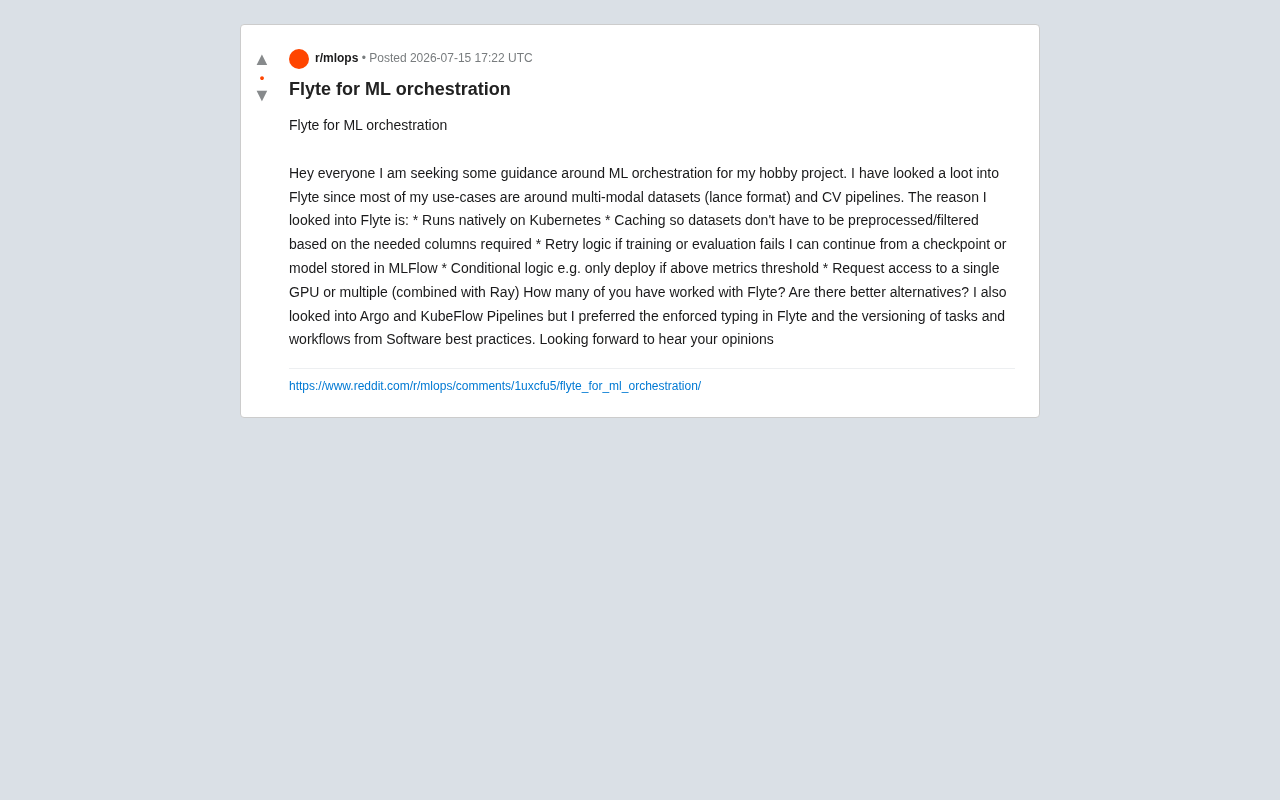
Recently, a Reddit user shared their thought process for selecting an ML orchestration tool for a personal project. Their use case focused on multimodal datasets (in Lance format) and CV pipelines, and they ultimately zeroed in on the open-source orchestration framework Flyte. This article dives deep into that discussion, examining Flyte's core capabilities and how it differs from mainstream alternatives like Argo and KubeFlow Pipelines.
About the Lance Format: Lance is an open-source columnar storage format developed by the LanceDB team, designed specifically for multimodal ML datasets. Compared to Parquet, Lance natively supports efficient storage and random access for unstructured data like images, video, and audio, along with vector indexing. Its key advantages include incremental dataset updates (no need to rewrite entire files) and version-based time-travel queries — both closely aligned with MLOps requirements for data reproducibility. The Lance format is natively supported by mainstream ML frameworks including Ray Data and PyTorch DataLoader.
Flyte's Core Strengths
Deep Cloud-Native Kubernetes Integration
One of Flyte's defining characteristics is that it runs natively on Kubernetes, inheriting K8s's elastic scaling, resource isolation, and containerization advantages out of the box. Kubernetes has become the de facto standard for cloud-native ML infrastructure — its core scheduling mechanism lets ML workloads declare precise resource requirements (CPU, memory, GPU count and type) at the Pod level, with namespace-based multi-tenant resource isolation. More importantly, K8s's Custom Resource Definitions (CRD) mechanism allows Flyte to map ML concepts (training jobs, hyperparameter tuning experiments) directly to native K8s resource objects, fully leveraging the K8s scheduler's auto-scaling (HPA/VPA) and self-healing capabilities.
For GPU resource management, Flyte allows on-demand declaration of single or multiple GPUs, and can be combined with Ray for distributed training. Ray is a distributed computing framework incubated by UC Berkeley RISELab; its sub-projects Ray Train and Ray Tune handle distributed model training and hyperparameter search respectively. Compared to traditional distributed training approaches like Horovod and PyTorch DDP, Ray offers a more unified programming model — developers don't need to worry about low-level communication primitives (All-Reduce, parameter servers), but simply declare a distributed strategy with decorators. Through the officially maintained Ray plugin (flytekit-ray), Flyte supports spinning up a Ray cluster on demand when a task executes and automatically reclaiming it upon completion, avoiding idle resource waste. This fine-grained resource declaration approach makes resource allocation for training jobs clear and controllable — scheduling logic is managed uniformly by the framework, with no need to manually handle complex resource contention.
Intelligent Caching
When working with multimodal datasets, data preprocessing is often a time-consuming and repetitive bottleneck. Flyte's built-in caching mechanism is based on content-addressable principles: the system computes a hash over the task's code version, input parameters, and dependencies to generate a unique cache key. When the same cache key appears again, the system directly returns the historical output stored in remote object storage (such as S3 or GCS), completely skipping task execution. This is fundamentally different from purely timestamp-based caching strategies (like Make's file timestamp comparisons), and more precisely identifies scenarios that truly require recomputation.
This feature is particularly valuable for iterative, experiment-heavy projects. When you only need to adjust training hyperparameters while the data processing logic remains unchanged, caching lets you skip the entire data preparation stage and jump straight into training. For large-scale CV datasets (often hundreds of GB of image data), this mechanism can compress end-to-end iteration time from hours to minutes, significantly boosting experiment velocity.
Production-Grade Reliability
Retry Logic and Checkpoint Recovery
GPU out-of-memory errors, network interruptions, data anomalies — training job failures are a normal part of ML engineering. Flyte's built-in retry logic supports resuming execution from checkpoints or model snapshots stored in MLFlow, rather than starting from scratch every time.
MLFlow is an open-source ML experiment management platform from Databricks, offering four core modules: experiment Tracking, Model Registry, Projects, and Models. In checkpoint recovery scenarios, training code typically saves model weights (checkpoints) and optimizer state to MLFlow as artifacts at regular intervals, identified by a Run ID. Flyte's retry logic can query the latest valid checkpoint path via the MLFlow API when a task restarts, using it as the recovery starting point. This integration pattern reflects the "separation of concerns" principle in modern MLOps toolchains: Flyte handles orchestration and scheduling, MLFlow handles experiment tracking — each doing what it does best.
This checkpoint recovery capability is especially valuable for long-running jobs: hours or even days of compute work won't be lost due to a transient interruption, providing meaningful robustness guarantees for the entire pipeline.
Conditional Logic and Automated Deployment
Flyte supports conditional logic, giving workflows intelligent decision-making capabilities. A typical scenario: automatically trigger the deployment process only when model evaluation metrics exceed a predefined threshold.
This result-based branch control embeds MLOps best practices directly into the orchestration layer, fundamentally preventing subpar models from reaching production and enabling end-to-end quality control from training to deployment — all without manual intervention.
Flyte vs. Argo vs. KubeFlow Pipelines
During the selection process, Argo and KubeFlow Pipelines are also mainstream Kubernetes-based alternatives. Flyte ultimately stands out primarily due to two key differentiators:
Enforced Typing: Flyte's type system is built on Python type hints and strictly validated at runtime via the flytekit SDK. It supports not just native Python types (int, str, List), but also built-in ML domain-specific types: FlyteFile (remote file references), FlyteDirectory (remote directories), StructuredDataset (tabular data with schema), and tensor types for PyTorch and TensorFlow. When the output type of an upstream task doesn't match the expected input type of a downstream task, Flyte raises an error at compile time — not at runtime. This stands in sharp contrast to Spark's Schema-on-Read strategy. This "contract-first" design philosophy moves data pipeline reliability from "discovered during testing" to "discovered while writing code," dramatically reducing debugging costs for complex multi-stage pipelines.
Task and Workflow Versioning: The reproducibility crisis in ML workflows is a well-recognized industry problem — the same code run at different times can produce different results, rooted in implicit changes to data, environment, and random seeds. Flyte addresses this with a three-layer versioning system: image versioning (each task is bound to a specific Docker image SHA), code versioning (based on Git commit hash), and workflow versioning (an immutable version number automatically assigned by the Flyte platform). This means any historical execution can be precisely reproduced — just specify the workflow version number and Flyte will automatically pull up the corresponding image and code. By comparison, Argo Workflows is essentially a general-purpose Kubernetes-native workflow engine; version management relies on external Git/CI systems and lacks built-in ML semantic version tracking. KubeFlow Pipelines v2 adopts a Protocol Buffers-based IR compilation model supporting multiple backends, but its v1-to-v2 migration has API incompatibility issues, and its native support for unstructured data (images, video) is less mature than Flyte's.
How to Choose the Right Tool
If your project places high value on engineering rigor, requires strong type guarantees, and needs fine-grained version management, Flyte is a highly fitting choice — it elevates ML orchestration to the level of software engineering discipline.
Metaflow (open-sourced by Netflix) takes a different approach, adopting a Python-centric design philosophy that minimizes intrusion into business code via decorators, making it better suited for small data-scientist-led teams. ZenML is positioned as an orchestration abstraction layer that can run on top of Flyte, Airflow, or Kubeflow, trading some native capability for greater backend flexibility.
If your team is already deeply invested in the KubeFlow ecosystem, or only needs lightweight DAG orchestration, KubeFlow Pipelines and Argo remain reliable alternatives. Your selection should comprehensively evaluate your team's K8s operational expertise, the degree of lock-in to existing toolchains, and your requirements for engineering rigor — data scale and team size are always the core dimensions to consider.
Summary
Flyte stands out in multimodal dataset and CV pipeline scenarios because it precisely addresses ML production pain points: cloud-native GPU scheduling, content-addressable intelligent caching, MLFlow-integrated checkpoint recovery, conditional deployment logic, plus the engineering reliability brought by strong typing and three-layer versioning — together forming an orchestration framework that is both flexible and rigorous.
For engineers evaluating orchestration tools for ML projects, the "software engineering best practices × ML workflows" fusion philosophy that Flyte champions is worth serious study and hands-on exploration. That said, the final decision still requires validation against real-world scenarios — comparing multiple options side by side and running your own tests remains the most reliable path to finding the right tool.
Key Takeaways
Related articles

Apple HomeView Hands-On Review: Is the $300 Smart Home Hub Worth It?
Apple HomeView hands-on: a $300 smart home hub with facial recognition for quick account switching, but no App Store or voice recognition. Is the wall-mounted version worth it? Should you buy the first generation?

Meta Muse Wonder Launch: What It Means for Meta's Return to the Frontier AI Race
Meta releases Muse Wonder and WonderFull, benchmarks reach the frontier, community feedback is polarized. An in-depth look at Meta's return to the frontier AI race, its personal agent strategy, and Zuckerberg's different path.

Apple Home Smart Home Lineup Leaked: LG and Schneider Team Up, UWB Door Lock on Board
Apple Home ecosystem gains new LG and Schneider devices: UWB smart lock with proximity unlock, 2.5K dual-camera doorbell, privacy indoor camera, and AirPods-like seamless pairing.