FNO Boost: Quantum Error Mitigation Improves Shor's Algorithm Success Rate by 79%

Fourier Neural Operators recover Shor order information from noisy quantum measurements, with significant gains in both simulation and on real hardware.
Quantum noise distorts circuit measurement distributions, yet information for inferring the correct algorithm output remains hidden within. A new study proposes a theory-driven quantum error mitigation method using a Fourier Neural Operator (FNO) to recover latent Shor order-finding information from noisy distributions. The team modeled how circuit errors affect output distributions and designed the FNO with a learnable gain to modulate Fourier modes. In 1,351 simulated cases, exact order recovery rose from 19% to 34%, and median Jensen-Shannon divergence dropped 50%. On 101 Mersenne rotation circuits across five IBM quantum processors, correct order estimates increased from 35 to 53. The core innovation is the deep integration of theoretical knowledge with neural network design, showing that even when noise renders algorithmic structure nearly invisible, it may remain recoverable.
Quantum noise distorts the distribution of circuit measurement results, yet valuable information often remains hidden within—enough to infer the algorithm's correct output. A new study proposes a theory-driven quantum error mitigation method that uses a Fourier Neural Operator (FNO) to recover the latent information of Shor's order-finding algorithm from noisy distributions. In simulated tests, the method raised the exact order recovery rate from 19% to 34% and reduced the median Jensen-Shannon divergence from the ideal distribution by 50%; on real IBM quantum processors, the number of correct order estimates also increased from 35 to 53.
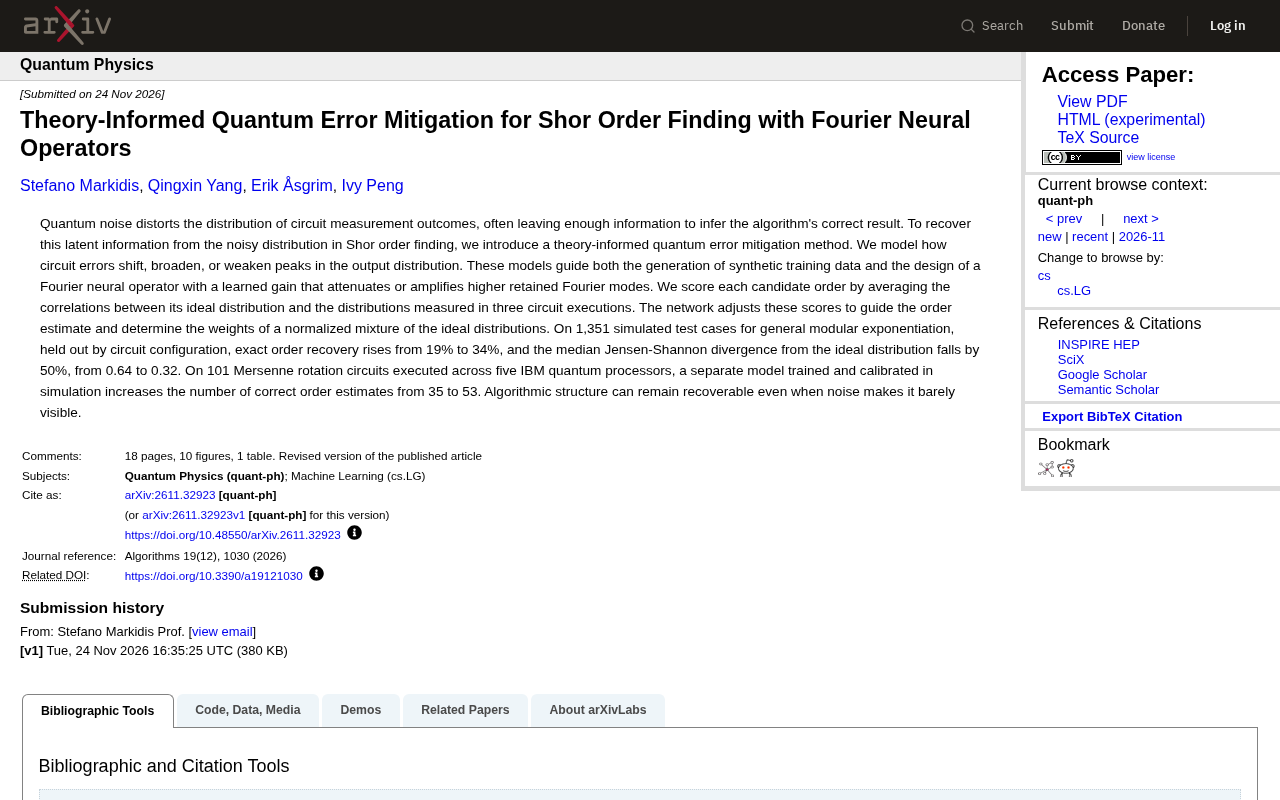
Theory-Driven Error Modeling and Network Design
The research team first modeled how circuit errors affect the output distribution: errors cause peaks in the distribution to shift, broaden, or weaken. These models were used not only to generate synthetic training data but also to guide the design of the FNO—a learnable gain was added to the network to attenuate or amplify the retained higher-order Fourier modes. This theory-informed approach enables the network to adapt more precisely to noise characteristics.
According to the paper, the FNO guides order estimation by adjusting the scores of candidate orders and determines the weights of the normalized mixture of ideal distributions. Specifically, the score for each candidate order is obtained by computing the average correlation between its ideal distribution and the measured distributions from three circuit executions, and the network then adjusts these scores.
A Fourier Neural Operator (FNO) is a class of neural network architecture specifically designed to learn function-to-function mappings. Its core idea is to perform linear transformations in the Fourier frequency domain, thereby efficiently capturing global dependencies. Unlike traditional convolutional neural networks that filter in local space, FNO projects the input into the frequency domain via the fast Fourier transform, truncates low-frequency modes and applies learnable weights, then transforms back to the original space. This design makes it particularly sensitive to shape changes in distributions (such as peak shifts and broadening), making it well-suited for handling probability distributions deformed by noise in quantum measurements. In this study, the frequency-domain characteristics of the FNO naturally correspond to the effects of circuit errors on distributions (peak shifting and broadening), allowing the network to learn noise patterns in a targeted manner.
Shor's order-finding algorithm is the core subroutine of Shor's factoring algorithm, and its goal is to find the smallest positive integer r (called the order) satisfying a^r ≡ 1 (mod N). In quantum computing, this algorithm encodes order information into the peak positions of the measurement distribution via quantum phase estimation; ideally, peaks appear at frequencies related to 1/r. However, noise in real quantum hardware blurs or even shifts these peaks, making it difficult to read the order directly from measurement results. This study uses the FNO to recover this peak information from noise-distorted distributions, thereby improving the accuracy of order estimation.
Performance Improvements in Simulation and on Real Hardware
In 1,351 simulated test cases for generic modular exponentiation (with held-out circuit configurations), the exact order recovery rate increased from 19% to 34%, and the median Jensen-Shannon divergence from the ideal distribution dropped from 0.64 to 0.32—a 50% reduction.
More critically, on 101 Mersenne rotation circuits executed on five IBM quantum processors, a single model trained and calibrated in simulation increased the number of correct order estimates from 35 to 53. This demonstrates the method's practical potential on real hardware.
Jensen-Shannon divergence (JSD) is a metric for measuring the difference between two probability distributions, ranging from 0 to 1 (when base 2 is used), with smaller values indicating that the two distributions are closer. In this study, JSD was used to quantify the deviation between the measured distribution and the ideal noiseless distribution. The median JSD dropping from 0.64 to 0.32 means that the average gap between the error-mitigated distribution and the ideal distribution was halved, intuitively reflecting the method's effectiveness in recovering the algorithm's correct output distribution.
Recoverability of Algorithmic Structure
Even when noise renders the algorithmic structure nearly invisible, the structure may still remain recoverable. This study demonstrates how combining theoretical models with deep learning can extract valuable information from noise, offering new ideas for error correction and error mitigation in quantum algorithms.
The core innovation of this method lies in deeply integrating theoretical knowledge with neural network design, rather than relying purely on data-driven approaches. This approach is expected to generalize to other quantum algorithms and hardware platforms.
One-line Summary
Using Fourier Neural Operators to recover Shor order information from noisy quantum measurements, with significant improvements in both simulation and on real hardware.
Paragraph Summary
Quantum noise distorts the distribution of circuit measurement results, yet information sufficient to infer the algorithm's correct output still lies hidden within. A new study proposes a theory-driven quantum error mitigation method that uses a Fourier Neural Operator (FNO) to recover the latent information of Shor's order-finding algorithm from noisy distributions. The research team first modeled how circuit errors affect the output distribution and designed the FNO accordingly, adding a learnable gain to modulate Fourier modes. In 1,351 simulated test cases, the exact order recovery rate increased from 19% to 34%, and the median Jensen-Shannon divergence from the ideal distribution was reduced by 50%. On 101 Mersenne rotation circuits executed on five IBM quantum processors, the number of correct order estimates increased from 35 to 53. The core innovation of this method lies in deeply integrating theoretical knowledge with neural network design, demonstrating that even when noise renders the algorithmic structure nearly invisible, the structure may still remain recoverable.
Related articles

AI SDK TUI 1.0.185 Patch Released: The Ecosystem Significance Behind a Minor Version Update
AI SDK TUI releases patch 1.0.185, automatically published by GitHub Actions and linked to ai@7.0.184. This article analyzes the automated release process, the positioning of the TUI component, and how developers should rationally view high-frequency patch iteration.

AI SDK Toolkit web-fetch Releases Patch Update
AI SDK toolkit @ai-sdk/tool-web-fetch releases patch 1.0.34, auto-published and signature-verified by GitHub Actions, paired with ai@7.0.184 core package for low-risk smooth upgrades.

Vercel AI SDK Update: Vue Package Bumped to 4.0.184
Vercel AI SDK's Vue binding package @ai-sdk/vue releases patch 4.0.184 to sync changes from core package ai@7.0.184. This article explains the monorepo release logic, impact on Vue developers, and upgrade advice.