Vercel AI SDK Update: Vue Package Bumped to 4.0.184

@ai-sdk/vue releases patch 4.0.184, syncing fixes from core package ai@7.0.184.
Vercel AI SDK's Vue binding package @ai-sdk/vue has released patch version 4.0.184. The release notes list only ai@7.0.184, indicating the update syncs core package fixes rather than adding new features. The article explains the monorepo synchronized release mechanism, noting aligned versions and clear dependencies as benefits, but less detailed per-package change notes as a cost. For users, upgrading is low-risk but should focus on verifying streaming rendering and message state updates; upgrading is not mandatory if no related issues exist. The release is automated via github-actions with a verified signature, and sustained patch iterations reflect AI SDK's ongoing investment in the Vue ecosystem.
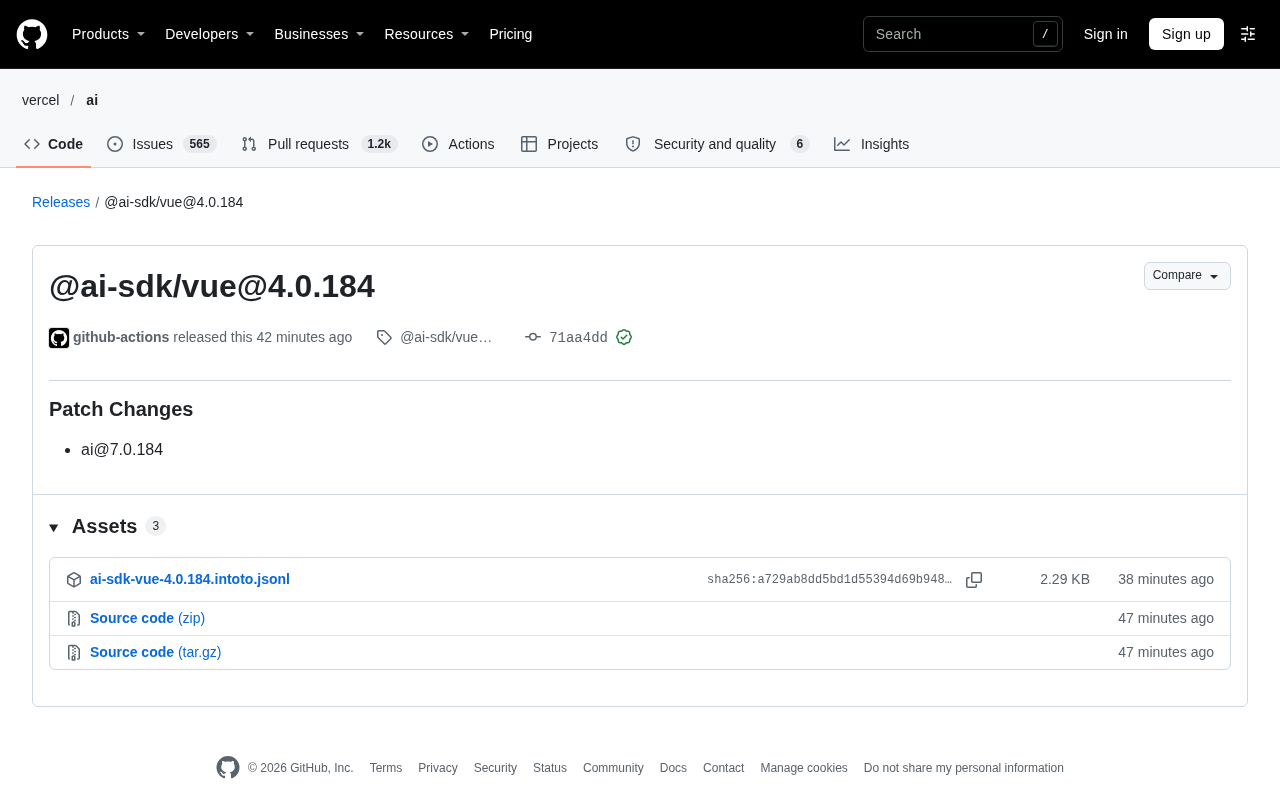
The Vue binding package for Vercel AI SDK, @ai-sdk/vue, has released a new patch version, 4.0.184. According to the GitHub release record, this is a typical patch-level update whose main purpose is to sync changes from the underlying ai package.
The Fix Logic Behind the Version Number
The Patch Changes section of the release notes lists only one line: ai@7.0.184. This means that this release of @ai-sdk/vue does not independently introduce new features; instead, it follows the fix cadence of the core ai package and brings the latest changes into the Vue adaptation layer.
In the monorepo structure of Vercel AI SDK, framework-layer packages (such as @ai-sdk/vue and @ai-sdk/react) typically depend on hooks and utility functions provided by the core package. When the core package fixes a behavioral issue or adjusts an internal interface, the framework packages need to publish a new version to deliver the fix to end users.
The benefit of this synchronization mechanism is aligned version numbers and clear dependency relationships; the cost is that the update notes for an individual package often point only to the core package and do not include itemized change details, so developers need to visit the repository or compare tags to get the full information.
Under the SemVer (Semantic Versioning) specification, the patch version number (the third digit in 4.0.184) indicates backward-compatible bug fixes that neither introduce new features nor break existing APIs. In a monorepo scenario, packages often adopt fixed or independent versioning strategies: the 4.x line of @ai-sdk/vue and the 7.x line of the core ai package are not on the same major version line, so "sync" refers to the release date and the corresponding fix content, not to identical version numbers. When upgrading, developers should rely on the core package's behavioral changes as the source of truth and also pay attention to the framework package's own major-version constraints.
How to Understand This Kind of Patch Release
For developers using @ai-sdk/vue, when you see a version number like 4.0.184, you can use the following approach to decide whether an upgrade is needed:
Look at Core Package Changes First
Patch versions do not change the stability promise of the public API. If your current project has not encountered any AI SDK-related issues, upgrading is not mandatory, but keeping dependencies updated helps avoid accumulating technical debt.
Pay Attention to Fixes Related to Rendering and State Management
The core responsibility of the Vue package is to wrap capabilities provided by the ai package—such as streaming chat and message state—into Vue composables. Fixes in the core package in this area are usually directly reflected in the reactive behavior at the Vue layer.
Vue composables are functions that encapsulate reusable logic based on setup() and the reactivity system (ref, reactive, computed), conventionally named with a use prefix, such as useChat. The Vue binding layer of AI SDK uses exactly this approach to connect incremental data from streaming responses into Vue's dependency tracking, so that templates automatically re-render when messages update. In streaming scenarios, data arrives in chunks over time; composables need to maintain the message list, loading state, and error state, and correctly handle abort and cleanup when components unmount. These boundary behaviors are often the focus of core package fixes.
Signals at the Ecosystem Level
The timing of this release (November 27) and the sustained cadence of small version iterations indicate that Vercel AI SDK is still in a phase of high-frequency maintenance. For developers in the Vue ecosystem, this means that when choosing AI SDK, there is no need to worry that the framework binding layer will be marginalized—it advances in sync with the React version.
Another detail worth noting is the automation of the release process. The release is executed by the github-actions bot, and the commit carries a GitHub verified signature. This is a common practice for standardized releases in monorepo projects and also reduces the probability of errors introduced by manual operations.
Monorepo (a single repository containing multiple packages) refers to managing multiple interdependent packages in the same Git repository. Typical tools include pnpm workspace, Turborepo, and Changesets. Vercel AI SDK adopts this structure: the framework binding packages and the core package share build configuration and the release process, and Changesets is responsible for automatically calculating version numbers and generating release notes based on change records. The fact that only one line, ai@7.0.184, appears in the release notes is exactly a manifestation of Changesets' dependency-linking mechanism: when a depended-upon package is upgraded, the dependent package automatically receives a patch number, while the change entry remains attributed to the core package.
Upgrade Recommendations
If your project is pinned to the 4.x version line, upgrading directly to 4.0.184 is a low-risk operation. After upgrading, it is recommended to focus on verifying whether streaming response rendering and message state updates behave as expected, because the fixes in such patches are usually concentrated in these paths.
If you are not yet using AI SDK, this patch release alone is not a reason to migrate, but it can serve as a reference for observing its maintenance activity—a sustained, traceable patch cadence often reflects the health of a library better than major-version marketing.
One-line Summary
@ai-sdk/vue releases patch 4.0.184, syncing fixes from the core package ai@7.0.184.
Paragraph Summary
The Vue binding package for Vercel AI SDK, @ai-sdk/vue, has released patch version 4.0.184. The release notes list only one line, ai@7.0.184, indicating that this update is intended to sync fixes from the core package rather than introduce new features. The article explains the synchronized release mechanism in a monorepo where the framework binding layer depends on the core package, noting that its advantage is aligned versions and clear dependencies, while the cost is that the change notes for an individual package are not detailed enough. For developers using this package, upgrading is a low-risk operation, but it is recommended to focus on verifying streaming rendering and message state updates; if the project has not encountered related issues, upgrading is not mandatory. The release is executed automatically by github-actions with a verified signature, and the sustained small-version iterations also reflect AI SDK's ongoing investment in the Vue ecosystem.
Related articles

Pure-Code Video Generation Tested: Which AI Model Actually Follows Instructions?
A Bilibili creator tested three AI models' pure-code video generation with unified prompts and three revisions each: Xiaonaomao has a high ceiling but lacks stability, GPT 6.2 Extra models well but only follows half the instructions, and OPAS 5.5 remains the benchmark.

GPT-6 Six-Tier Hands-On Test: Astra Ultra Dominates but Bills Double
GPT-6 six-tier test: Astra Ultra sweeps 3:0 in 3D tasks thanks to sub-agents and runs 14% faster, but hidden backend bills make its real cost 2.6x single-threaded.

GPT-6.2 Astra vs Fable 5.2: Huge Cost-Efficiency Gap Across 12 Real-World Tests
Bilibili creator tests GPT-6.2 Astra vs Fable 5.2 across 12 real tasks: Fable wins 7-5 but costs 7.2x more and takes nearly 5x longer. Token efficiency emerges as the key selection metric.