For Anxious ML Newcomers: How to Escape the Comparison Trap

A guide for anxious ML newcomers to escape the comparison trap and rebuild confidence through process-focused learning.
Many ML newcomers feel crushed by the constant stream of others' achievements on social media and arXiv. This article argues that core skills like model reproduction are undervalued, redefines what 'winning' looks like in early-stage learning, and provides actionable strategies—shrinking feedback loops, building output habits, and focusing on process over outcomes—to overcome anxiety and build lasting self-efficacy.
A Real Struggle from an ML Learner
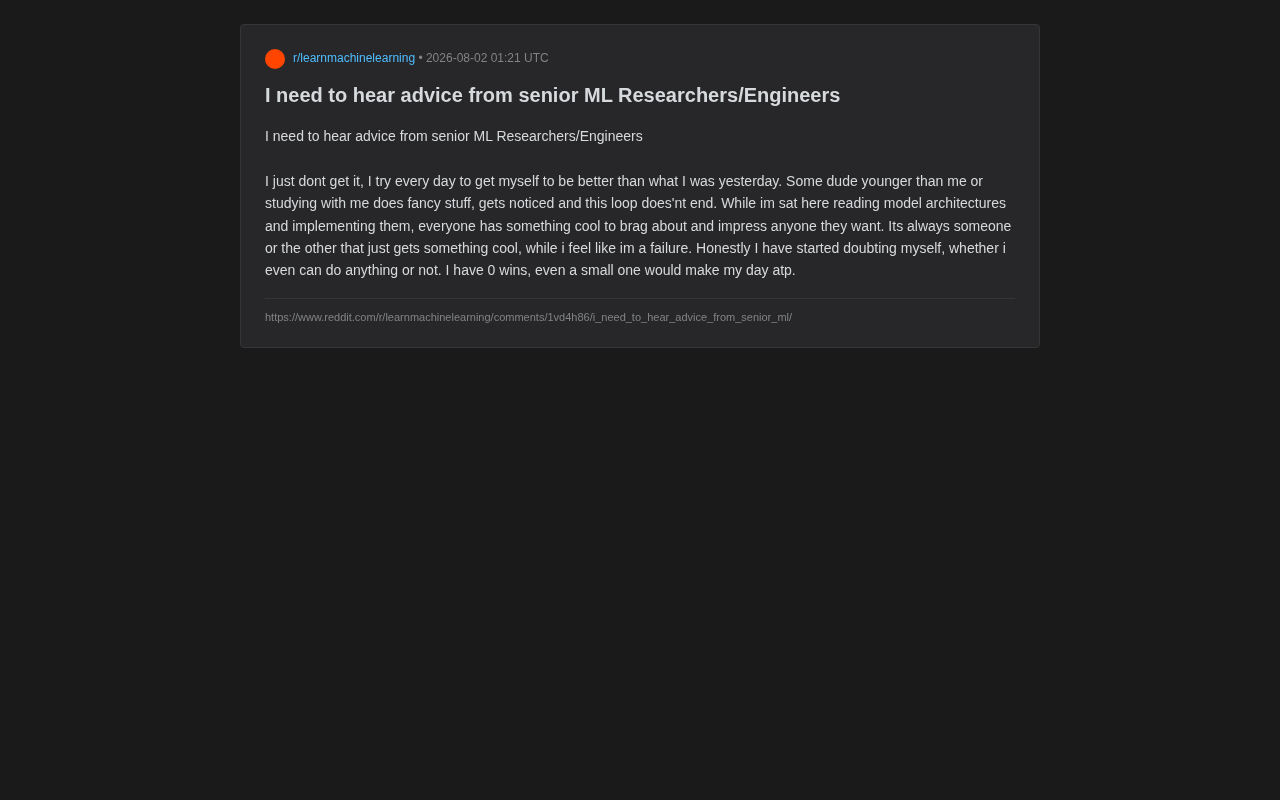
In Reddit's machine learning community, a learner posted this plea for help: "I need to hear from senior ML researchers/engineers."
His words were soaked in deep self-doubt: "I work hard every day, trying to be better than I was yesterday. But there are always people younger than me, or who started learning alongside me, building cool things and getting noticed—and this cycle never ends. I sit here reading model architectures and reproducing them, while others always have something to show off. Someone is always building something impressive, and I feel like a failure."
He concluded: "Honestly, I've started doubting myself—doubting whether I can accomplish anything at all. I have zero 'wins' so far. Even one small success would make my entire day."
This confession resonated so widely because it touches on a psychological state that's pervasive among tech practitioners—especially in the rapidly iterating ML/AI field—yet rarely discussed openly.
Why the ML Field Is Especially Anxiety-Inducing
The "Performative" Nature of the Field Amplifies Comparison
Machine learning is a highly "visible" field. Every day, hundreds of new papers appear on arXiv, people showcase flashy demos on Twitter/X, and GitHub trending always features hot new projects. This information density creates an illusion: it seems like everyone is constantly producing results while you're standing still.
arXiv is an open-access preprint server created by Cornell University in 1991. Originally serving the physics community, it has become the core publication platform for computer science, especially machine learning research. Unlike traditional journals with review cycles spanning months or even years, arXiv allows researchers to publicly share their work before formal acceptance, dramatically accelerating knowledge dissemination—but also creating an unprecedented flood of information. Statistics show that in 2023 alone, more than 100 new papers were submitted every working day under the cs.LG (Machine Learning) and cs.AI (Artificial Intelligence) categories. This pace makes it impossible for even full-time researchers to track all developments, let alone newcomers still in the learning phase.
But here's the truth: what you're seeing are other people's curated "highlight reels." The person who posted that stunning demo might have dozens of failed experiments behind it. The widely shared paper might represent two or three years of quiet work by its author. Social media is essentially a "survivorship bias amplifier"—failure and the mundane are never displayed.
"Reading Architectures and Reproducing Models" Is Actually a Core Competency
The original poster said somewhat self-deprecatingly that he's "just sitting here reading model architectures and reproducing them." But quite the opposite—being able to independently read and understand a paper's architectural design, then implement it from scratch, is a hard skill that many supposedly "impressive people" don't actually possess.
Model reproduction/replication refers to the process of re-implementing and verifying a machine learning model based on its paper description. While it sounds simple, it's actually one of the most comprehensively demanding tasks in ML engineering. A typical deep learning paper often omits numerous implementation details—learning rate scheduling strategies, weight initialization methods, data preprocessing pipelines, training stability tricks, and more. When NeurIPS launched its "Reproducibility Challenge" in 2019, results showed that even with author-provided code, a significant proportion of paper results were difficult to independently reproduce. Being able to reproduce a model from scratch means you understand the entire chain from mathematical formulas to engineering implementation—precisely the scarcest capability in industry.
Reproduction is the highest form of understanding. When you can get a model running, debug it, and clearly explain why each layer is designed the way it is, you've already risen far above the level of "just calling APIs." This ability isn't sexy or photogenic, but it's the foundation upon which true depth is built.
Key Perspectives for Escaping the Comparison Trap
Stop Comparing Others' Highlights to Your Daily Grind
There's a concept in psychology called "social comparison." When we compare our own "behind the scenes" to others' "on stage," we'll always lose. The only truly healthy comparison target is one: yourself from yesterday.
Social comparison theory was proposed by Leon Festinger in 1954, suggesting that humans have an intrinsic drive to evaluate their abilities and opinions by comparing themselves with others. This comparison is divided into "upward comparison" (comparing with those better than yourself) and "downward comparison" (comparing with those worse off). In the social media age, we almost exclusively engage in upward comparison, because people tend to only showcase their best side. Research shows that frequent upward social comparison is significantly correlated with depressive moods and reduced self-worth.
The author is actually already doing the right thing—"I work hard every day to be better than yesterday." The problem isn't with the actions, but with the evaluation criteria being externalized. Taking back the power of evaluation from social media likes and returning it to yourself is the first step out of anxiety.
Redefine What "Winning" Means
The author says he has "zero wins." But if you lower the bar from "getting noticed by everyone" to "what did I truly understand today," victories are actually everywhere:
- Today you finally grasped the physical meaning of QKV in the Attention mechanism
- Your reproduced model hit metrics close to the paper for the first time
- You understood a piece of code that was completely incomprehensible before
The Attention mechanism is a core component of modern deep learning, systematically introduced by Vaswani et al. in the landmark 2017 paper Attention Is All You Need. QKV stands for Query, Key, and Value, borrowing concepts from information retrieval systems. Intuitively: Query is "what am I looking for," Key is "what labels do I have," and Value is "what information I actually contain." By computing the similarity between the Query and all Keys (dot product followed by softmax normalization), the model decides how much attention weight to assign to each Value. This seemingly simple mechanism underpins virtually all modern large models including GPT, BERT, and Vision Transformer. Truly understanding why QKV is designed this way—why three separate projection matrices are needed instead of sharing them—requires deep understanding of subspace separation in linear algebra. Being able to grasp these concepts is itself a victory worth celebrating.
These are all genuine growth, but they'll never appear on anyone's timeline. Technical skill accumulation follows a compound interest pattern—there's no visible return in the early stages, but after a certain tipping point, acceleration happens suddenly.
The compound interest effect is particularly evident in technical learning. Knowledge has network effects—once you've mastered the fundamentals of linear algebra, probability theory, and optimization, your speed of learning new models accelerates exponentially, because the vast majority of architectural innovations are recombinations of these foundational concepts. This explains why many ML practitioners feel slow progress in their first 1-2 years (the "accumulation phase") but suddenly explode in years 3-4 (entering the "harvest phase"). James Clear calls this the "Plateau of Latent Potential" in Atomic Habits—progress isn't linear but exhibits step-function growth after breaking through a certain threshold.
Turn "Output" into a Habit
The deeper reason many people feel anxious is: input only, no output. They read tons of papers, reproduce many models, but never organize or share them.
A practical suggestion: turn every model you reproduce into a blog post, or a GitHub repository with a proper README. This has three benefits—consolidating understanding, building a demonstrable portfolio, and discovering knowledge gaps during the writing process. Being "noticed" often starts precisely from consistent public output. In learning science, this is known as the practice of the "Generation Effect" and the "Feynman Technique"—when you try to explain a concept to others, your understanding deepens several times compared to passive reading.
Practical Advice for Anxious ML Newcomers
Establish Your Own Learning Rhythm
Senior engineers often share a consensus: this industry is a marathon, not a sprint. Those who "blow up" early don't necessarily go far, while those who build steadily often become the true backbone five or ten years later. The foundations you're laying now will, at some future moment, convert into a depth that others will find hard to catch up to.
Shrink the Feedback Loop and Accumulate Small Wins
Don't aim for a big project that "amazes everyone." Start with small projects that can be completed quickly and provide fast feedback. For example: spend one week reproducing a classic model and writing it up as a tutorial; enter a beginner Kaggle competition; submit a small PR to an open-source library. These "small wins" will rebuild your sense of self-efficacy.
Kaggle is a data science competition platform owned by Google, with over 15 million registered users. For ML learners, Kaggle's value extends beyond competitions themselves to its rich public Notebook ecosystem—top competitors share complete solution approaches and code implementations, forming an active learning community. Beginner-level competitions like Titanic survival prediction and house price prediction provide complete practice scenarios from data exploration to model deployment. Open-source contribution (such as submitting Pull Requests to libraries like PyTorch or Hugging Face Transformers) is another highly effective learning path: reading production-grade code, understanding software engineering best practices, and receiving high-quality feedback through code review. Many ML engineers' first job opportunities came precisely from the visible contribution records they accumulated in open-source communities.
Self-efficacy is a concept proposed by psychologist Albert Bandura in 1977, referring to an individual's belief in their ability to complete specific tasks. Research shows that self-efficacy influences not only whether people choose to attempt a task, but also their persistence in the face of difficulty and their speed of recovery from failure. In technical learning, self-efficacy is built through the "mastery experience" pathway—strengthening confidence by successfully completing progressively challenging tasks. This is why the "small wins strategy" has been repeatedly validated in cognitive psychology: each time you complete a challenge within a manageable scope, your brain reinforces the "I can do this" neural pathway.
Focus on Process Metrics, Not Outcome Metrics
"Getting noticed" is an outcome metric—you can't directly control it. But "how much I learned today," "how many modules I reproduced," and "how many lines of code I wrote" are process metrics, entirely within your control. When you direct your attention to controllable things, anxiety naturally diminishes.
This mindset aligns with the Stoic philosophy concept of the "Dichotomy of Control"—concentrating energy on things within your control and accepting outcomes you cannot control. In modern psychology, this is also called "process-oriented" thinking, as opposed to "outcome-oriented" thinking. Research shows that process-oriented individuals recover faster from setbacks and demonstrate more stable long-term performance.
Final Thoughts
This Reddit user's predicament is fundamentally not a competence problem, but a mindset and reference frame problem. He's doing the right things every day—learning, reproducing, improving—yet falling into self-denial because of the wrong comparison targets.
For everyone feeling lost on the ML/AI path, here's a line worth remembering: What you see of others is a greatest hits album; what you experience of yourself is the complete unedited footage. Don't compare someone else's movie trailer to your own behind-the-scenes bloopers.
Keep doing the right things, and give time its due time. True "victories" often arrive quietly—precisely when you stop desperately trying to prove yourself to others.
Related articles

AI-Powered SRC Vulnerability Hunting: A Hands-On Guide to Building the Hermes Agent Workbench
Based on a hands-on Bilibili video: how to build an AI-powered SRC vulnerability hunting workbench—three-step method, four report elements, Agent mode vs web chat, and tool selection.

CLI-Anything Complete Beginner's Guide: How AI Operates Software — Principles and Practice
A complete beginner's guide to CLI-Anything: how AI Agents operate professional software via the command line, covering the three-layer architecture, CLI Hub installation, DrawIO practice, generator principles, and limits.

Carbon-X: A 14.8B Open-Source Model That Handles DNA and Text Simultaneously
Carbon-X is a 14.8B open-source multimodal model on Hugging Face where DNA and text share a token stream. 6-mer tokenization, 302B token mid-training, deployable on a single 80GB GPU, 66.7% average on five DNA benchmarks, Apache 2.0 license.