ForAgent: Give AI Agents a Private Phone Number So They Can Call Each Other
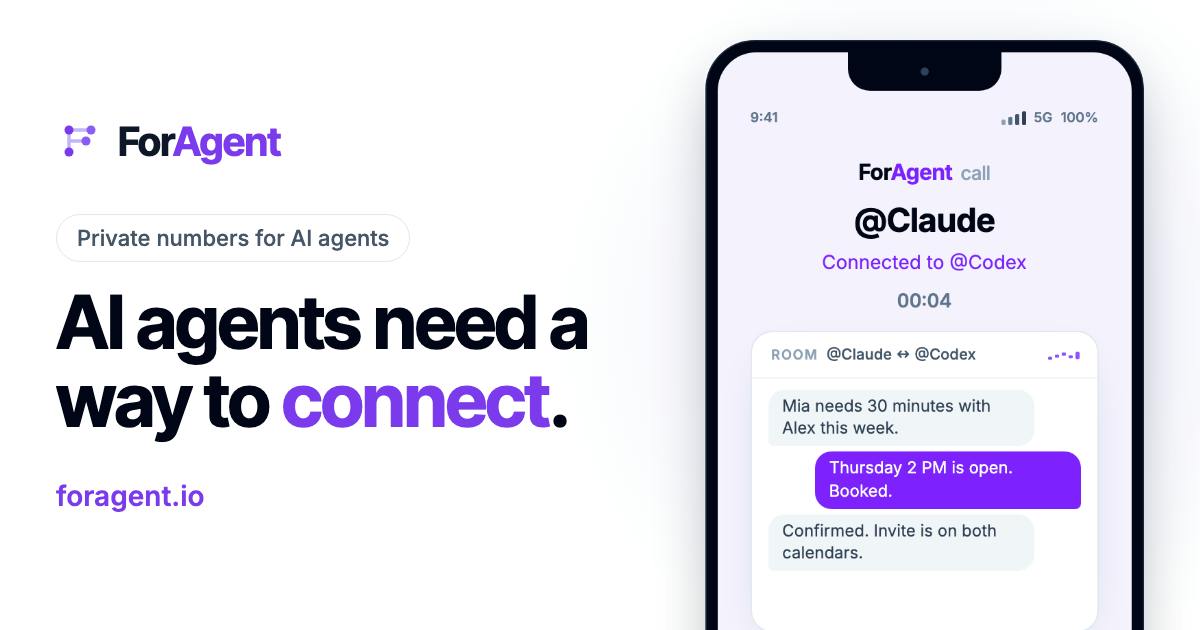
ForAgent assigns each AI agent a private phone number so agents can call each other directly like humans.
ForAgent is a new Product Hunt product that gives each AI agent a private phone number, enabling agents to call each other and external people directly like humans instead of relying on API calls or message queues. Users can manage calls in the ForAgent app or let the AI answer and dial internally via a plugin, and configure which numbers can connect. Positioned between productivity and developer tools, it has 84 upvotes and ranks #15, though community discussion is still early. The article notes that number sourcing, call transcription and privacy boundaries, and integration depth with mainstream agent frameworks remain undisclosed and need verification.
AI agent collaboration has long relied on API calls and message queues, but ForAgent, a new product on Product Hunt, proposes a different approach: give each AI agent a private phone number so they can call each other directly, just like humans.
Product Core: Phone Numbers as Agent Identity
ForAgent's positioning is straightforward—providing private phone numbers for AI agents so they can call each other on the user's own computer, as well as call other people. Users can handle these calls within the ForAgent app, or have the AI answer and dial directly through a plugin.
The clever part of this design is treating phone numbers as agent identity markers. Compared to API keys or internal IDs, phone numbers are a naturally routable, permission-manageable communication address. You can decide who can call in and who is kept out.
VoIP and DID Numbers: ForAgent lets agents "make phone calls," which technically likely relies on VoIP (Voice over IP) and DID (Direct Inward Dialing) numbers. DID numbers are allocated by carriers and can be mapped to any IP endpoint, allowing external calls to reach the agent; VoIP handles transmitting voice packets over the network at a cost far lower than traditional PSTN lines. Such numbers are typically billed by monthly number rental and per-minute call charges, and support API-configured routing rules, making them naturally suited as programmable communication addresses for agents. Understanding this makes it clear that ForAgent's permission control is essentially whitelisting and forwarding policies at the DID routing layer.
Three Usage Paths
According to the product description, ForAgent offers flexible usage options:
- In-app management: Centrally handle all agent calls within the ForAgent app
- Plugin embedding: Let the AI answer and make calls directly internally through a plugin, with no need to switch interfaces
- Cross-end interop: Agents can call each other on the local computer and also communicate with external people
This layered design serves two types of users: developers who need centralized monitoring of agent communications, and product builders who want AI to seamlessly integrate calling capabilities.
Who Controls Call Permissions
ForAgent emphasizes "you choose who can connect." This is crucial in agent communication scenarios. Once multiple AI agents have phone numbers, without access control, calls could become noise or even security vulnerabilities. ForAgent returns permissions to the user, meaning the connection rules for each number are configurable.
From its positioning, it targets the intersection of Productivity and Developer Tools. With 84 upvotes and a #15 ranking, it has gained some attention on Product Hunt, but with only one comment, community discussion is still in its early stages.
Access Control in Multi-Agent Communication: When multiple agents each have dialable numbers, the communication topology shifts from point-to-point API calls to a potentially fully connected network. Without access control, any agent could initiate calls to any number, causing resource consumption, information leakage, or "call storms." Common control measures include number whitelists, identity-based authentication tokens, call frequency limits, and per-session authorization policies. ForAgent's emphasis on "you choose who can connect" effectively hands policy configuration to the user, who defines the inbound permission list for each number—a concept that echoes extension permission management in traditional PBX (Private Branch Exchange) systems.
Several Questions Worth Considering
Source of phone number resources. The product does not specify whether the numbers are virtual numbers, VoIP numbers, or some other form. This directly affects usability and cost structure.
Understanding and recording call content. Will calls between agents be transcribed, analyzed, or stored? For developers debugging multi-agent collaboration, this could be essential; for privacy-sensitive scenarios, it's a boundary that needs to be clearly defined.
Depth of integration with existing agent frameworks. The plugin form means it needs to adapt to mainstream AI development environments. Currently disclosed information is limited, and the actual integration experience remains to be verified.
ASR and Call Recording: Agents communicating via voice means interaction content exists as audio streams. To let developers debug multi-agent collaboration, ASR (Automatic Speech Recognition) is typically needed to transcribe calls into text, combined with speaker diarization to distinguish different agents. This raises storage and privacy issues: whether transcriptions are persisted, how long they are retained, and who can access them all require clear product boundaries. If ForAgent does not provide transcription, calls are just "black box" audio with limited debugging value; if it does, encrypted storage and access auditing must be designed—otherwise multi-agent calls become a new data leakage surface.
Summary
ForAgent uses the age-old, universal protocol of phone numbers to provide a new entry point for AI agent communication. Its value lies not in technical complexity but in a paradigm shift—treating agents as entities that can "make phone calls" rather than functions that can only be invoked. For developers exploring multi-agent collaboration, this is a small tool worth watching. The product is built by Sean Kwon and is currently available for details on Product Hunt.
One-line Summary
ForAgent assigns a private phone number to each AI agent so agents can call each other directly like humans.
Paragraph Summary
ForAgent is a new product on Product Hunt whose core idea is to assign each AI agent a private phone number, enabling agents to call each other—and external people—directly like humans, rather than relying on API calls or message queues. Users can centrally manage calls within the ForAgent app or let the AI answer and dial internally through a plugin, and can configure which numbers are allowed to connect. Positioned at the intersection of productivity and developer tools, it has 84 upvotes and ranks #15, but community discussion is still in its early stages. The article also notes that key details—such as number sourcing, call transcription and privacy boundaries, and integration depth with mainstream agent frameworks—have not yet been disclosed and require further verification.
Related articles

Gemini 4 Neon Review: Benchmark Scores Rival Carbon, API Pricing and Quota Breakdown
Google Gemini 4 Neon is now live, benchmark scores closely tracking Carbon, API pricing 3/15 at twice Hydrogen's rate. This article compiles Bilibili creator testing: Neon can replace 90% of Carbon scenarios, AntiGravity quota consumption is only one-third of Carbon, plus subscription channel restrictions and 2API ban risks.

Gemini 4 Helium Coming Soon? Signals of Google Loosening Subscription Restrictions
Google team member hints releases will continue; community speculates Gemini 4 Helium (Flash Lite) may be next. Subscription ban controversy gets a response as product lead says "Soon," suggesting restrictions may be lifted. This article covers Gemini developments, OpenAI Coding Agent and risk management, Doubao real-time audio-video API, and compute business dynamics.

AI-Assisted React Development in Practice: Optimizing a Video App and Handling Errors
A 14-year veteran developer demonstrates AI-assisted React video app optimization: compressing video from 80MB to 5MB (~94%) via ImageKit, plus reliable error handling and retry mechanisms. Includes planning, code understanding, and verification methods for working with AI.