Ford Promises Not to Sell Driving Habits to Data Brokers

Ford promises not to sell driving data, but effectiveness depends on boundary definition and auditable oversight.
Ford has publicly committed never to sell customer driving data to third-party data brokers and incorporated this into a new privacy protection framework, aiming to distinguish itself in the connected vehicle era from competitors that have faced lawsuits and regulatory pressure over telematics data sharing. The article notes that driving habits, routes, and braking frequency are highly sensitive and may be used for insurance pricing and targeted advertising, while consumers have long lacked awareness. The symbolic significance is returning data control to vehicle owners, but the real difficulty lies in defining the boundary between "selling" and "sharing," establishing auditable internal mechanisms, and whether to provide data access and deletion tools. It views this as a positive signal, but without unified legislation, self-regulatory statements have limited binding force, and whether privacy protection can become a differentiating advantage remains to be verified.
Ford's New Privacy Commitment: Driving Data Will Not Be Sold
Ford Motor Company recently made a public commitment that it will never sell customer driving data to third-party data brokers. This statement is seen as a key move by Ford to distinguish itself from some competitors in the era of connected vehicles. Previously, other automakers have faced lawsuits and regulatory pressure for sharing telematics data with data brokers without authorization, and Ford clearly hopes to use this move to build a trustworthy brand image.
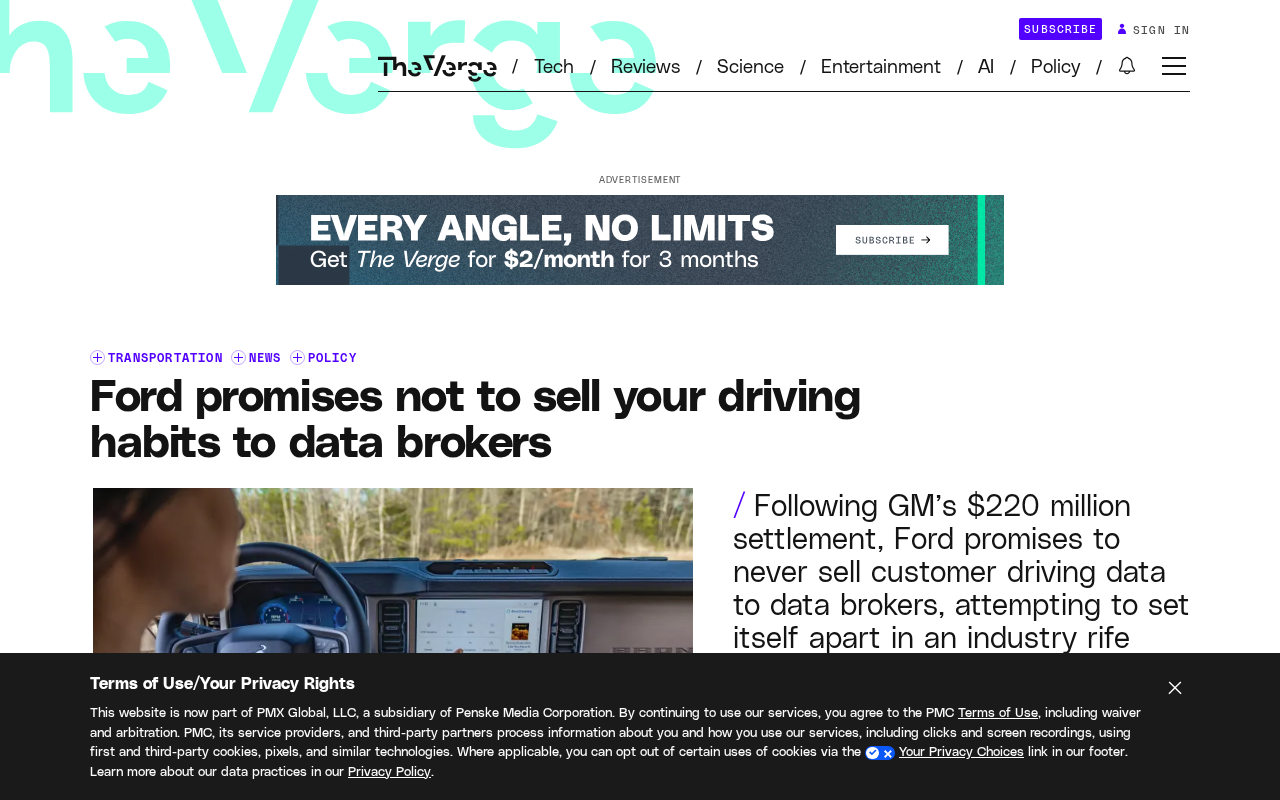
According to the original report, Ford incorporated this commitment into its new privacy protection framework and emphasized that it will "work to protect" customer data. Although the report did not disclose specific implementation details, the clear core is that sensitive information such as driving habits will not become a trading target for data brokers.
Why Driving Data Is So Sensitive
Modern smart cars generate massive amounts of data every second—hard braking frequency, driving routes, acceleration habits, and even in-car conversations. Once this information is obtained by data brokers, it can be used for insurance pricing, targeted advertising, and even more complex user profiling. Many consumers lack awareness of this, and industry transparency has long been insufficient.
Ford's statement at this time directly responds to public concerns that "cars are becoming data collectors." The symbolic significance of its commitment lies in returning data control to vehicle owners, rather than allowing driving behavior to become raw material for third-party profit-making.
Comparison with Competitors
The report mentioned that some automakers have faced legal and regulatory backlash for sharing telematics data without authorization. Although Ford did not name names, this background makes its commitment more targeted. In the U.S. market, which lacks unified federal legislation, automakers' self-regulatory statements often become an important basis for consumers to judge safety.
Data Broker refers to companies whose business model is to collect, aggregate, and resell personal data. They usually do not interact directly with users, but instead purchase data in bulk from various channels and process it into user profiles or risk scores for sale to downstream customers in insurance, marketing, finance, and other sectors. The United States is currently the most developed market for the data broker industry, but it has long lacked dedicated federal legislation, and industry transparency is very low. Driving data, because of its strong continuity, realistic scenarios, and high degree of binding to personal behavior, is regarded as a high-value asset in the eyes of data brokers—it can not only reflect where a person goes, but also infer their driving style, daily routine, and even economic status. For this reason, controversies surrounding data brokers mainly focus on whether users are informed, whether they consent, and whether the resale chain is traceable.
Telematics Data refers to operational data collected and transmitted in real time by vehicles through sensors and onboard communication modules, including vehicle speed, braking and acceleration intensity, mileage, engine status, location trajectories, and even intervention records of advanced driver assistance systems. Unlike general in-car entertainment data, telematics data comes directly from the vehicle itself. Automakers often obtain collection authorization through standard-form terms when users purchase a car, but whether the scope of authorization covers resale to third parties is often unclear. In recent years, multiple lawsuits and regulatory investigations against automakers have centered on the core dispute that telematics data was shared with data brokers or insurance companies without fully informing vehicle owners. Understanding this concept helps judge the actual coverage of Ford's commitment not to sell driving data.
Implementation Challenges Behind the Commitment
Merely claiming "not to sell" is not enough. The use scenarios for driving data are complex: insurance companies may offer discounts in exchange for data, fleet management requires information sharing, and map services rely on location data. Ford needs to clearly define the boundary between "selling" and "sharing" and establish auditable internal mechanisms.
The original material did not disclose whether Ford will provide supporting tools such as data access dashboards and deletion rights. Without transparency reports and independent oversight, the commitment may become a mere formality. Consumers and regulators have reason to ask: who will verify that Ford has not violated its commitment?
The legal boundary between "selling" and "sharing" is key to evaluating such commitments. In privacy legislation in some U.S. states (such as California's CCPA/CPRA), "selling" is broadly defined as exchanging data for money or other valuable consideration, while "sharing" may cover data flows used for purposes such as cross-context behavioral advertising. If automakers provide data to insurance partners or map suppliers under names such as "service providers" or "business necessity," whether this constitutes disguised selling depends on the specific contractual arrangements and the form of consideration. This is precisely why Ford's commitment needs accompanying definitions and audits: without clarifying the meaning of these two terms, the commitment could be technically circumvented.
Implications for the Industry and Users
Ford's statement is a positive signal, but it should not be seen as the end point. Users still need to pay attention to updates to automakers' privacy policies and actively manage in-car connectivity settings. For the industry, competitive pressure may push more companies to make similar commitments, but real progress depends on whether there are verifiable standards and consequences for violations.
Today, when data has become a core asset, Ford's choice shows that protecting privacy can become a differentiating advantage rather than a cost burden.
One-line Summary
Ford promises not to sell driving data, but the actual effect depends on boundary definition and auditable oversight.
Paragraph Summary
Ford has publicly committed never to sell customer driving data to third-party data brokers and has incorporated this into a new privacy protection framework, aiming to distinguish itself in the connected vehicle era from competitors that have faced lawsuits and regulatory pressure over telematics data sharing. The article points out that data such as driving habits, routes, and braking frequency is highly sensitive and may be used for insurance pricing and targeted advertising, while consumers have long lacked awareness. The symbolic significance of the commitment lies in returning data control to vehicle owners, but the real difficulty lies in defining the boundary between "selling" and "sharing," establishing auditable internal mechanisms, and whether to provide data access and deletion tools. The article views this as a positive signal, but holds that self-regulatory statements have limited binding force without unified legislation, and whether privacy protection can become a differentiating advantage remains to be verified.
Related articles

9 AI Subscription Plans Compared: The Real Cost Per 100M Tokens Revealed
Bilibili creator tests 9 AI subscription plans from Volcano, Alibaba, Tencent, Baidu, Zhipu, Xiaomi, MiniMax and more, converting them all to real cost per 100M tokens, breaking down fixed-quota vs. three-tier coefficient billing and how caching, time-of-day discounts, and window limits affect actual quota.

Vibe Coding for Beginners: Expressing Intent Instead of Handwriting Code
What is Vibe Coding? A 137-episode Bilibili course defines it: the core is expressing intent, not writing code. This article analyzes Vibe Coding's productivity logic, target audience, and entry expectations to help beginners decide if it's worth learning.

LangChain Beginner's Guide: An Agent Development Roadmap from LangGraph to Deep Agents
Clarify the encapsulation relationship among LangChain, LangGraph, and Deep Agents, and master the learning path and selection logic for agent development frameworks—suitable for beginners in large model development.