Forge Launches New Capabilities: Start with Open Models, Cut Costs with Ensembles, Train on Custom Data

Forge starts with open models, cuts costs via multi-model ensembles, and custom-trains on business data to serve all enterprises.
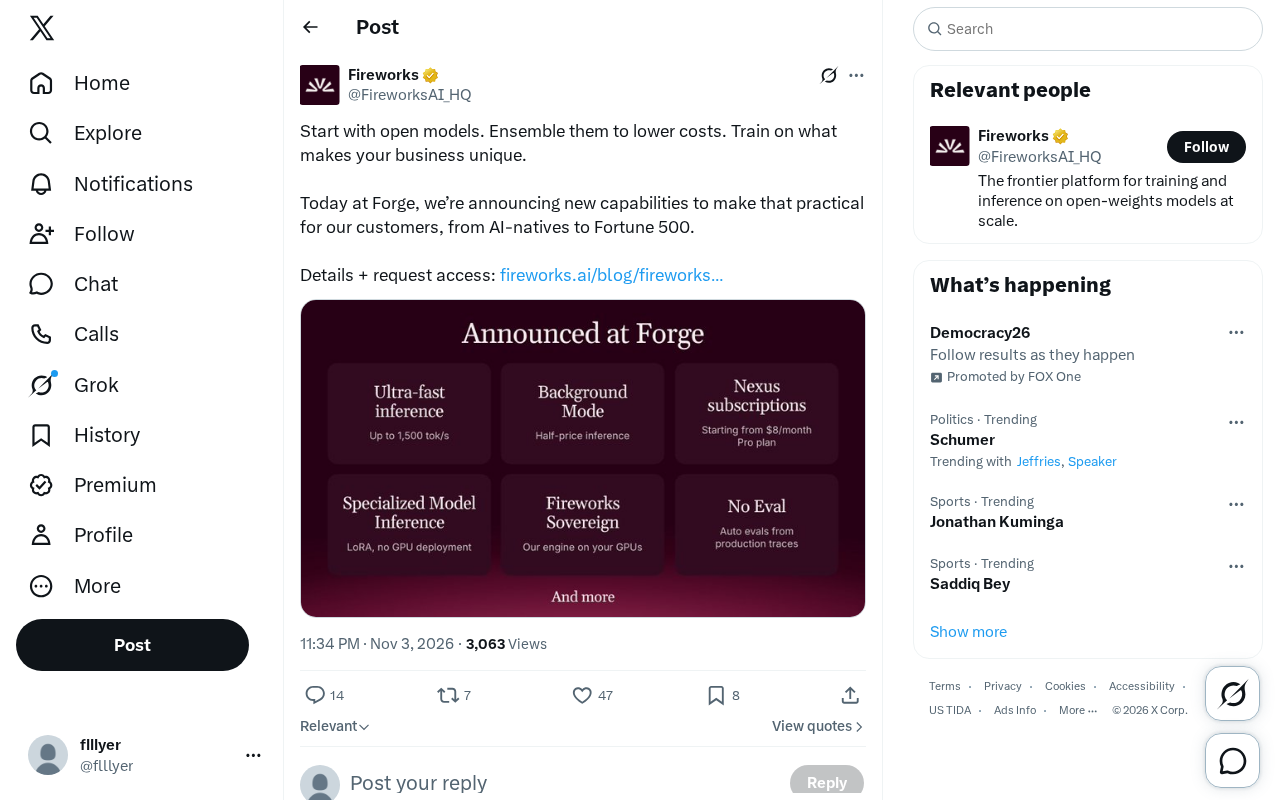
Forge's capability update outlines a three-step path for enterprise AI: start with open models for cost, controllability, and data sovereignty; ensemble multiple models with task-tiered invocation to structurally reduce inference costs; and train on business-unique data to embed domain know-how into model weights rather than prompts. Together these form a closed loop from starting point to cost to differentiation. The new capabilities target customers from AI-native companies to the Fortune 500, balancing out-of-the-box readiness with enterprise permissions and auditing, and are in a controlled-availability phase requiring application. Quality consistency after ensembling, data thresholds for custom training, and depth of compliance support remain to be proven.
Open models are becoming a pragmatic starting point for enterprise AI adoption. Forge's latest capability update centers on three steps—"start with open models, cut costs with ensembles, and train on what makes your business unique"—attempting to turn this path from a concept into an actionable solution for customers ranging from AI-native companies to Fortune 500 enterprises.
Why Open Models Are the Starting Point for Enterprise AI
The first piece of advice Forge offers in its tweet is "start with open models." Behind this is a forming industry consensus: while closed frontier models are powerful, constraints around cost, controllability, and data sovereignty make it hard for many enterprises to adopt them as long-term infrastructure. Open models allow enterprises to deploy, fine-tune, and audit within their own environments, giving them visibility into model behavior from day one.
For AI-native teams, open models mean greater freedom to iterate; for large enterprises, they mean predictability in compliance and procurement processes. Forge presents these two customer types side by side, indicating that its capability design does not assume customers already have mature model engineering teams.
Open models typically refer to models whose weights are publicly available and that can be deployed, fine-tuned, and redistributed in one's own environment, in contrast to closed models that offer only API access. They are not equivalent to fully open source, and license terms vary widely: some permit commercial use, while others restrict redistribution or large-scale serving, so enterprises need to check the scope of the license when selecting models. The core value of open models lies in keeping data on-premises, enabling auditable behavior, and making inference costs predictable—but the trade-off is that enterprises must bear the deployment, operations, and model engineering effort themselves. By comparison, closed frontier models still hold advantages in general capabilities and suit scenarios that demand out-of-the-box readiness and involve limited inference volume.
Ensembling Multiple Models: An Engineering Lever for Driving Down Costs
The second proposition is to "ensemble them to reduce costs." A single model can hardly achieve optimal cost-effectiveness across all tasks; combining models of different sizes and specialties—routing simple tasks to lightweight models and complex tasks to stronger ones—is a common approach to controlling inference costs today.
By listing ensembling as a formal capability, Forge means that routing, result merging, and quality evaluation—components that would otherwise need to be built in-house—can be handled by the platform. For high-volume inference scenarios, the benefit of this tiered invocation is structural, not merely a matter of per-call price differences.
Model ensembling takes several common engineering forms: first, routing, where a lightweight classifier or rules judge task difficulty and dispatch requests to models of different sizes; second, cascading, where a small model is called first and escalated to a stronger model when confidence is insufficient; third, result merging, where outputs from multiple models for the same input are combined via voting or weighting. The first two have the greatest impact on latency and cost, while the third is better suited to quality-first offline scenarios. The added complexity of ensembling lies in quality consistency: different models differ in output style, format, and refusal behavior, requiring unified evaluation and fallback mechanisms. Even if the platform handles this work, enterprises still need to clearly define routing policies and acceptance criteria for each task.
Using Business Uniqueness as Training Data
The third proposition is to "train on what makes your business unique." General models inherently have limited understanding of industry know-how, and an enterprise's real moat often lies in its proprietary processes, historical interactions, and domain corpora. What Forge emphasizes is turning this data into model capability rather than stopping at shallow prompt-level adaptation.
This proposition and the open-model strategy reinforce each other: only when model weights can be trained can business uniqueness truly be embedded into the model, rather than repeatedly injecting context on every call.
Training open models typically involves several technical paths: full fine-tuning delivers the strongest results but carries high compute and storage costs; parameter-efficient fine-tuning (such as LoRA) trains only a small number of additional parameters, offering low cost and fast iteration and suiting most enterprises getting started; continued pre-training is used to inject large volumes of domain corpora. Which path to choose depends on data scale and task divergence. In addition, custom training places far higher demands on data quality than quantity—historical interaction data is often noisy and requires cleaning and labeling. Trained models also need a regression evaluation set to prevent degradation in general capabilities, an engineering investment that is often underestimated.
From AI-Native Companies to the Fortune 500
Forge explicitly states that the new capabilities target customers "from AI-native companies to the Fortune 500." This span suggests its product balances ease of use with enterprise-grade requirements—small teams need out-of-the-box readiness, while large enterprises need permissions, auditing, and integration capabilities.
The tweet also provides a details page and an application-for-access entry point, indicating that the relevant capabilities are in a controlled-availability phase and that enterprises must apply for access.
What's Pragmatic About This Path—and What Remains to Be Proven
The three-step path Forge lays out is not novel, but packaging it as product capability rather than consulting advice lowers the barrier for enterprises to experiment. Open models solve the starting-point problem, ensembling solves the cost problem, and custom training solves the differentiation problem—together forming a closed loop.
What bears watching is the execution detail: how quality consistency is ensured after ensembling, the minimum data requirements for custom training, and the depth of compliance support for Fortune 500 customers. These are not yet elaborated in the tweet, and the actual experience after applying for access will be key to judging its value.
One-line Summary
Forge starts with open models, cuts costs through multi-model ensembles, and custom-trains on business data in three steps to serve enterprises of all kinds.
Paragraph Summary
Forge's capability update centers on a three-step path for enterprise AI adoption: start with open models to gain cost, controllability, and data sovereignty advantages; ensemble multiple models with task-tiered invocation to structurally reduce inference costs; and train on business-unique data to embed domain know-how into model weights rather than leaving it at the prompt level. The three propositions reinforce each other, forming a closed loop from starting point to cost to differentiation. The new capabilities target customers from AI-native companies to the Fortune 500, balancing out-of-the-box readiness with enterprise-grade permissions and auditing, and are currently in a controlled-availability phase requiring an access application. The article also notes that quality consistency after ensembling, the data threshold for custom training, and the depth of compliance support remain execution details to be proven.
Related articles

9 AI Subscription Plans Compared: The Real Cost Per 100M Tokens Revealed
Bilibili creator tests 9 AI subscription plans from Volcano, Alibaba, Tencent, Baidu, Zhipu, Xiaomi, MiniMax and more, converting them all to real cost per 100M tokens, breaking down fixed-quota vs. three-tier coefficient billing and how caching, time-of-day discounts, and window limits affect actual quota.

Vibe Coding for Beginners: Expressing Intent Instead of Handwriting Code
What is Vibe Coding? A 137-episode Bilibili course defines it: the core is expressing intent, not writing code. This article analyzes Vibe Coding's productivity logic, target audience, and entry expectations to help beginners decide if it's worth learning.

LangChain Beginner's Guide: An Agent Development Roadmap from LangGraph to Deep Agents
Clarify the encapsulation relationship among LangChain, LangGraph, and Deep Agents, and master the learning path and selection logic for agent development frameworks—suitable for beginners in large model development.