Forking a Teammate's AI Agent Session Like a Git Branch — Is This Idea Viable?

A developer proposes forking a teammate's AI Agent session like a Git branch to break down collaboration silos.
The article discusses a Reddit proposal: sessions in AI coding tools like Claude Code and Codex are completely isolated, so teammates cannot share context and can only interrupt each other or restart from scratch. The proposed solution is a shared workspace that allows forking a running Agent session—branches inherit the full history, work in parallel, discover each other's improvements, and remain provider-agnostic. The author sees this as transplanting Git's collaboration philosophy to the AI session layer, but its viability hinges on whether it truly saves time, while facing three obstacles: habit cost, permission and privacy, and technical complexity. Current team workarounds all lose context integrity.
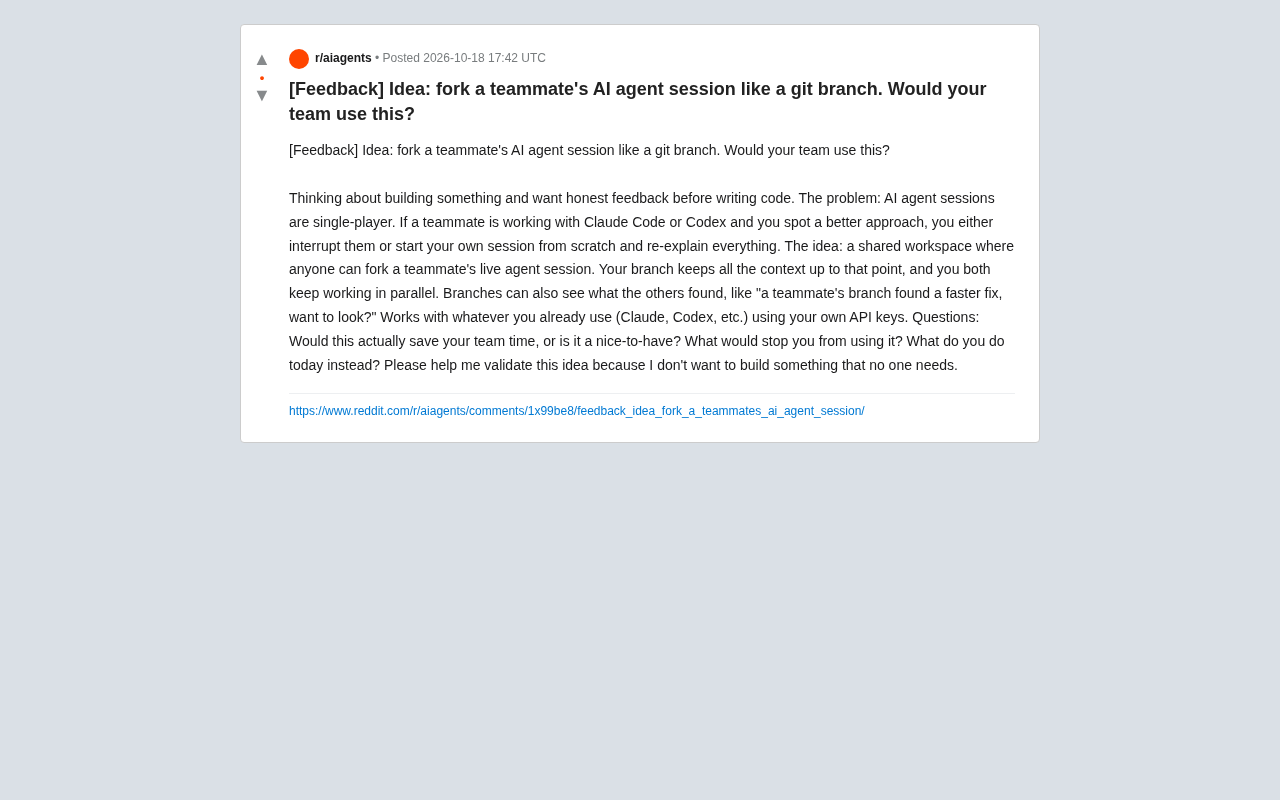
A proposal from a developer on Reddit sparked discussion: why can't we fork a teammate's running AI Agent session the way we fork a Git branch? This seemingly simple idea touches on a fundamental shortcoming of current AI coding tools when it comes to team collaboration.
The Problem: AI Agent Sessions Are a "Single-Player Game"
The developer who started the discussion pointed out a common pain point: when a teammate is using an AI coding tool like Claude Code or Codex, their session is completely isolated. If you discover a better implementation path, or want to continue exploring based on the context your teammate has already built up, you only have two options—either interrupt them, or start a new session from scratch and re-explain all the background.
This "single-player game" model stands in sharp contrast to the collaborative workflows that modern software development emphasizes. Code can be shared, branched, and merged, but AI conversation context is locked away in isolated islands.
AI coding Agent session context typically refers to the full message history accumulated in a single conversation, including user instructions, the Agent's reasoning process, tool call records (such as files read and written, terminal commands executed), and returned results. Tools like Claude Code and Codex rely on this context to maintain task continuity—the reason an Agent can "remember" which file it modified earlier and why it chose a particular approach all comes down to this. But this context currently exists only in a single user's local session, with neither a standardized export format nor an interface for cross-user synchronization. So when a teammate wants to reuse your context, there's no technical way to directly "plug in"—only manual retelling. This is precisely the root of session isolation.
The Solution: Shared Workspace + Session Branching
The developer's vision is to build a shared workspace that allows anyone to fork a teammate's running Agent session. The specific mechanisms include:
- Branches inherit the full context: Your branch retains the entire conversation history up to that moment, and you and your teammate can work in parallel on your respective branches without interfering with each other
- Cross-branch discovery sharing: Branches can see each other's findings—for example, the system might prompt, "Your teammate's branch found a faster fix. Want to take a look?"
- Tool-agnostic: Not tied to any specific AI provider, supporting mainstream tools like Claude and Codex, using your own API keys
What's elegant about this design is that it transplants Git's collaboration philosophy to the AI session layer. Git lets code changes fork and merge, and this proposal gives the "thinking process" itself the same operability.
Session fork draws on the branching model from version control: take a snapshot of the session state at a given moment, have the new branch inherit all history prior to the snapshot, and from then on let each branch evolve independently. Unlike Git branches, the "commits" of a session branch are conversation messages and tool calls rather than code diffs, so the semantics of merging are also murkier—two branches may reach different conclusions rather than produce automatically mergeable text. Implementation typically requires serializing session history into a copyable state object, maintaining an independent append log for each branch, and having "discovery sharing" between branches rely on subscriptions to new messages or summary pushes.
Will Teams Buy In? The Key Is Whether It "Saves Time" or Is Just "Nice to Have"
The original author very astutely raised three validation questions: Does this really help teams save time, or is it just a "nice to have" feature? What would stop you from using it? How do you currently deal with this problem?
From an engineering practice perspective, the value of this idea depends on team size and working style. For teams that frequently do pair programming or code review, forking a session means the reviewer can follow the author's line of reasoning and keep building on it without interrupting the author. For distributed teams, asynchronously "relaying" an Agent session may be more efficient than synchronous meetings.
But the resistance is equally obvious. First is the habit cost—developers are already used to their own independent AI workflows, and introducing shared sessions requires changing collaboration conventions. Second are permission and privacy concerns—sessions may contain sensitive code snippets or internal discussions, and granular control over sharing needs to be very fine-grained. Finally, there's technical complexity—synchronizing the context of multiple branches in real time while keeping them independent is no easy feat.
Pair programming and asynchronous relay are two collaboration modes worth distinguishing when evaluating tools like this. Pair programming emphasizes real-time synchronization, with two people sharing the same screen and context; the value of forking a session lies in letting the reviewer briefly "branch off" to verify a hypothesis without interrupting the mainline Agent run. Asynchronous relay targets distributed teams: a teammate leaves a half-finished session before logging off, and someone in another time zone forks it and continues—essentially treating the Agent session as a handoff-able work item. The two modes have different requirements for context consistency and permission control; the former prioritizes low-latency synchronization, while the latter prioritizes branch traceability and audit logs.
The Current State: Chaotic Workarounds
Before an ideal solution emerges, teams typically do the following: share conversation snippets via screenshots, paste key conclusions into Slack, or simply start a new session and describe the problem from scratch. All of these approaches lose context integrity to varying degrees and waste the conversational foundation that has already been established.
Whether this idea can be realized ultimately depends on how many teams genuinely feel the friction caused by "session isolation." If your team frequently finds itself "interrupting teammates" or "re-explaining background," then the value proposition of such a tool is quite clear.
One-line Summary
A developer proposes forking a teammate's AI Agent session like a Git branch to break down collaboration silos.
Paragraph Summary
The article centers on a Reddit proposal: currently, sessions in AI coding tools like Claude Code and Codex are completely isolated, teammates cannot share context, and the only options are to interrupt each other or restart a session from scratch. The proposed solution is to build a shared workspace that allows forking a running Agent session—branches inherit the full history, can work in parallel, can discover each other's improvements, and are not tied to any specific provider. The author sees this as transplanting Git's collaboration philosophy to the AI session layer, but whether it can be realized depends on whether it truly saves time, while facing three obstacles: habit cost, permission and privacy, and technical complexity. Teams' current workarounds (screenshots, pasting conclusions, restarting sessions) all lose context integrity.
Related articles

Free Unlimited Claude Code Solution: Agnes AI + CC Switch Setup Guide
No paid subscription needed — pair the free AI platform Agnes AI with the open-source tool CC Switch to provide a backend for Claude Code, enabling unlimited free calls to text, image, and video models. This guide covers the full setup, test results, and usage boundaries.

A Complete Zero-Cost Guide to Getting Started with Claude Code for Beginners in China
A beginner's guide to Claude Code for users in China: two installation methods (command line and IDE plugin), full configuration steps for replacing the official API with the free domestic LongCat model, and a hands-on demo of building a small tool with natural language, plus tips.

When the NSA Gets Involved: The AI Supply Chain Crisis Behind Open-Source CVEs and API Key Hijacking
Multiple open-source projects disclosed severe CVEs in one day, PHP flaws alarmed the FBI, and Railway and OpenCode were breached with API keys stolen. This article breaks down the vulnerability window, AI-accelerated exploitation, and the AI supply chain crisis behind the API key black market, with a developer defense checklist.