Four AI Models Face Off on a Paper Airplane Animation: Opus 5.5 Steals the Show

Opus 5.5 tops a four-way AI animation showdown, but single-prompt results warrant careful interpretation.
A user tested Opus 5.5, GPT-6 Astra, DeepSeek V4.1 Flash, and Gemini 3.8 Flash on a single paper airplane animation prompt, concluding that Opus 5.5 came out clearly ahead. The task is deceptively demanding, testing physical motion understanding, temporal coherence, and creative scene-building all at once. While such same-prompt comparisons offer useful intuitive snapshots, the article cautions that single-user, single-prompt results are heavily influenced by random parameters and should not be treated as definitive model rankings — more reliable evaluation requires multiple rounds, varied topics, and standardized scoring criteria.
One Prompt, Four Models Put to the Test
On social media, a user ran a head-to-head comparison of four leading AI models using a single prompt: "Create a short animation featuring a paper airplane." The models in the ring were Opus 5.5, GPT-6 Astra, DeepSeekAd V4.1 Flash, and Gemini 3.8 Flash. The tester's verdict was blunt — in their view, Opus 5.5 "crushed" the other three across every dimension.
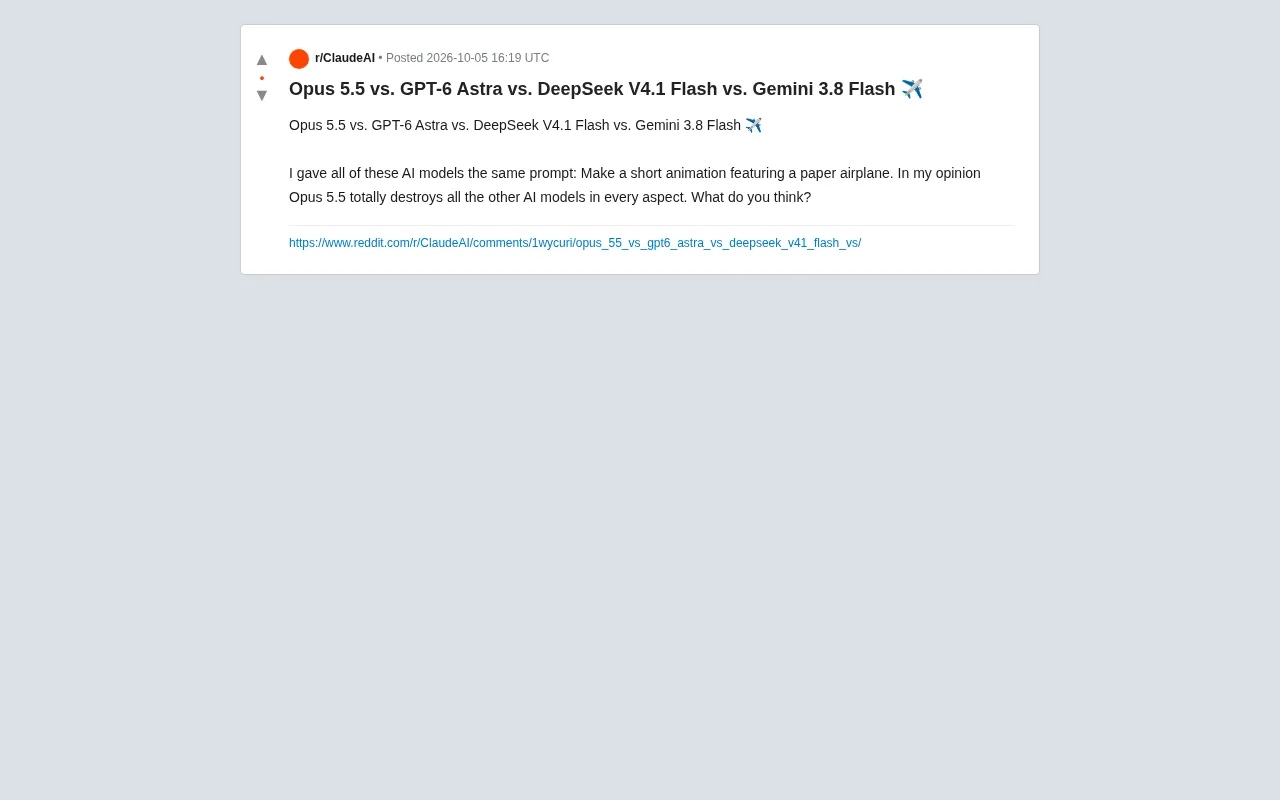
This kind of "same-prompt showdown" draws attention because it presents output differences between models on an identical task with minimal variable overhead. A paper airplane animation may seem simple, but it simultaneously tests a model's understanding of spatial motion, physical trajectories, frame-to-frame coherence, and creative presentation.
Why a "Paper Airplane Animation" Makes for a Good Test
Generating a paper airplane flight animation involves several layers of capability. The model needs to understand the physical characteristics of a paper airplane — it doesn't fly in a straight line at constant speed, but rather follows a curved path with gliding, descent, and subtle wobbling. Next comes frame continuity: whether the animation flows smoothly, and whether the object suffers from frame jumps or distortion, directly exposes a model's weaknesses in temporal modeling.
There's also the creative and scene-building dimension: background environment, lighting, camera movement — these details determine whether the final product is merely "watchable" or genuinely impressive. A short prompt manages to compress all of these demands into one, making it a solid litmus test for overall generative quality.
Worth noting is that mainstream AI models currently take different technical approaches to generating animation. Some directly output video frame sequences (based on video-generation diffusion models), others generate executable animation code (such as SVG animations or CSS/JavaScript effects), and still others produce frame-by-frame descriptions that a rendering engine then processes. This means the "animation output" of different models can look fundamentally different — some produce pixel-level video, others produce vector animation code. If testers don't standardize the output format, they're effectively comparing two categorically different capabilities. This is one of the inherent reasons why cross-model comparisons of this kind can never be entirely fair.
The Tester's Subjective Verdict
According to the poster, Opus 5.5's output was noticeably superior to the other three models in terms of smoothness, physical realism, and overall visual quality. GPT-6 Astra, DeepSeek V4.1 Flash, and Gemini 3.8 Flash each had their moments, but none managed to keep pace with the top spot in this user's evaluation framework.
It's important to emphasize that this is a subjective judgment from a single user based on a single prompt. Animation generation quality is influenced by many factors — prompt phrasing, random seeds, sampling parameters, and more — so a single result is not sufficient grounds for a definitive verdict on model capability. With different prompts or different subject matter, the rankings could easily shift.
How to Read These Comparisons More Objectively
Same-prompt showdowns in the community are genuinely useful as a reference point, but readers should approach them with caution. Reaching more credible conclusions typically requires multiple rounds of testing, diverse subject matter, and as standardized an evaluation rubric as possible (for instance, scoring fluency, realism, and creativity separately).
For users who care about AI-generated content, the greater value of posts like this lies in providing a window for "cross-model perception": you get an intuitive sense of the rough pecking order among current models in the video and animation space, which you can then combine with your own practical needs to inform a choice — rather than simply taking a single subjective ranking at face value.
In the field of AI capability evaluation, the industry has developed more systematic benchmarking methods, such as blind scoring (where judges don't know which model produced which output), ELO rating systems (building rankings through large numbers of pairwise comparisons), and automated metrics (such as FVD for frame-level perceptual distance in video generation, and FID for image quality scoring). User-driven tests on social platforms typically lack these conditions; their value lies more in rapidly spreading "first impressions" than in delivering statistically significant conclusions. Understanding this context helps readers more accurately calibrate how much weight to give posts of this kind.
Conclusion
One paper airplane prompt, four models on the same stage. Opus 5.5 earned high praise from the poster in this round, but painting the true picture of each model's capabilities will require more samples and more rigorous evaluation. For everyday users, rather than obsessing over who came in first, the better move is to run the test yourself with the scenarios you actually use — and let the results speak for themselves.
Related articles

REA: Reverse Engineer Any App with AI, No Coding Required
REA is a viral open-source AI reverse-engineering tool that lets Claude, Codex, and other AI agents analyze any app and generate functional clones—no coding required. This article covers how it works, installation, a hands-on test, and legal risks.
2026 AI Coding Tools Comparison: Claude, ChatGPT, Gemini — Which Is the Best?
A 2026 comparison of five mainstream AI coding tools — Claude Code, ChatGPT Codex, Gemini, DeepSeek, and GitHub Copilot — on real projects, pricing, and code quality, to help you decide where that $20/month should go.

ChatGPT Codex Can Clone Any Software? Testing the Risks and the Truth
YouTube shorts claim ChatGPT Codex or Claude Code can clone Adobe, Excel, and Figma for lifelong free use. We break down the feasibility, legal risks, and DM-funnel tactics—and explain what AI coding tools are truly good for.