Four Gemini Agents Beat Minecraft: The Real Cost of Multi-Agent Collaboration

Four Gemini agents beat Minecraft autonomously via chat and shared memory, with no central orchestrator.
This article analyzes an experiment: four Gemini 4 Argon agents, without a central orchestrator, coordinated spontaneously through in-game chat and shared memory to defeat Minecraft's Ender Dragon in 27 hours. The agents wrote 2,783 programs and died 605 times, with roles emerging through observation and imitation. The article notes that shared memory used eventual consistency and last-write-wins, causing frequent stale reads and race conditions; Mineflayer as a tool boundary introduced three challenges: abstraction leaks, async management, and state synchronization. This pattern suits exploratory research and recoverable-failure scenarios, but cannot meet production requirements for correctness, determinism, and strong consistency.
Four Gemini 4 Argon agents beat Minecraft survival mode and defeated the Ender Dragon with no human intervention. They wrote 2,783 programs, died 605 times, and ran continuously for 27 hours. No predefined roles, no hand-written game logic, no human debugging—just four agents, the Mineflayer library, shared memory, and in-game chat.
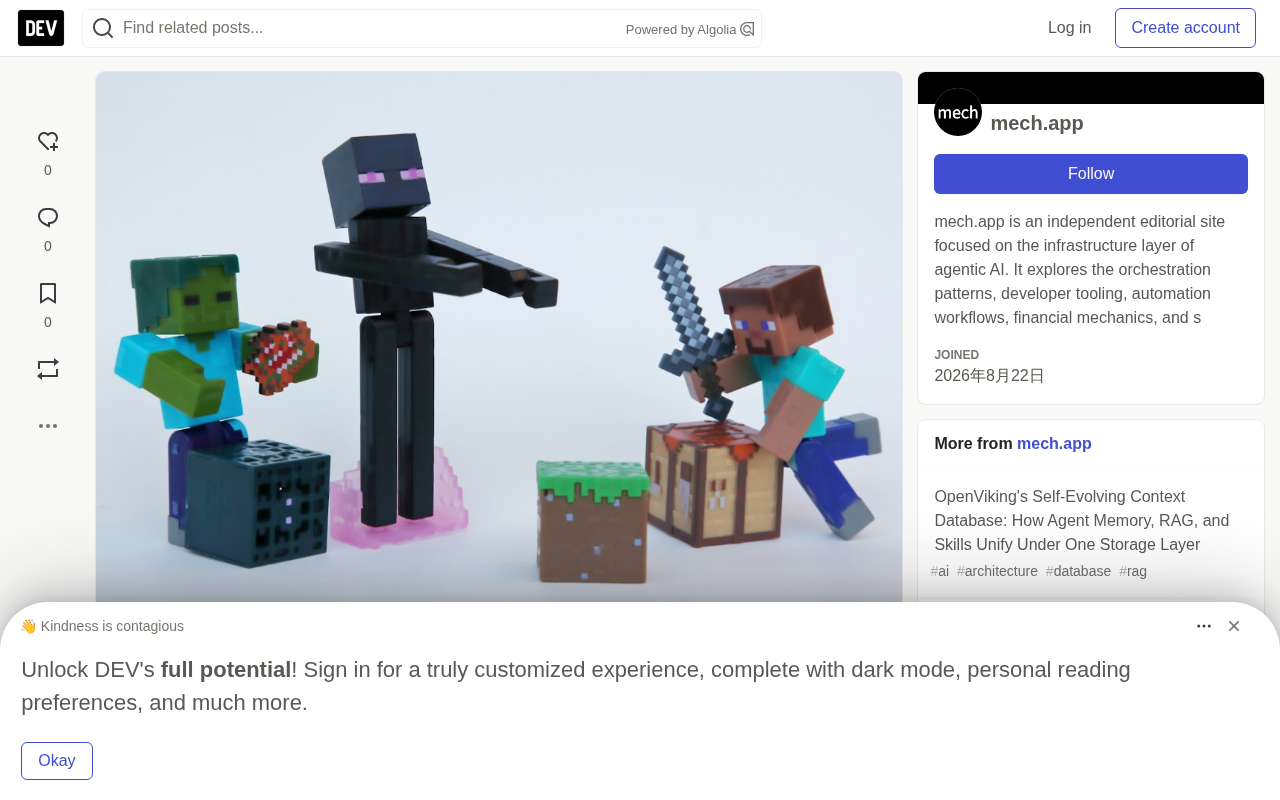
This wasn't a demo. It was a stress test of multi-agent orchestration in a complex, long-running environment—where state diverges, tools fail, and coordination failures cascade. The real value isn't the Ender Dragon milestone; it's the problems the underlying pipeline exposed.
Experimental Setup: Four Agents, One Goal, Zero Orchestrator
Each agent controls a Minecraft player through Mineflayer. Mineflayer is an open-source Node.js library that exposes game state and player behavior as a JavaScript API. Agents can read world state (inventory, health, nearby blocks and entities), perform actions (move, dig, craft, attack), send and receive in-game chat messages, and access a shared memory store.
The task goal is to defeat the Ender Dragon. This requires mining resources, crafting tools, building a base, finding a stronghold, activating the End portal, and fighting the dragon—spanning hundreds of interdependent steps in a randomly generated world.
The researchers provided a real-time dashboard for observability but never intervened. The agents planned, coded, debugged, and recovered from failures autonomously.
How Mineflayer works: Minecraft uses a client-server architecture where the client communicates with the server via a custom binary protocol covering login handshakes, chunk data delivery, entity position updates, block changes, and hundreds of other packet types. Mineflayer implements the full protocol stack in Node.js, parsing these low-level packets into JavaScript objects (such as bot.entity.position, bot.inventory.items()) and wrapping player actions as async functions (such as bot.dig(block), bot.craft(recipe)). This means when an agent calls a single function, underneath it's actually sending several packets, waiting for server confirmation, updating local cache, and parsing the response. This abstraction lets agents avoid understanding protocol details, but it also means every action can fail due to network latency, server rejection, or game state changes—requiring Promise rejection handling and retry logic.
Coordination Without a Central Orchestrator
Most multi-agent systems use a supervisor or coordinator to assign tasks and resolve conflicts. This experiment didn't. Agents coordinated through two channels:
In-game chat: Agents broadcast intentions, request help, and share discoveries. Chat is asynchronous, lossy (agents may miss messages), and unstructured, with no protocol constraints.
Shared memory: A key-value store accessible to all agents, used for persistent state like base locations, resource counts, and task assignments.
Roles emerged naturally. One agent focused on mining, another on crafting, a third on exploration. No explicit role assignment. Agents negotiated through chat and dynamically adjusted based on other agents' behavior.
The Inevitability of Failure Modes
This coordination model produces predictable failure modes:
- Stale reads: Agent A reads shared memory, Agent B updates it, Agent A still acts on the old state.
- Race conditions: Two agents read the same resource count and both decide to craft the same item.
- Chat overload: As messages accumulate, critical information gets buried.
- Role drift: Agents switch tasks mid-way, leaving dependencies unmet.
The paper doesn't detail how often these occurred, but 605 deaths and a 27-hour runtime suggest they were quite frequent.
Theoretical background on emergent coordination: In multi-agent systems, coordination mechanisms are typically divided into explicit (central schedulers, contract net protocols, auction mechanisms) and implicit (shared environment, stigmergy, imitation). The no-orchestrator experiment falls under implicit coordination, whose core idea is: agents leave traces by modifying the environment (shared memory, game world), other agents read these traces and adjust behavior, producing global order. This approach has extensive research in swarm intelligence (ant colonies, bird flocks), with advantages of decentralization and robustness (a single agent failure isn't fatal), and disadvantages of slow convergence and oscillation. In this paper, agents exchange intentions through chat and shared memory, essentially combining environmental traces (shared memory key-values) with direct communication (chat), but lacking conflict resolution protocols (such as mutex locks, version vectors), making stale reads and race conditions inevitable.
Mineflayer as a Tool Boundary
Mineflayer abstracts the Minecraft protocol into JavaScript functions. Moving to coordinates, digging blocks, crafting items—all just require calling a single high-level API line.
This abstraction is both an advantage and a constraint.
Advantage: Agents don't need to understand Minecraft's network protocol or low-level game mechanics; calling high-level functions suffices.
Constraint: Mineflayer's API defines what agents can perceive and do. If the library doesn't expose a game feature, agents can't use it. If a function has a bug, agents inherit that bug.
Three Lessons from the Tool Boundary
- Abstraction leaks: Pathfinding can fail when terrain generation is unexpected. Agents must detect and recover from this.
- Async hell: Many Mineflayer functions are asynchronous. Agents must manage Promises, handle timeouts, and retry on failure.
- State synchronization: Mineflayer maintains local state (inventory, position). If local state diverges from the server, agents make wrong decisions.
The agents wrote 2,783 programs. Many were likely fixing edge cases in Mineflayer or their own code.
Trade-offs of the Shared Memory Architecture
The paper doesn't specify the shared memory implementation, but some constraints can be inferred: frequent reads (agents constantly checking base locations, resource counts, task status), less frequent writes (only when resources are deposited, tasks completed, or plans change), and no transaction mechanism (agents don't lock memory across multi-step operations, which causes race conditions).
One possible architectural choice is an in-memory key-value store, eventual consistency, last-write-wins conflict resolution, and unstructured JSON data structures. This design prioritizes speed and simplicity over correctness. Acceptable for a research demo, problematic for production.
What Production Would Require
- Versioned writes: Agents attach version numbers when updating, detecting and resolving conflicts.
- Event logs: All state changes appended to a log, agents can replay history to debug divergence.
- Schema validation: Enforce structural constraints on shared memory, preventing agents from writing malformed data.
- Access control: Restrict which agents can write which keys, preventing accidental overwrites.
Eventual consistency and last-write-wins: Eventual consistency is a consistency model in distributed systems that guarantees all replicas eventually converge to the same value if no new updates occur, but doesn't guarantee reads immediately see the latest write. Last-write-wins (LWW) is a conflict resolution strategy where, when multiple writes occur concurrently, the write with the highest timestamp or version number wins. LWW is simple to implement and requires no coordination, but can lose updates—in this paper's scenario, if agents A and B both read resource count as 5, each decides to craft an item and writes back 3, actually consuming 4 resources but only recording 3, causing resource count errors. Such errors accumulate over long runs, manifesting as agents believing they have enough resources but being unable to craft, or repeatedly crafting the same item.
Observability: The Missing Critical Layer
The researchers had a real-time dashboard, but the paper doesn't describe what it displayed. To debug four agents running for 27 hours, at minimum you'd need observability across these dimensions:
Per-agent metrics: Current task and subtasks, inventory state, health and position, recently sent and received chat messages, programs written and executed, errors and retries.
System-level metrics: Shared memory state and update frequency, task dependency graphs, resource flows (who mined what, who crafted what), death events and causes, time spent on each major milestone.
Trace correlation: Linking chat messages to state changes, deaths to recent actions, program writes to execution results.
Without these, debugging a 27-hour run is nearly impossible. Minecraft cannot be deterministically replayed, so observability must be real-time and comprehensive.
The relationship between deterministic replay and observability: In traditional distributed systems, deterministic replay allows precisely replaying execution by recording all non-deterministic inputs (network messages, clocks, random seeds), enabling offline debugging. Minecraft cannot be deterministically replayed because world generation includes random seeds, entity AI includes randomness, and network timing isn't reproducible—even recording all inputs can't guarantee the same outcome. Therefore, debugging agent systems must rely on real-time observability—capturing sufficiently fine-grained state snapshots and event logs at runtime to analyze failure causes after the fact. This explains why the paper emphasizes the dashboard's importance: without real-time tracing, a 27-hour run that fails is nearly impossible to root-cause; you can only re-run and hope the problem reproduces.
Role Emergence: Coordination Through Imitation
Agents received no role assignments. Roles emerged through observation and imitation. One agent sees another mining iron, infers iron is needed, and switches to mining coal to avoid duplicated effort.
This pattern works under these conditions: agents can observe each other's behavior (chat, shared memory, world state); tasks have natural parallelism (mining, crafting, exploring are independent); agents can recover from role conflicts (two agents mining the same resource is inefficient but not fatal).
It fails under these conditions: dependencies are tight (Agent A needs Agent B to finish first); roles require sustained focus (switching tasks mid-way wastes progress); coordination overhead exceeds task complexity (too much chat, too little work).
The 605 deaths suggest role conflicts were quite common. Agents may have duplicated work, left tasks unfinished, or failed to coordinate in combat.
Code Generation at Scale
2,783 programs in 27 hours—roughly one every 35 seconds. Most were probably small scripts: dig 10 blocks, craft 5 torches, move to coordinates. But some were complex: pathfinding, combat logic, crafting chains.
Code quality faces several fundamental challenges. No testing—agents can't write unit tests for Minecraft scripts; they test by running in the world. No version control—agents overwrite programs, and if the new version breaks, they can only rewrite from memory. No code review—agents don't review each other's code, so bugs propagate.
This is closer to REPL-driven development than software engineering. Agents iterate quickly, accept failure, and move on.
Technical Judgment: When to Use, When Not To
Scenarios suited for no-orchestrator multi-agent coordination: Tasks are naturally parallel and loosely coupled; agents can observe each other's state and behavior; coordination overhead is low; failures are recoverable; strong observability exists to debug divergence. Typical examples include distributed data processing, swarm robotics, and collaborative editing.
Scenarios to avoid: Tasks are tightly dependent and require strict ordering; coordination overhead exceeds task complexity; failures are catastrophic (financial transactions, safety-critical systems); stale reads or race conditions are unacceptable; observability is weak or absent. Typical examples include database transactions, real-time trading, and medical devices.
This is a research milestone, not a production pattern. Four agents beat Minecraft through brute force: 605 deaths, 2,783 programs, 27 hours of runtime. The coordination model (chat plus shared memory) is simple but fragile, with stale reads, race conditions, and role conflicts being inevitable.
The real value isn't the Ender Dragon itself. It's that it proved one thing: agents can achieve coordination in complex environments through simple primitives (chat, shared memory). The pipeline is messy, but it works.
Reference Links
Related articles

Altman Declares: The Cybersecurity Crisis Is Unsolvable and There Are Too Many Vulnerabilities to Patch
OpenAI CEO Sam Altman publicly admits he can't fix all security vulnerabilities and that the cybersecurity crisis will keep worsening. This article analyzes the industry reality behind this statement: exploding software complexity, the double-edged sword of AI, and the need to shift security paradigms from "zero vulnerabilities" to resilient defense.

Product Hunt Launches Visual Launch Editor, Saying Goodbye to Tedious Form Filling
Product Hunt launches a Visual Launch Editor with in-place editing for name, tagline, gallery, and maker info, auto-saved drafts, and a checklist to guide creators.

Zelensky Speaks: How We Held Kyiv Against 200,000 Russian Troops
Zelensky recalls the early Russia-Ukraine war: 200,000 Russian troops drove on Kyiv while Ukraine's main forces were in the east. He explains how mobilization grew the army from 200,000 to 800,000 and how Kyiv and Chernihiv oblasts were recaptured.