Four Layers of AI Agent Guardrails: From Input to Runtime

AI Agent guardrails should be defended in four layers — input, tool actions, output, and runtime — with security logic embedded in the execution path.
The article argues that AI Agent security doesn't come from a smarter model but from layered containment. Since prompt injection is OWASP's top risk with no foolproof defense, the goal is to keep the blast radius limited. Guardrails have four layers: the input layer does schema validation, jailbreak and indirect injection screening, and early PII removal before inference, following fail-closed; the tool and action layer is the highest-leverage, emphasizing least privilege, tool risk tiers, approvals bound to precise actions with idempotency keys, and loop limits; the output layer enforces schemas, grounding checks, and scope control; the runtime layer provides redacted audit logs, cost and call monitoring, and a one-touch kill switch. The conclusion: security must live in the execution path — managed services handle generic risks, while business logic risks must be borne by your own code.
Four Layers of AI Agent Guardrails: From Input to Runtime
What your AI Agent needs isn't a smarter model — it's effective containment. That's the core argument of an Agentic Affairs article on agent guardrails. OWASP lists prompt injection as the top risk in its LLM Application Top 10, and explicitly states that it's currently unclear whether any foolproof defense exists. For that reason, the goal isn't to build a perfect wall, but to construct layered defenses: when one layer is breached, the blast radius is contained within a limited scope, and humans show up precisely at the key decision points.
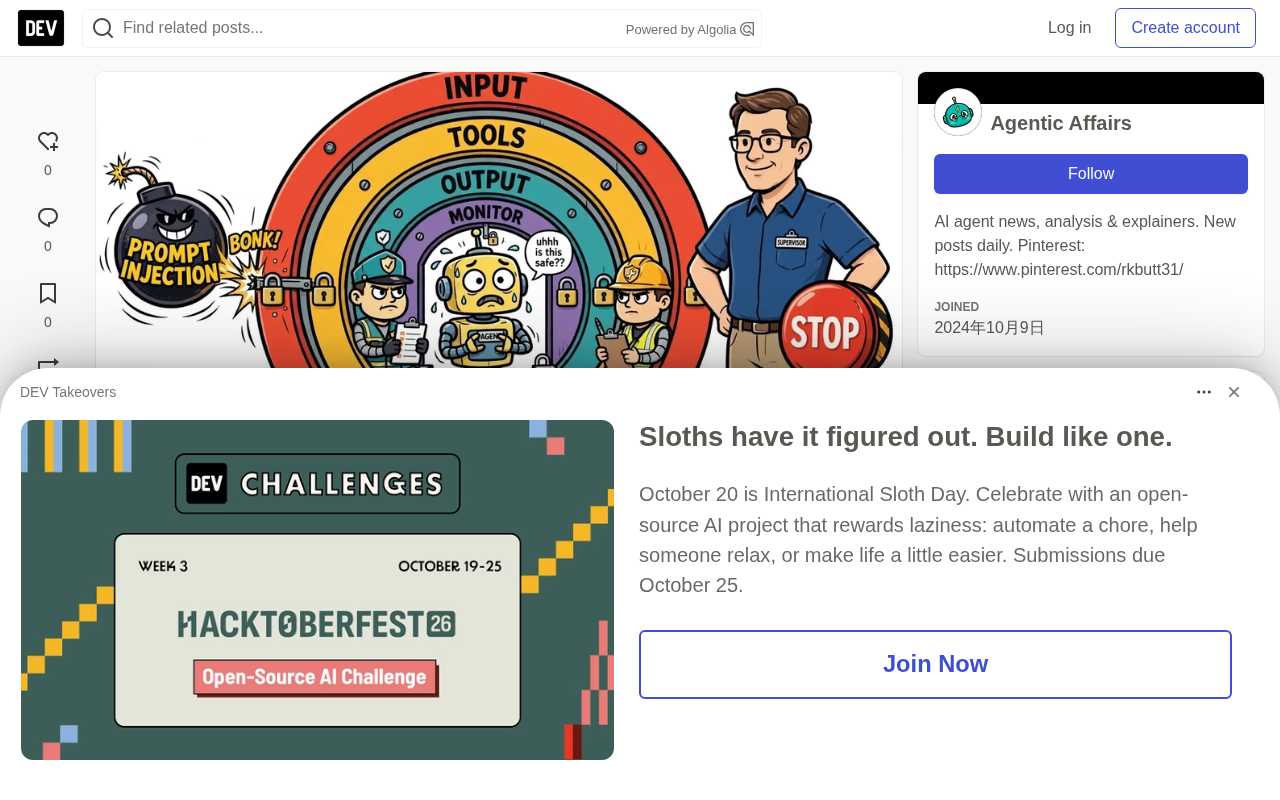
The article breaks guardrails down into four layers — input, tools & actions, output, and runtime — and emphasizes that security logic must be embedded in the execution path rather than relying on prompts. Let's go through each layer.
Layer 1: Input Guardrails — Keeping the Poison Outside the Door
The core task of input guardrails is to validate and sanitize before inference happens. This includes verifying structure against a schema, setting length limits, and maintaining allowlists. At the same time, it's necessary to screen for jailbreak attempts and for indirect injections hidden in the documents the Agent reads — the key point being that this gate sits before inference, not after. If you intercept after the model has already processed malicious input, the damage may already be done.
Another often-overlooked measure is clearing PII (personally identifiable information) as early as possible. Data the model never receives can never leak — this is the most reliable form of data protection. All checks should follow a "fail closed" principle: if a check fails or times out, the protected operation doesn't execute. Better to halt the flow than to let uncertainty through.
Indirect prompt injection refers to attackers who don't talk to the Agent directly, but instead hide malicious instructions in the external data the Agent will read — web pages, PDFs, emails, tickets, code comments, or even tool return results. When the Agent retrieves this content to complete a task, the malicious text is treated as "context" and executed by the model as instructions. What makes this type of injection dangerous is that it bypasses filters aimed at user input, and its sources often appear trustworthy. The key to defense is: treat retrieved content as untrusted data rather than instructions, isolate and mark it before splicing it into the prompt, and impose stricter approval requirements on tool calls triggered by external content.
Layer 2: Tool and Action Guardrails — Limiting What the Agent Can Do
The author considers this the highest-leverage layer: a single policy can constrain all irreversible operations. Specific practices include:
- Least privilege: keep the tool list as small as possible. If the list grows, split the Agent rather than granting a single Agent too many capabilities.
- Assign a risk level to each tool (low/medium/high). High-risk operations — refunds, deletions, payments, sending external messages — should always have an approval gate.
- Bind approvals to precise actions: approval must target this specific order, this amount, this idempotency key. If state changes, approval must be re-obtained. A generalized "allowed to operate" is not an effective guardrail.
- Limit loops: set hard caps on steps, tokens, cost, and duration per task to prevent the Agent from falling into infinite loops or runaway costs.
The design philosophy of this layer: security cannot rely on the model's "self-discipline" — it must be enforced by code.
An idempotency key is a unique identifier that ensures repeated execution of the same operation produces an effect only once. In the Agent context, it serves two purposes: first, it prevents duplicate refunds or duplicate orders caused by retries, loops, or concurrency; second, it binds approvals to specific actions — approval targets "this order + this amount + this idempotency key," and once the parameters or state change, the old approval automatically becomes invalid and must be re-obtained. Without idempotency keys, approval degenerates into a one-time verbal permission that cannot constrain the call that actually executes later.
Layer 3: Output Guardrails — Validate Before It Lands
Output guardrails ensure that the Agent's output is inspected before it affects the outside world. First is schema enforcement, so that malformed output fails loudly rather than silently passing through. Second are grounding checks: comparing claims in the output against the sources actually retrieved, to prevent the model from fabricating facts.
Content moderation and scope control are also needed. The author gives an example: a customer service Agent answered questions far beyond its remit — even if the answers themselves were harmless, this exposed a failure of scoping. Output guardrails aren't just about content safety; they're also about whether the Agent is doing what it's supposed to do.
Grounding checks verify whether model output has traceable backing. Common approaches include: requiring output to include cited sources and confirming those sources actually exist in this retrieval result; comparing key fields (amounts, dates, policy clauses) against the raw data for consistency; and flagging claims with no support in the sources as unverified or rejecting them outright. This addresses the model's tendency to "fabricate with a straight face" — hallucinations in customer service, finance, healthcare, and similar scenarios can translate directly into wrong decisions, so grounding checks are the last factual gate before output lands.
Layer 4: Runtime Guardrails — Watching the Loop
Runtime guardrails focus on observability and emergency control during Agent execution. Audit logs need to be redacted — the raw logs themselves can become the very data leak you're trying to prevent. Monitoring metrics should cover latency, error rates, tool call patterns, and per-task cost; these signals can surface anomalous behavior early.
Perhaps most critical is the kill switch: a way for a human to stop the Agent quickly. The author stresses that it must be a button, not a ticket — during an incident, going through an approval process means missing the window for damage control.
A kill switch is the last resort of runtime guardrails, and its design priorities are "fast" and "independent": it should be able to cut off execution without relying on the Agent's own logic — for example, by using a feature flag to directly disable a certain class of tool calls, revoke credentials, or pause the task queue. An effective implementation typically requires the switch to be triggered directly by a human, to have a clearly designated owner, and to be rehearsed so it actually works under pressure. Compared with a ticket-based process, the value of a kill switch is compressing damage-control time from hours to seconds.
Core Conclusion: Security Lives in the Execution Path
The article closes with a clear criterion: security exists in the execution path — approval binding, state version checks, idempotency keys — not in prompts. A policy that a model can talk its way around doesn't deserve to be called a guardrail.
On tool selection, the author distinguishes two categories of risk: managed services (such as Bedrock Guardrails and Azure AI Content Safety) are good at handling generic risks like toxicity and injection; while business logic risks — refund limits, approval workflows, kill switches — must be borne by your own code. This division of labor is directly useful for teams building production-grade Agents.
The full implementation guide (including an end-to-end policy flow for high-risk refund tool calls, and a comparison of Bedrock and Azure) is published on Agentic Affairs.
Related articles

Free Unlimited Claude Code Solution: Agnes AI + CC Switch Setup Guide
No paid subscription needed — pair the free AI platform Agnes AI with the open-source tool CC Switch to provide a backend for Claude Code, enabling unlimited free calls to text, image, and video models. This guide covers the full setup, test results, and usage boundaries.

A Complete Zero-Cost Guide to Getting Started with Claude Code for Beginners in China
A beginner's guide to Claude Code for users in China: two installation methods (command line and IDE plugin), full configuration steps for replacing the official API with the free domestic LongCat model, and a hands-on demo of building a small tool with natural language, plus tips.

When the NSA Gets Involved: The AI Supply Chain Crisis Behind Open-Source CVEs and API Key Hijacking
Multiple open-source projects disclosed severe CVEs in one day, PHP flaws alarmed the FBI, and Railway and OpenCode were breached with API keys stolen. This article breaks down the vulnerability window, AI-accelerated exploitation, and the AI supply chain crisis behind the API key black market, with a developer defense checklist.