Four Major AI Labs Ask Congress to Approve "Collusion": The Sovereign AI Response

Four major AI labs seek antitrust exemption for coordinated slowdown, facing bipartisan rejection as sovereign AI counters with open weights.
The CEOs of four leading AI labs jointly requested an antitrust exemption from the U.S. Congress to enable a "coordinated slowdown." Anthropic's CEO published a long essay advocating for it, with Musk, Altman, and Hassabis voicing support. But Congress showed rare bipartisan opposition, with Senator Hawley refusing outright. Bloomberg reported the labs had already been coordinating for weeks, needing legal cover rather than permission. The article argues policy is downstream of infrastructure — without owning compute, weights, and pipelines, regulation is ineffective. Sovereign AI responds by building open weights and local models, achieving distributed power through distributed ownership as a structural check on centralization.
A Rare Public Request
The heads of four leading AI labs jointly submitted a request to the U.S. Congress — not for more computing subsidies, nor for looser export controls, but for an antitrust exemption. According to the original report, Anthropic's CEO published a 3,800-word essay calling for "coordinated slowdown" among leading AI labs, after which Elon Musk, Sam Altman, and Demis Hassabis publicly voiced support within days.
The request is packaged respectably: safety, alignment, responsibly advancing AGI. But strip away the rhetoric, and what it seeks is essentially the right for a handful of companies to legally sit together and agree on pacing — which, under antitrust law, is precisely the textbook definition of collusion.
Antitrust exemption refers to a specific industry or companies being legally allowed to operate outside the constraints of antitrust laws (such as the Sherman Act and the Clayton Act). In the U.S., such exemptions are typically granted only to sectors with special public interest, such as professional sports leagues, agricultural cooperatives, insurance companies, and parts of the shipping and aviation industries. An exemption means companies can legally engage in price coordination, output restrictions, or market division — acts normally deemed illegal. Historically, antitrust exemptions have rarely been granted to large tech companies, and when they are, they come with strict regulatory conditions. Four AI labs seeking an exemption is equivalent to asking for a legal enclave in the AI sector, allowing them to openly coordinate the pace of technology development — precisely the core behavior antitrust law has guarded against since its inception.
Bipartisan Rejection
The reaction on Capitol Hill was strikingly uniform. Senator Josh Hawley's response was widely quoted: "I would absolutely not agree to give the most powerful companies in the history of the world — a handful of three or four — an antitrust exemption so they can collude." This statement crossed party lines, demonstrating just how politically indigestible "letting AI giants legally collude" is.
More telling is Bloomberg's report: these labs had already been coordinating for weeks beforehand. They don't really need permission — they need cover: to legitimize a fait accompli, to turn private coordination into public policy.
This exposes a key fact: the competitive landscape of frontier AI is already so highly concentrated that a meeting among a few companies can effectively determine the technological pace of an entire industry — and now they want this coordination to be shielded from legal accountability.
Policy Is Downstream of Infrastructure
The original article captures the essence of the whole matter in one sentence: "Policy is downstream of infrastructure. You can regulate what you can see. You cannot regulate what you don't own."
This sentence deserves to be read over and over. Regulation presupposes visibility and control. If you don't own compute clusters, don't control model weights, don't control training pipelines, then all you can do is opine on others' behavior. When the regulated entities are also the owners of the infrastructure, regulators hold remarkably few cards.
This also explains why the four labs dare to publicly request an exemption — they know that given the current concentration of compute and talent, policymakers lack real alternatives. Their "request" is more like a notification.
Compute clusters, model weights, and training pipelines constitute the three critical layers of current AI infrastructure. Compute clusters refer to supercomputing facilities composed of tens of thousands to hundreds of thousands of GPUs/TPUs connected via high-speed interconnects, with a single cluster costing billions of dollars — only a few entities worldwide can afford them. Model weights are the billions to trillions of parameters saved after neural network training, determining a model's capability ceiling and typically regarded as core intellectual property. Training pipelines encompass the full engineering process of data collection, cleaning, distributed training, and reinforcement learning alignment. Mastering these three layers means controlling the "water source" of AI production. If regulators cannot directly access or control these facilities, they cannot verify compliance, conduct audits, or enforce rules — so "policy is downstream of infrastructure" is not rhetoric but a direct description of the power structure.
Sovereign AI: The Builders' Answer
Faced with this centralization trend, the original article's response is not protest but self-building: open weights, local models, independence from a few labs.
This approach has precedents. The ACM (Association for Computing Machinery) has already endorsed this direction in relevant recommendations; the EU's sovereign initiatives in instant messaging (such as requiring platform interoperability) are an extension of the same logic — when a critical infrastructure is monopolized by a few entities, the sovereign-level countermeasure is to build alternative, autonomously controllable versions.
AI is becoming infrastructure more foundational than communications. If communications sovereignty needs defending, AI sovereignty is only more urgent.
Distributed Ownership Is Distributed Power
The original article's core assertion is concise and powerful: Sovereignty breaks monopolies. Distributed ownership is distributed power.
When a country, a company, or even a single developer can run models on local, open weights, they gain an option that doesn't depend on the four labs. The mere existence of options is itself a form of power — it strips "coordinated slowdown" collusion of its coercive force. If everyone must draw water from the same well, then whoever controls the well controls everyone.
The significance of open-weight models isn't just cost or privacy — it's a structural check on centralized power. Every local inference is a vote for that check.
Full white paper: The AI Cartel and the Sovereign Response.
Open-weight models differ from API-only or open-source code releases: they refer to the public release of final parameter files after a model is trained, allowing anyone to download, run locally, fine-tune, or further distribute them. Representative projects include Meta's Llama series, Mistral's models, and EleutherAI's work. The key political-economic significance of open weights is that once weights are public, they cannot be remotely recalled or restricted. Anyone can run inference on their own hardware without needing the original developer's permission or ongoing payment. This means model capability ceases to be a scarce resource monopolizable by a few entities and becomes a replicable, transmissible public good. For sovereign AI, open weights are the technical prerequisite for building local alternatives and the material foundation for breaking the situation of "having to draw water from the same well."
One-line Summary
Four major AI labs request an antitrust exemption to coordinate a slowdown, triggering bipartisan opposition, as sovereign AI counters with open weights.
Paragraph Summary
The CEOs of four leading AI labs jointly requested that the U.S. Congress grant them an antitrust exemption to enable a "coordinated slowdown." Anthropic's CEO published a long essay calling for it, followed by expressions of support from Musk, Altman, and Hassabis. But Congress showed rare bipartisan unity in opposition, with Senator Hawley explicitly refusing. Bloomberg reporting revealed these labs had already been coordinating for weeks — what they need is legal cover, not permission. The article argues that policy is downstream of infrastructure: without owning compute, weights, and training pipelines, effective regulation is impossible. In response, sovereign AI builds open weights and local models, achieving distributed power through distributed ownership and providing a structural check on centralization.
Related articles

M&M's Spent Millions Replacing Artificial Blue Dye — Why Is It So Hard?
Mars spent millions trying to replace artificial blue dye in M&M's with spirulina, but thick material clogs pipes and residue risks mold, forcing a full production-line rebuild. Here's the engineering behind the reformulation.
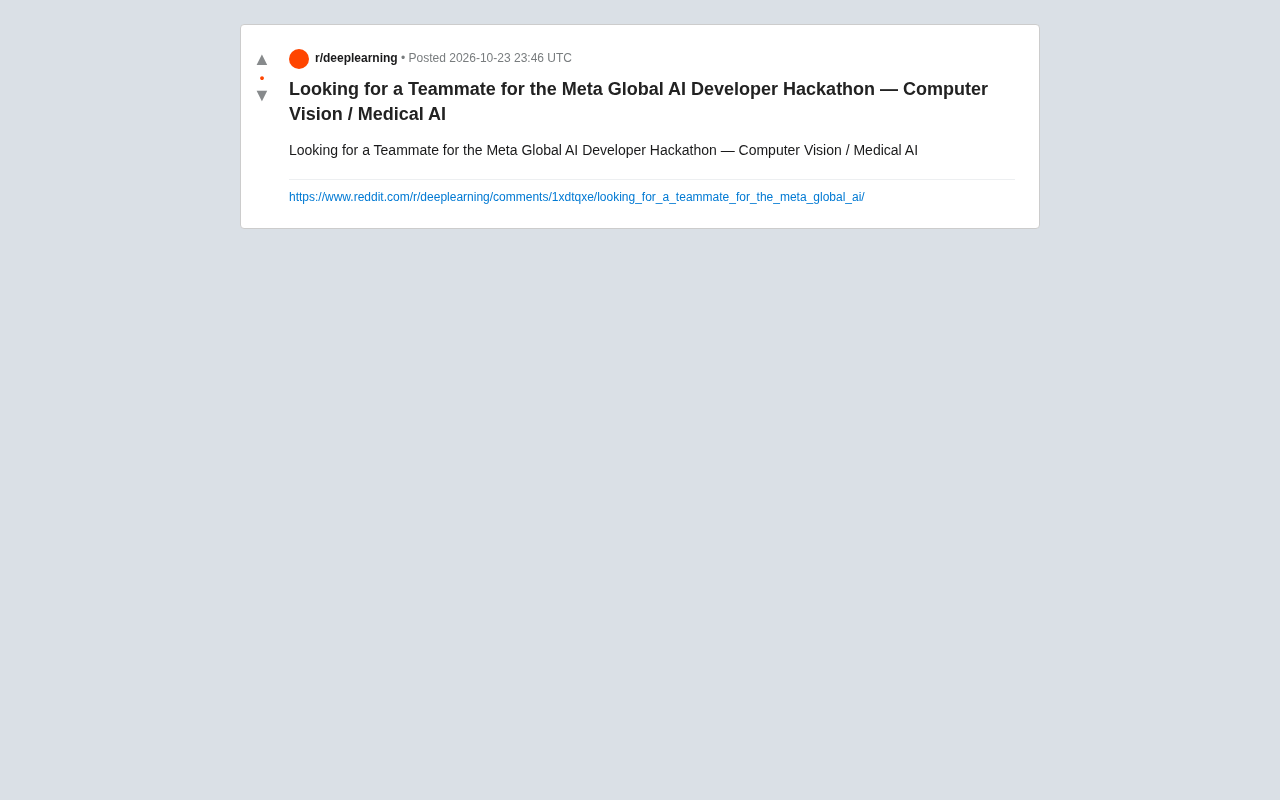
Teammate Wanted for Meta Global AI Developer Hackathon: Computer Vision & Medical AI
A Reddit developer seeks teammates for the Meta Global AI Developer Hackathon, focusing on computer vision and medical AI. This article analyzes the track logic, skills-complementarity needs, and topic selection strategy behind this teaming signal.
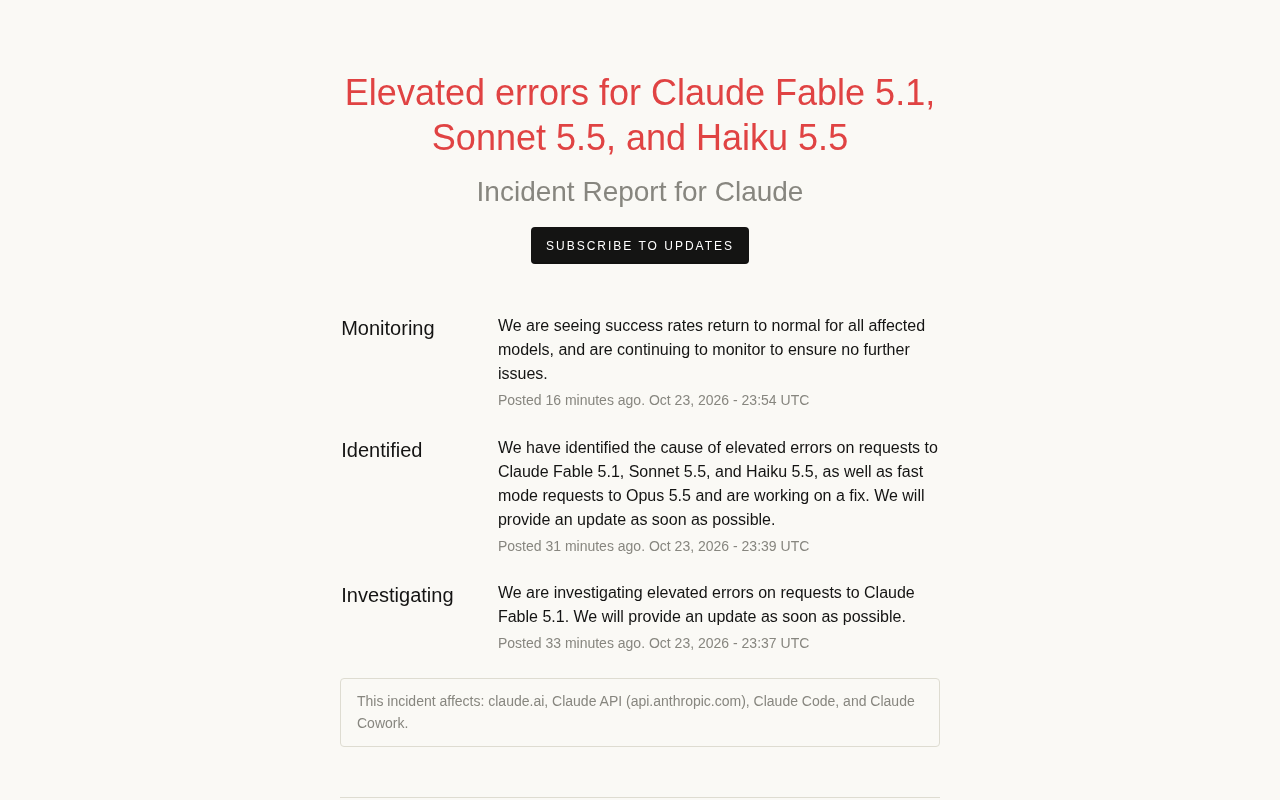
Multiple Claude Models Hit by Errors: A Postmortem of Fable 5.1, Sonnet 5.5, and Haiku 5.5
Claude Fable 5.1, Sonnet 5.5, Haiku 5.5, and Opus 5.5 fast mode saw elevated errors; Anthropic identified and resolved the issue in 17 minutes. This postmortem covers the timeline, the technical reasons for the multi-model cascading failure, and practical lessons for retry and degradation strategies.