Four Vendors Including Alibaba and Baidu Adjust LLM Pricing: Industry Price War Continues

Alibaba, Baidu, and two other vendors cut LLM prices as inference costs fall and ecosystem competition intensifies.
Alibaba, Baidu, Decart, and Wafer have all recently adjusted their LLM API pricing, reflecting deepening price competition across the industry. Advances in inference frameworks and model quantization continue to push down per-token costs, while the race to capture developer ecosystems and enterprise customers provides additional motivation to cut prices. Major cloud vendors have the ecosystem depth to sustain a prolonged price war; smaller players are largely playing defense. For end users, falling prices expand the economic viability of AI applications — though latency, capability, stability, and billing details all matter as much as the sticker price.
LLM Pricing Sees Another Round of Changes
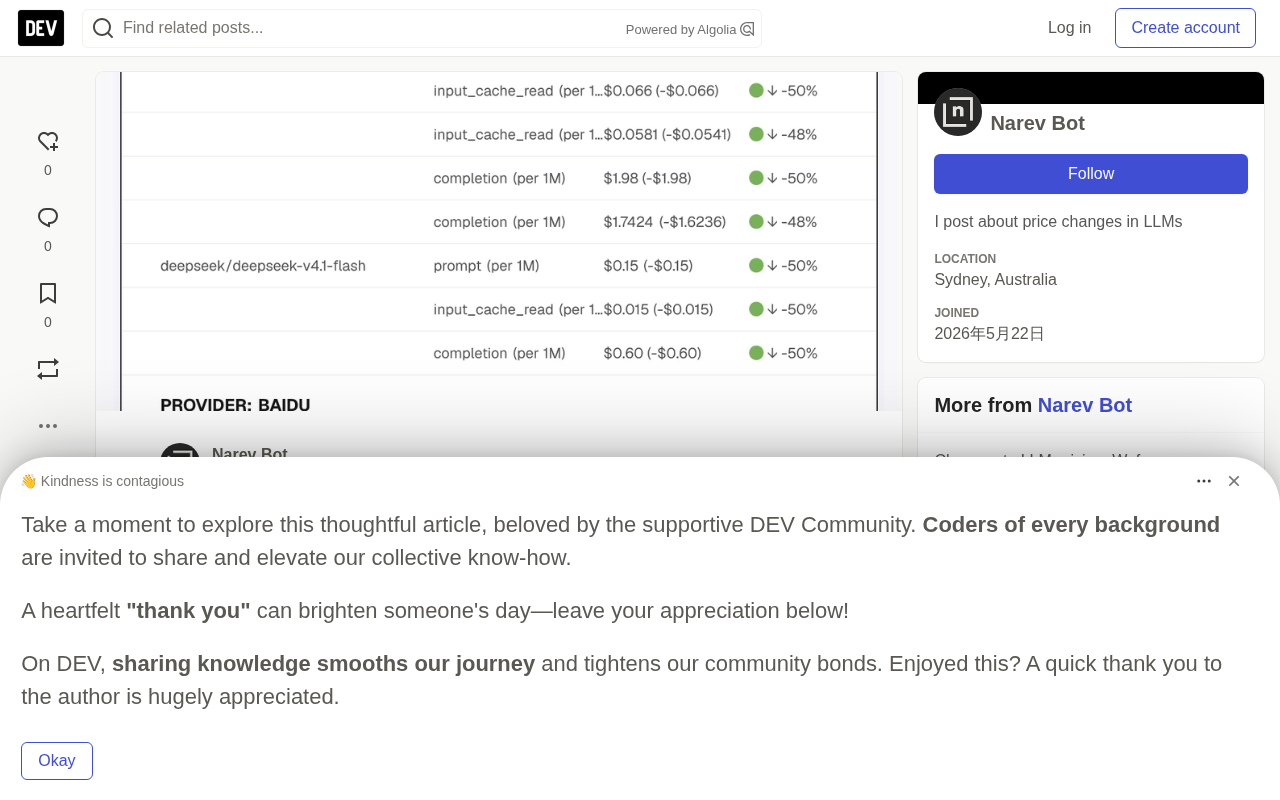
Recent monitoring data shows that four vendors — Alibaba, Baidu, Decart, and Wafer — have adjusted their large language model (LLM) pricing. The news has once again drawn the industry's attention to the intensifying price competition in the LLM market.
The source material only flags "detected model price changes" without disclosing specific adjustment figures or before-and-after comparisons. However, the mix of vendors involved is telling: it includes major Chinese cloud providers and model suppliers like Alibaba and Baidu, alongside smaller, more niche players like Decart and Wafer. This suggests that pricing pressure is no longer confined to the giants — it's spreading across the entire supply chain.
The Industry Logic Behind the Price Adjustments
Declining inference costs are the core driver behind this round of price changes. As model architectures have been optimized, inference frameworks improved, and compute scheduling made more efficient, the cost per token has dropped significantly — giving vendors room to lower their prices accordingly.
For Alibaba and Baidu, repricing isn't just a matter of passing on cost savings. It's also a market strategy. In China's LLM API market, price has become a key lever for winning over developers and enterprise customers. By offering more competitive rates, vendors aim to lock in higher call volumes during this ecosystem land-grab phase — spreading out infrastructure costs while building long-term customer stickiness.
Different Calculations for Leaders vs. Long-tail Players
Players like Alibaba and Baidu, which own their own compute infrastructure and run full cloud ecosystems, have the staying power to endure a prolonged price war. They can offset compressed API margins through adjacent businesses like cloud services and enterprise solutions.
Smaller participants like Decart and Wafer, on the other hand, are more likely following suit out of defensive necessity — the logic being "cut prices or get cut out." Without the benefit of scale, smaller vendors feel the squeeze much more acutely, and this dynamic may accelerate industry consolidation and shakeout.
Advances in inference frameworks have played a critical role here. High-performance inference engines like vLLM and TensorRT-LLM — leveraging techniques such as PagedAttention and Continuous Batching — have dramatically improved GPU memory utilization and throughput, allowing the same compute to serve far more concurrent requests. Meanwhile, model quantization compresses weights from FP16 down to INT8 or even INT4 precision, cutting memory usage roughly in half with minimal impact on output quality, further driving down the marginal cost per token. These technical breakthroughs are precisely why vendors can keep cutting prices without burning through their margins.
What This Means for Developers and Enterprise Users
For developers and enterprise users, continued price declines are unambiguously good news. Lower call costs enable AI features to be deployed at greater scale, and use cases that were previously shelved due to expense — such as long-document processing, bulk content generation, and large-scale Agent workflows — are becoming more economically viable.
That said, users shouldn't fixate solely on unit price when selecting a model provider. Latency, model capability, context window size, reliability, and the surrounding toolchain are equally critical factors that affect real-world performance and total cost of ownership. Price is just one dimension of the decision.
Pay Attention to the Actual Pricing Details
Since the available information amounts to little more than a price-change alert, it's worth checking official pricing pages and billing documentation carefully. Key details to verify include: separate rates for input vs. output tokens, whether pricing varies by model version, whether discounts apply for caching or batch processing, and whether tiered pricing is in effect. These specifics often have a greater impact on your actual bill than any headline "price cut" announcement.
Token-based billing is the foundational concept for understanding LLM pricing. Tokens are not equivalent to characters or words — they are the smallest semantic units a model processes. In English, roughly 4 characters map to 1 token; in Chinese, encoding differences mean that 1–2 characters typically map to 1–2 tokens, making Chinese generally less token-efficient than English. Most vendors price input tokens (prompt) and output tokens (completion) separately, with output typically costing 2–4× more than input, since the generation phase is computationally far more intensive than the prefill phase. Some vendors also offer Prompt Caching, which charges a reduced rate for repeated long prefixes — a feature that can meaningfully lower costs in Agent workflows or multi-turn conversation scenarios.
Conclusion
The latest pricing adjustments from Alibaba, Baidu, Decart, and Wafer are another marker of the LLM market entering a deeper, more competitive phase. As inference costs continue to decline, the price war shows no signs of abating in the near term — and the biggest beneficiaries remain developers and enterprise users. For market participants, the real challenge is finding a differentiated value proposition amid the broader downward pricing trend. That ability to stand apart will ultimately determine who survives and thrives in this competitive cycle.
Related articles

iPhone Duo Tips: An Essential Getting-Started Guide
iPhone Duo is Apple's all-new iPhone form factor with an obvious learning curve. This guide offers getting-started tips to help pre-order users adapt quickly.

Cursor AI Programming in Practice: Build a Student Management System from Scratch in 30 Minutes
A Bilibili creator demonstrates Cursor AI programming: generating a student management system in 30 minutes with natural language. Details on Agent mode, Claude selection, prompt techniques, and thresholds.

Top 20 AI Coding Tools Ranking: From Rock-Solid to Lackluster, a Scored Matrix
Bilibili creator releases top 20 AI coding tools ranking, tiered T0–T4 from rock-solid to lackluster, with Claude Code and Codex tied at T0. This article details the scoring dimensions (capability, reliability, robustness, durability, cost, domestic availability) and tool performances to help developers choose the right AI coding assistant.