FPV-CRASH: A Dataset for Localizing Crash Moments in Drone First-Person-View Video Released

FPV-CRASH releases the first drone FPV crash moment localization dataset, with a reference model halving MAE to 0.56 seconds.
FPV-CRASH is the first crash moment localization dataset and fixed-protocol benchmark for onboard drone FPV video, filling a gap in existing surveillance or dashcam datasets. It contains 1,052 clips (526 Crash, 526 Normal), each Crash clip with a single-frame timestamp annotation plus auto-generated captions for auxiliary text-to-video retrieval. The task regresses a single-frame crash moment from pure video input. The reference model estimates continuous timestamps from sparse frames via a heatmap, reducing MAE from 1.12s to 0.56s, with MedAE 0.33s and the 0.5s hit rate rising from 37.14% to 65.71%. The release includes annotations, source video URLs, split lists, and preprocessing code, enabling reproduction without redistributing original material.
FPV-CRASH: A Dataset for Localizing Crash Moments in Drone First-Person-View Video Released
In drone racing and freestyle flying, crashes often happen in the blink of an eye. When reviewing the footage afterward, the pilot's most pressing question is: "at exactly which frame did I lose control?" However, existing crash video datasets almost all come from surveillance cameras or dashcams, and their annotation schemes and task definitions are ill-suited to localizing the physical impact moment in onboard first-person-view (FPV) drone video.
To address this gap, researchers have released FPV-CRASH—a dataset and fixed-protocol evaluation benchmark for offline crash moment localization.
Task Definition: What Is Crash Moment Localization
Crash Moment Localization aims to identify, within onboard FPV drone video, the primary physical impact moment that interrupts controlled flight, thereby providing a temporal reference for post-hoc crash analysis of aerial robots.
The key difference between this task and generic video anomaly detection is that it requires single-frame-level timestamp regression rather than clip-level binary classification. Videos have only two label types—Crash or Normal—but Crash clips must provide a unique reference frame annotation. Normal clips carry no timestamp target and only supply background supervision signal during training.
At inference time, the input remains purely video-based, with no reliance on any text prompts—a point that is critical for real-world deployment.
The difference between single-frame-level timestamp regression and clip-level binary classification is not merely a change in output granularity, but a restructuring of the loss function and evaluation framework. Clip-level binary classification typically uses cross-entropy loss, with accuracy, F1, or AUC as evaluation metrics; timestamp regression, by contrast, requires modeling a continuous time axis, usually outputting a heatmap or probability distribution, then obtaining a scalar time via expectation or peak localization, with losses such as L1, L2, or KL divergence based on Gaussian soft labels. Evaluation shifts to MAE, MedAE, and hit rates "within a certain error threshold." This transition has two practical consequences: first, the model must be sensitive to temporal position, not just content category; second, annotation cost rises substantially, because each positive sample requires manual confirmation of a unique reference frame, whereas binary classification only needs to confirm whether a clip contains an event.
Dataset Composition and Annotation Scheme
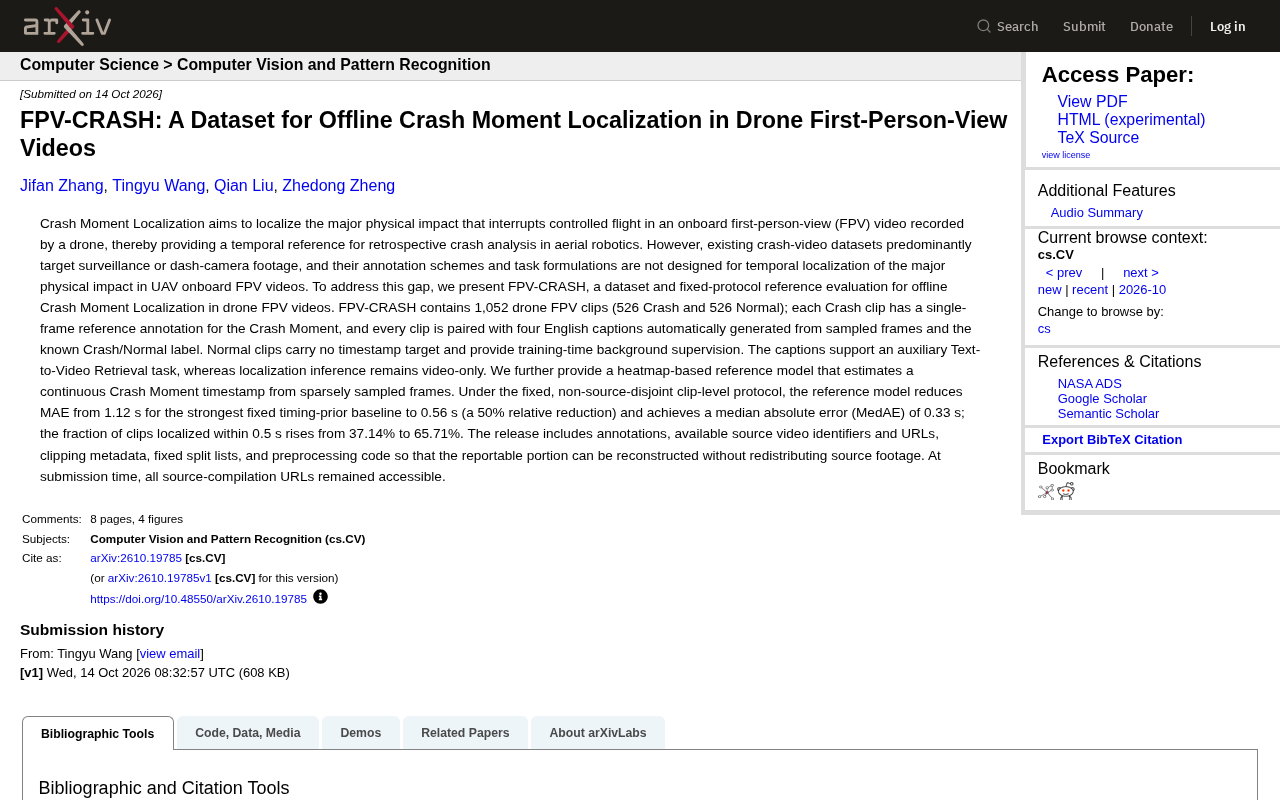
FPV-CRASH contains 1,052 drone FPV video clips in total, with 526 Crash and 526 Normal clips—perfectly balanced classes. Each Crash clip carries a single-frame reference annotation marking the crash moment.
A detail worth noting is the auxiliary annotation design: each video is accompanied by four English captions, automatically generated from sampled frames and the known Crash/Normal label. These captions support an auxiliary Text-to-Video Retrieval task, but the localization inference itself still uses only video—the captions are merely additional supervision during training and do not introduce a text shortcut at test time.
This "multimodal training, unimodal inference" design both leverages language signals to help the model learn more discriminative representations and avoids any dependence on text at inference time.
Text-to-Video Retrieval is a subtask of cross-modal retrieval: given a natural language description, find the semantically best-matching video clip from a video library. The typical approach maps both modalities into a shared embedding space using a text encoder and a video encoder respectively, then uses contrastive learning to pull matching pairs closer and push non-matching pairs apart. In FPV-CRASH, this auxiliary task is introduced not for retrieval itself, but to force the video encoder to learn representations aligned with language semantics during training. Since the captions are automatically generated from sampled frames and known labels, the language signal mainly provides "crash / normal" semantic contrast, helping the model distinguish the temporal patterns of the two motion classes. At inference, the text branch is removed, leaving only the video encoder and temporal localization head, so no dependence on text input arises.
Reference Model and Quantitative Results
The researchers provide a heatmap-based reference model that estimates a continuous crash timestamp from sparsely sampled frames.
Under the fixed, non-source-disjoint clip-level protocol, the results are as follows:
| Metric | Strongest fixed temporal prior baseline | FPV-CRASH reference model |
|---|---|---|
| MAE | 1.12 s | 0.56 s (50% relative reduction) |
| MedAE | — | 0.33 s |
| Hit rate within 0.5 s | 37.14% | 65.71% |
MAE halved, MedAE at 0.33 seconds, and the 0.5-second hit rate nearly doubled—demonstrating that the path of regressing continuous timestamps from sparse frames is viable in the FPV crash scenario.
One caveat is the "non-source-disjoint" protocol setting: the same source video may appear in both training and test splits, so the above numbers should be regarded as an upper-bound reference for a reference implementation rather than proof of cross-domain generalization.
Non-source-disjoint means the data split is not grouped by source video: different clips cut from the same original video may fall into training and test sets respectively. Because adjacent clips are highly similar in scene, lighting, and flight trajectory, the model may achieve inflated test performance by memorizing visual features of the source video. The opposing "source-disjoint" protocol requires all clips from the same source video to appear in only one split, more closely resembling cross-domain generalization. Thus, the MAE of 0.56 s under non-source-disjoint conditions should be understood as a reference upper bound within the same distribution; under a source-disjoint protocol, error typically rises. The paper explicitly notes this setting precisely so readers correctly interpret the scope of the numbers, rather than treating them as proof of the model's generalization to entirely new drones and entirely new scenes.
Reproducibility and Data Release Approach
The FPV-CRASH release includes annotation files, usable source video identifiers and URLs, clip metadata, fixed split lists, and preprocessing code.
The elegance of this release approach is that the parts needed for reporting can be reconstructed without redistributing the original video material, sidestepping copyright and storage issues. According to the paper, all compiled source video URLs were still accessible at submission time.
For teams working on aerial robot safety analysis, video temporal localization, or first-person-view vision research, this is a benchmark that can be picked up and reproduced directly.
Why This Dataset Is Worth Attention
Crash videos are inherently scarce and difficult to annotate—real crash footage often comes from individual pilot submissions, with severe viewpoint shake, heavy motion blur, and impact moments that may last only one or two frames.
FPV-CRASH advances the problem from "is this video a crash" to "at which frame did the crash occur." The task difficulty rises a notch, but it aligns more closely with engineering needs: accident investigation, flight controller log alignment, and insurance liability determination all require precise temporal anchors.
As drone autonomous flight and racing scenarios expand, specialized datasets targeting onboard first-person view may become infrastructure for safety analysis toolchains.
The core value of a fixed-protocol benchmark lies in comparability. If each research team splits data and defines evaluation metrics on its own, then MAE reported across different papers lacks comparability, and it becomes impossible to tell whether improvements come from the model or from a more favorable data split. FPV-CRASH provides fixed train/test split lists, a unified annotation format, and clearly defined evaluation metrics (MAE, MedAE, threshold hit rates), enabling subsequent work to be measured against the same yardstick. This design has precedents in video temporal localization—for example, ActivityNet and THUMOS standardized action localization. For a safety-critical task like crash analysis, a fixed protocol also reduces the risk of "good metrics but ineffective deployment," because all methods face the same test distribution and the same input constraints.
One-line Summary
FPV-CRASH releases the first drone FPV crash moment localization dataset, with a reference model halving MAE to 0.56 seconds.
Paragraph Summary
FPV-CRASH is the first crash moment localization dataset and fixed-protocol benchmark for onboard drone first-person-view video, filling the gap left by existing surveillance or dashcam datasets in task definition. The dataset contains 1,052 clips, with 526 Crash and 526 Normal clips, each Crash clip providing a single-frame timestamp annotation plus auto-generated English captions for auxiliary text-to-video retrieval. The task requires regressing a single-frame crash moment from pure video input rather than clip-level binary classification. The reference model estimates continuous timestamps from sparse frames via a heatmap, reducing MAE from 1.12 s to 0.56 s under a fixed non-source-disjoint protocol, with a MedAE of 0.33 s and the 0.5-second hit rate rising from 37.14% to 65.71%. The release includes annotations, source video URLs, split lists, and preprocessing code, allowing the reportable portion to be reproduced without redistributing the original material.
Related articles

AI Compute Is the New Oil, But the Market Mechanism Has Yet to Take Shape
Hacker News compares AI compute to the new oil, noting the lack of price discovery, concentrated supply, and no hedging tools. The article analyzes structural issues in compute trading and explores a possible three-tier market of spot, contracts, and derivatives, plus the real impact on AI practitioners' cost management.

Running Full iOS 16.5 Firmware on Android Devices: Technical Demo or Marketing Gimmick?
A Hacker News post claims full iOS 16.5 firmware can run on Android, with 315 upvotes. This analysis argues it is more likely a web UI simulation than a true firmware port, and explores the value and risks of such projects.

Etsy Cracks Down on AI Slop: Addressing Buyer and Seller Anxieties
Etsy introduces stricter rules limiting AI-generated content in listings, addressing buyer confusion over AI products and seller fears of original work being diluted by AI slop.