freddy.health: Talk to Your Health Data in Plain Language with AI

freddy.health uses MCP to connect wearables like Garmin and Oura to ChatGPT and Claude for natural language health queries.
freddy.health is a health data aggregation and AI conversation product that acts as a connectivity layer between wearable devices and AI tools. It supports over ten major platforms including Garmin, Oura, and WHOOP, routing sleep, HRV, recovery, and training data into ChatGPT and Claude via MCP. Users can ask questions in plain language instead of switching between apps, getting AI-driven insights from their actual personal data. The product targets quantified-self enthusiasts and athletes, uses an open architecture that isn't tied to any single AI platform, and addresses the long-standing pain point of fragmented health data — though data privacy merits close attention.
In an era of ubiquitous health tracking devices, many people wear a Garmin, Oura, or WHOOP on their wrist every day, generating vast amounts of sleep, heart rate variability (HRV), recovery, and activity data. But this data is often locked inside individual apps, nearly impossible to integrate across platforms — let alone use for deeper analysis. A product called freddy.health, featured on ProductHunt, takes a straightforward approach to solving this problem: connect your body data to AI so you can literally "have a conversation" with it.
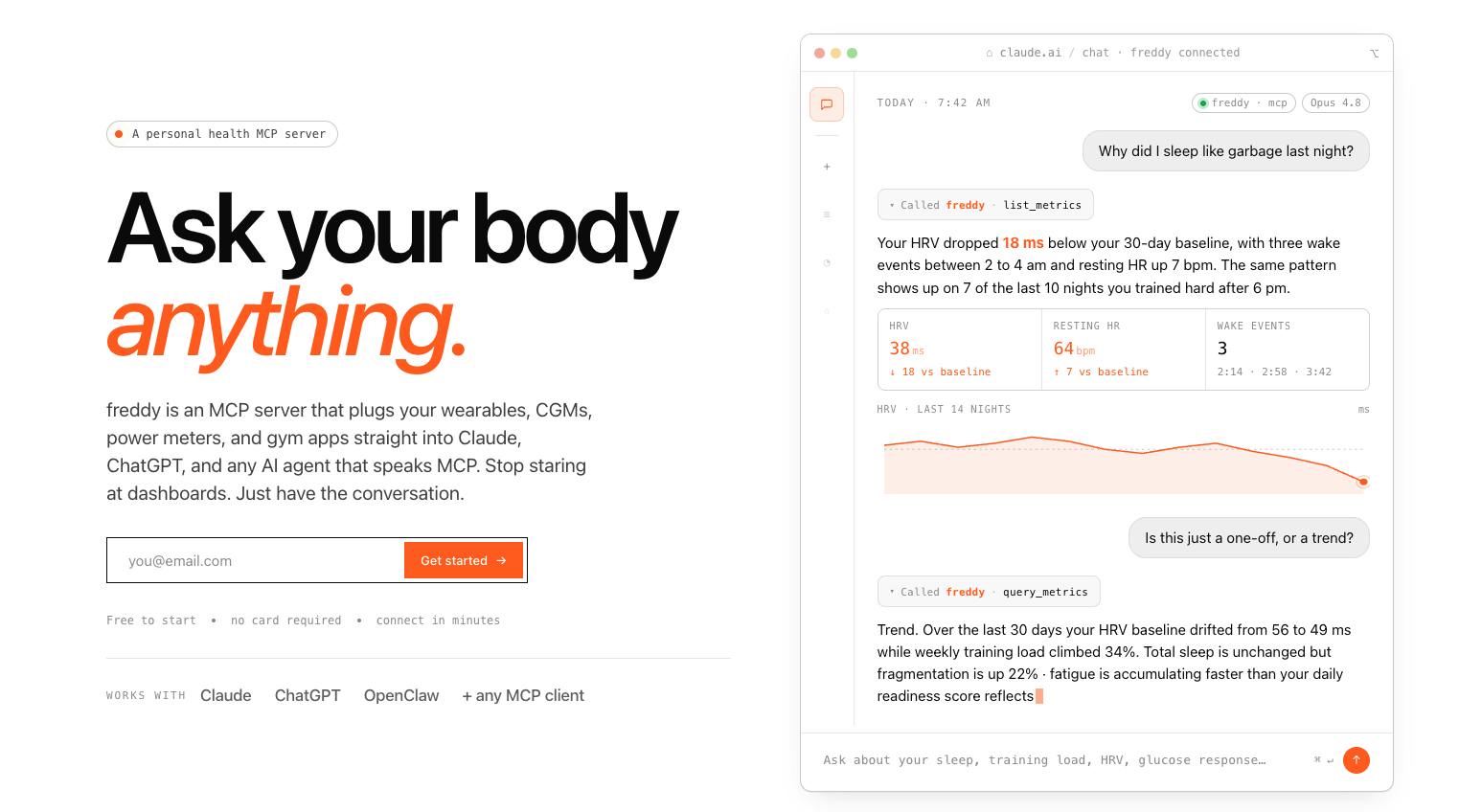
What It Actually Does
freddy.health positions itself as a connectivity layer. It bridges popular health and fitness tracking devices — including Garmin, Polar, Oura, Withings, Intervals.icu, Hevy, WHOOP, Suunto, and Concept2 — into AI tools like ChatGPT, Claude, Claude Code, or any AI client that supports MCP (Model Context Protocol).
In practice, this means you no longer need to jump between multiple apps to check your data. Instead, you can ask AI directly in natural language: "How was my sleep quality this week?" "Has my HRV been trending downward lately?" "How much did my strength training volume increase compared to last month?" The AI responds based on your actual wearable device data.
Built by Nick Payne and his team, the product earned 72 upvotes and 7 comments on ProductHunt, ranking 19th on the day — listed under Health & Fitness, Wearables, and Artificial Intelligence.
MCP Protocol Is the Key
The reason freddy.health can work with "any AI" comes down to its support for MCP (Model Context Protocol). MCP is a protocol that enables AI models to access external data sources and tools in a standardized way, and it's becoming a critical piece of infrastructure in the AI application ecosystem.
The significance of this design is that freddy.health doesn't lock itself to a single AI platform — it acts as an open data bridge. Whether users prefer Claude's reasoning capabilities, ChatGPT's ecosystem, or emerging tools like Muse, they can all connect to the same health data. This also reduces the risk of users being tied to any one platform.
The Value of Data Aggregation
Fragmented health data has been a persistent pain point. A serious athlete might use WHOOP to track recovery, Hevy to log strength training, Concept2 to record rowing sessions, and Oura to monitor sleep. These data silos make holistic analysis nearly impossible.
Once freddy.health aggregates all of this into a single AI-queryable layer, users can gain cross-device insights. For example, by combining sleep, HRV, and training load data, they can determine whether today calls for a hard effort or a recovery day — that's the real value of data integration.
MCP (Model Context Protocol) was introduced and open-sourced by Anthropic in late 2024. Its goal is to give AI models a unified way to call external data sources, APIs, and tools — similar to the role USB-C plays as a universal connector in hardware. Before MCP, every AI application that wanted to access external data had to build a separate integration layer for each platform, which was expensive to maintain. By defining standardized "tool call" and "resource read" interfaces, MCP allows the same data connectors to be used directly by any MCP-compatible AI client (such as Claude Desktop, Cursor, or certain ChatGPT plugins). For products like freddy.health, this means implementing the MCP server once and instantly supporting all compatible AI front-ends, without maintaining separate integrations for each platform.
HRV (Heart Rate Variability) is a key indicator of autonomic nervous system status, reflecting the variation in time intervals between consecutive heartbeats. Higher HRV generally indicates better recovery and lower stress levels; a sustained drop in HRV may signal overtraining, insufficient sleep, or accumulated physical stress. Devices like Oura and WHOOP collect HRV data during nighttime sleep and combine it with sleep stages, resting heart rate, and other metrics to generate a composite recovery score. Comparing HRV trends against actual training load is a common method in sports science for assessing training adaptability — but this kind of cross-platform correlation analysis previously required manually exporting CSV files. The AI query layer that freddy.health provides is designed precisely to address this pain point.
Who It's For
The most immediate audience for this product is "quantified self" enthusiasts and athletes who already rely heavily on wearable devices and are comfortable using AI assistants for everyday tasks. For them, turning health data into a conversational format significantly lowers the barrier to analysis.
For more casual users, this approach could also offer a new kind of health management experience — no need to decode complex charts; just ask a question and get an AI interpretation based on your personal data.
That said, health data is highly sensitive. When connecting it to third-party AI services, users should pay close attention to data privacy, storage practices, and authorization mechanisms. The product page currently emphasizes features and the breadth of supported devices, and the specifics of its privacy protections will need to be examined more closely in actual use.
Closing Thoughts
freddy.health sits at the intersection of two major trends: the explosive growth of wearable health data, and the standardization of AI tool interoperability represented by MCP. Rather than building yet another health app, it does something smarter — it brings the data you already have to life inside the AI tools you're already using. This "connect rather than replace" product philosophy carries real practical value in an era where AI applications are becoming increasingly fragmented.
Related articles

iPhone Duo Tips: An Essential Getting-Started Guide
iPhone Duo is Apple's all-new iPhone form factor with an obvious learning curve. This guide offers getting-started tips to help pre-order users adapt quickly.

Cursor AI Programming in Practice: Build a Student Management System from Scratch in 30 Minutes
A Bilibili creator demonstrates Cursor AI programming: generating a student management system in 30 minutes with natural language. Details on Agent mode, Claude selection, prompt techniques, and thresholds.

Top 20 AI Coding Tools Ranking: From Rock-Solid to Lackluster, a Scored Matrix
Bilibili creator releases top 20 AI coding tools ranking, tiered T0–T4 from rock-solid to lackluster, with Claude Code and Codex tied at T0. This article details the scoring dimensions (capability, reliability, robustness, durability, cost, domestic availability) and tool performances to help developers choose the right AI coding assistant.