From AI to SI: The Debate and Discussion Around 'Superintelligence' as a Label

A Reddit joke about OpenAI becoming OpenSI reveals deep public anxieties about AI jargon, politics, and regulation.
A Reddit post asking when OpenAI would rename itself to OpenSI sparked wide discussion that, beneath the jokes, raised serious issues. The satirical "AI → Superintelligence → Supreme Fascist" escalation chain reflects public wariness of inflated AI terminology and marketing hype, while comments linking AI tools to figures like Trump and Boris Johnson highlight the growing politicization of AI narratives. The thread also touched on whether governments can legally "regulate words," with commenters invoking the First Amendment to distinguish official document guidelines from restrictions on public speech. The real value of such community discussions, the article argues, is as a public mood barometer — when "superintelligence" is used casually and politically, the industry should reflect on how its language shapes public perception.
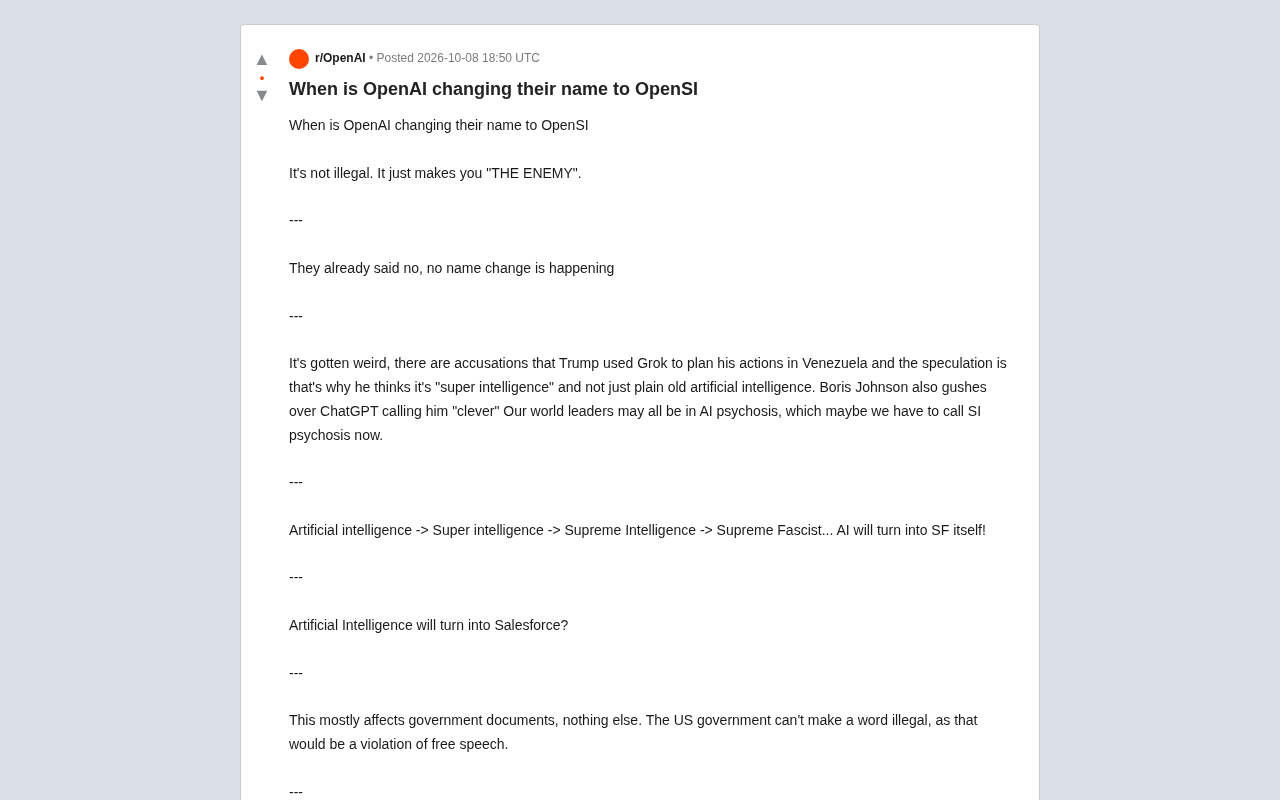
A seemingly tongue-in-cheek Reddit post — "When is OpenAI changing their name to OpenSI?" — sparked a broader conversation about the naming battle between "Artificial Intelligence" (AI) and "Super Intelligence" (SI). Behind this viral exchange lies a complex web of public sentiment about industry jargon inflation, the politicization of AI, and the boundaries of regulation and free speech.
A Joke With a Serious Undercurrent
The post opened with an obvious note of sarcasm — someone questioning whether OpenAI would rebrand from "Artificial Intelligence" to "Super Intelligence." The joke didn't come out of nowhere. In recent years, the term "Superintelligence" has been invoked with increasing frequency. Some practitioners and public figures have begun using it to describe a leap in AI capabilities, no longer content with the comparatively conservative framing of "artificial intelligence."
One commenter cut straight to it: "They've already said they won't — there's no rename happening." This suggests the naming speculation existed largely at the level of public discourse, not as any actual corporate plan. But the fact that the topic gained traction at all says something important: the choice of terminology has itself become a form of taking sides.
The Upgrade Chain: Satire and Anxiety
One thread of the discussion produced a darkly humorous "escalation chain": Artificial Intelligence → Super Intelligence → Supreme Intelligence → Supreme Fascist. Others joked about whether AI would eventually "turn into Salesforce."
These quips may seem absurd, but they reflect a genuine public anxiety: when technical terminology is endlessly inflated and loaded with ever-grander meaning, people start to wonder whether this reflects real technological progress or just successive layers of marketing spin. "Superintelligence" sounds more striking than "artificial intelligence," but it's also far more susceptible to drifting away from technical reality and sliding into ideologically charged rhetoric.
The concept of "Superintelligence" was first systematically articulated by philosopher Nick Bostrom in his 2014 book of the same name, referring to a hypothetical agent that surpasses human cognitive abilities across virtually every domain. Related to this is Artificial General Intelligence (AGI) — an AI system capable of performing any intellectual task a human can — which is typically seen as the precursor stage to superintelligence. In recent years, leading organizations like OpenAI and DeepMind have begun using AGI and even "superintelligence" in official communications, treating them as near-term milestones rather than distant science fiction. This terminological upgrade carries strategic weight: it attracts capital attention, sets the frame for regulatory negotiations, and conveys a narrative of technological inevitability to the public. Critics therefore argue that "superintelligence," in its current context, functions more as a branding and agenda-setting tool than as an accurate description of the present state of the technology.
The Politicization of AI Narratives
The most contentious part of the discussion involved linking AI terminology to real political figures. Some comments referenced allegations about Donald Trump using Grok to "plan actions," speculating on why someone might prefer the label "superintelligence" over plain "artificial intelligence" to describe such tools. Others noted Boris Johnson's apparent satisfaction at being told by ChatGPT that he was "intelligent."
This gave rise to a sardonic observation: "World leaders may all be suffering from AI psychosis — and now maybe we need to call it SI psychosis."
It bears emphasizing that these are individual Reddit users' personal opinions and unverified speculation, not established facts. But they reveal something worth noting: AI is evolving from a purely technical topic into a vehicle for political narratives and public emotion. When decision-makers publicly express reliance on or admiration for AI tools, it's natural for the public to become alert to the role of technology in the exercise of power.
Regulation, Free Speech, and "Policing Words"
Another valuable thread in the discussion touched on the boundary between regulation and free speech. One commenter argued: "This mainly affects government documents — everything else is unaffected. The U.S. government cannot make a word illegal; that would violate free speech."
When someone challenged this with "Have you been living under a rock?", the response was: "I actually read the White House memo, and I've read the U.S. Constitution." This exchange gets at a key question: whether, and to what extent, governments can regulate the use of AI-related terminology.
From a legal standpoint, a government standardizing the language in official documents is a fundamentally different matter from restricting public speech. The former falls within the scope of internal administrative management; the latter is protected by the First Amendment. This distinction is frequently blurred in public debates about AI regulation — and understanding it clearly is essential to thinking rationally about AI policy.
The "White House memo" referenced in the discussion likely refers to a series of executive orders signed by the Trump administration in early 2025, including directives requiring federal agencies to adjust AI-related language in official documents — for example, removing phrases like "AI safety" that were deemed to carry a particular political valence. Such administrative interventions are not without historical precedent: by controlling the linguistic framing within the bureaucratic apparatus, governments can shape policy direction and public discourse without going through the legislative process. The First Amendment explicitly prohibits Congress from enacting laws that restrict freedom of speech, but its scope primarily applies to government restrictions on citizens' expression — it does not constrain the government from regulating the language its own employees use or that appears in official documents. There is therefore a fundamental difference between internal agency terminology directives and "making a word illegal," and conflating the two in public debate often amplifies unnecessary alarm.
What This Online Debate Actually Reveals
This discussion — sparked by the joke of OpenAI renaming itself OpenSI — may have started as a gag, but it touched on several genuinely real issues: the inflation and proliferation of technical terminology, the politicization of AI narratives, and the tension between regulation and free speech.
For readers who follow AI development, the value of these kinds of community discussions lies not in their conclusions — much of the content is satire and unverified speculation — but in what they reveal as a barometer of public sentiment. When a term like "superintelligence" starts to be used casually, politicized, and deployed to express anxiety or irony, perhaps the entire industry should step back and ask: what kind of language are we actually using to describe this technology — and what kind of public understanding is that language shaping?
Related articles

AI Compute Is the New Oil, But the Market Mechanism Has Yet to Take Shape
Hacker News compares AI compute to the new oil, noting the lack of price discovery, concentrated supply, and no hedging tools. The article analyzes structural issues in compute trading and explores a possible three-tier market of spot, contracts, and derivatives, plus the real impact on AI practitioners' cost management.

Running Full iOS 16.5 Firmware on Android Devices: Technical Demo or Marketing Gimmick?
A Hacker News post claims full iOS 16.5 firmware can run on Android, with 315 upvotes. This analysis argues it is more likely a web UI simulation than a true firmware port, and explores the value and risks of such projects.

Etsy Cracks Down on AI Slop: Addressing Buyer and Seller Anxieties
Etsy introduces stricter rules limiting AI-generated content in listings, addressing buyer confusion over AI products and seller fears of original work being diluted by AI slop.