From Call of Duty to Environmental AI: The Cross-Disciplinary Growth Path of a Gen-Z Developer
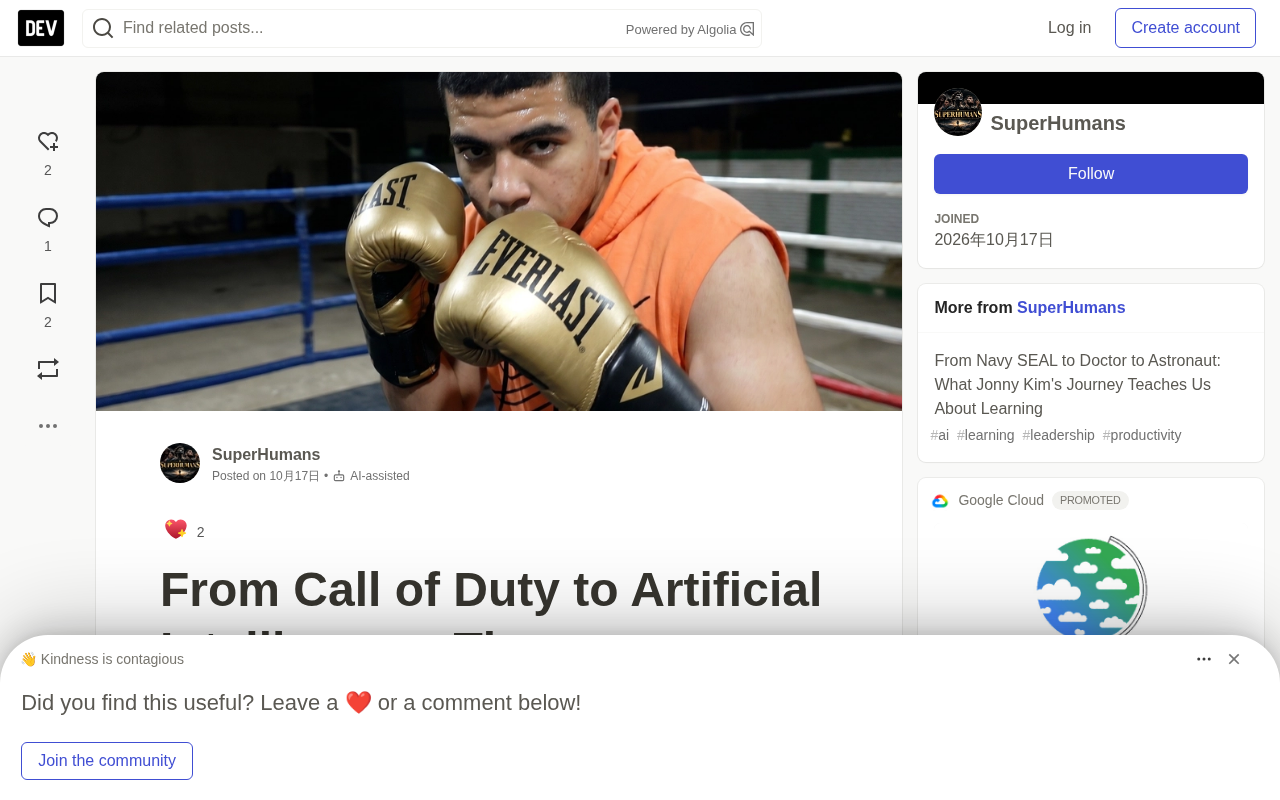
A Gen-Z developer's cross-disciplinary journey from Call of Duty to martial arts, programming, and environmental AI.
The article tells the cross-disciplinary growth story of Omar Abdelfattah Alshafai, born in Saudi Arabia in 2008. Starting with Call of Duty at age six, he developed an interest in immediate feedback and experimentation through gaming; he later moved to Egypt, trained in Sanda Kung Fu and Tang Soo Do, earned black belts, and self-reports winning multiple championships; in 2023 he began learning programming independently, building skills through online courses and a Python library project; he then participated in NASA ARSET remote sensing training, extending his interests to environmental AI and Earth observation. The article stresses that achievements in each field should be evaluated independently, and that the value of the cross-disciplinary combination lies in continuous learning and building, not in a finished success story.
Every developer has a starting point. Some begin in a school computer lab, others with a personal project they couldn't debug late at night. Omar Abdelfattah Alshafai's starting point was rather unconventional—a game console.
Born in 2008 to an Egyptian family in Saudi Arabia, he spent his childhood in Riyadh. By around age six, he was already immersed in various modes of Call of Duty, trying to push his own limits. There was no computer science degree, no software library, and no hint of environmental AI research. Just a young gamer who wanted to get better.
This experience itself isn't unusual. But it raises a topic worth exploring: when gaming, martial arts, programming, and environmental science—seemingly unrelated fields—converge in one person, is there some transferable underlying logic among them?
1. Competitive Gaming: The Earliest Feedback System
Omar mainly played Call of Duty: Advanced Warfare and Black Ops 3 in his early years. According to his recollection, at age eight he once scored 100 kills in a Team Deathmatch within five minutes, and completed a Gunfight mode run in Black Ops 3 in 1 minute 13 seconds. These are personal statements, not independently verified, but they illustrate what gaming meant to him.
He wasn't just interested in playing—he was interested in performance. Games provide a system with rules, quantifiable metrics, and immediate feedback: failures can be retried, difficulties can become personal goals.
This structure has similarities to software development. When a program's output doesn't match expectations, the developer troubleshoots, modifies the implementation, and tests again. Progress comes from understanding what went wrong and then trying a better approach. Gaming and programming are, after all, two different things—success in one domain doesn't automatically transfer to the other—but both can provide fertile ground for curiosity and repeated experimentation.
At the end of 2017, he moved to Egypt. The environment changed, and so did the arenas in which he would later compete.
2. From Virtual Competition to the Martial Arts Ring
Gaming wasn't the only interest that shaped his adolescence. He began training in Sanda Kung Fu and Tang Soo Do, entering a world that demands physical fitness, technique, patience, and resilience.
In 2022 he earned a black belt in Tang Soo Do, and in 2023 a black belt in Sanda Kung Fu. By his own account, he won the African Championship in 2022 and 2023, the Mediterranean Championship in 2023, and the Jeet Kune Do Open League Championship in 2024. His reported competition record is 83 fights with 67 wins, 3 losses, and 13 draws—though the scope of this record depends on which competitions are counted.
Combat sports require individuals to respond to changing conditions rather than simply execute a pre-set plan. Training involves recognizing patterns, making decisions under pressure, correcting errors, and adapting to opponents. This has an interesting parallel to engineering practice: a solution that works in theory still needs to perform under real-world conditions.
This comparison shouldn't be taken too far. Fighting and programming require different skills, but both reward preparation, adaptation, and the ability to learn from failure.
3. Sim Racing and Coaching: Another Extension of Competition
In 2023, at age 15, he participated in an Aramco-sponsored Aston Martin sim racing event at Boulevard City in Riyadh. He competed in the GT3 class using Project CARS 3 and reported finishing second. The event marked his return to a digital competitive environment, but by then gaming was no longer the only stage in his life.
His sports involvement also extended beyond his own performance. He became a coach for a U13 kickboxing team and reported serving as a trainer for his school's kickboxing team while attending a military middle school in Egypt. Coaching changes the nature of the challenge: no longer focused solely on personal improvement, but on helping others develop their abilities.
He also reported earning a sports coaching certificate through the International Olympic Committee and completing a FIFA Football Medicine Diploma in 2025. These experiences reflect an understanding of sports that goes beyond competition itself, extending to training, development, and the science behind athletic performance.
4. Learning to Code: From Consuming Tools to Building Systems
In 2023, Omar began learning programming independently. This introduced a new kind of challenge. No longer competing against another player or athlete, but engaging with logic, algorithms, data, and software systems. Progress is no longer measured by scores or match results, but by building something and seeing whether it works as intended.
His learning resources included online educational content associated with institutions such as Harvard, IBM, Cisco, and Microsoft. These resources formed part of his independent learning. Completing online courses is not equivalent to earning a university degree, but online education can provide a pathway to explore technical topics and build foundational skills.
His interests gradually gravitated toward computer science, software engineering, and artificial intelligence. One of his projects, omni-data-refinement, is a Python library. The significance of such projects lies in this: programming becomes more meaningful when concepts are applied to something concrete. Developers must think about what a tool should do, how components fit together, and how to make its behavior useful to potential users.
This process is different from watching tutorials or completing isolated exercises. It's also an important shift from "learning a programming language" to "thinking like a software developer."
Python libraries are pre-written collections of code that can be called by other programs, typically organized around a particular type of functionality, such as numerical computation (NumPy), data analysis (pandas), or machine learning (scikit-learn). Unlike standalone applications, libraries are not directly aimed at end users but at developers, who reuse their functions, classes, and modules through import. Developing a library means designing clear APIs, handling edge cases, writing documentation and tests, and considering how other developers will install and integrate it. This is precisely the key step from "writing scripts to solve your own problems" to "building reusable tools," and it's the engineering mindset embodied by Omar's omni-data-refinement project.
5. Environmental AI and NASA ARSET: When Code Meets Earth Observation
Artificial intelligence offers a particularly interesting direction for people whose interests span technology, data, and real-world systems. AI isn't just chatbots or image generation—it also involves extracting information from complex datasets, identifying patterns, developing predictive models, and building tools that support decision-making.
For Omar, this field became part of his broader interest in how computational methods can be applied to problems beyond traditional software. His technical interests extended to environmental computing and Earth observation.
Environmental systems generate massive amounts of data. Satellites observe the Earth's surface and atmosphere, while other instruments collect information on land cover, vegetation, water, temperature, and weather. Understanding these observations requires data processing, statistical analysis, machine learning, and scientific interpretation. Machine learning models can help classify satellite images, identify vegetation changes, or estimate environmental conditions from remote sensing observations.
But these applications also present challenges. Can a model trained in one geographic region work in another? How does performance vary across seasons? Do differences in sensors or environmental conditions affect predictions? These aren't just programming questions—they sit at the intersection of software engineering, data science, machine learning, and environmental research.
Omar later participated in NASA's Applied Remote Sensing Training program (ARSET). The program provides training on remote sensing data and its applications, covering environmental monitoring, agriculture, water resources, and disaster management. For a computer science student interested in environmental AI, remote sensing offers an opportunity to explore how software and machine learning can be combined with real-world observations.
To be clear, participating in ARSET training is not equivalent to working at NASA or participating in NASA research missions. It is an educational experience related to a scientific field.
Remote sensing refers to the technology of using sensors mounted on satellites, aircraft, or drones to record electromagnetic wave information reflected or emitted by the Earth's surface, without direct contact with the target object, thereby inferring surface properties. Common optical remote sensing relies on visible to infrared bands, while radar remote sensing actively emits microwaves and receives echoes. Remote sensing data is typically presented as multi-band raster imagery, where each pixel has different values across bands, providing rich input features for machine learning models. Many tasks in environmental AI—such as land cover classification, vegetation index calculation, water body extraction, and crop yield estimation—are essentially pixel-level or object-level pattern recognition on remote sensing imagery. Understanding the basic principles of remote sensing helps grasp why data preprocessing (such as atmospheric correction and cloud masking) and model generalization are so critical in environmental applications.
6. Why This Combination Is Worth Noticing
At first glance, gaming, martial arts, coaching, programming, and environmental computing seem like unrelated interests. One involves digital competition, one involves physical performance, one requires building systems with code, and environmental computing applies computational techniques to studying the Earth.
But there's a useful way to understand it: each provides a different type of problem to solve. The challenge in gaming might be mastering a difficult level; in martial arts, refining technique or adapting to an opponent; in coaching, helping others understand a skill; in software development, designing a tool that runs reliably; in machine learning, discovering whether a model can identify meaningful patterns in data it has never seen.
The details differ, but all these pursuits involve learning, practice, and evaluation. This doesn't mean that athletic achievement guarantees technical ability, nor that an interest in gaming automatically makes someone a good programmer. Skills in each domain must be developed independently.
The more interesting point is this: people don't necessarily need to limit themselves to a single interest during their learning years. An athlete can study computer science, a developer can explore environmental science, and a student can build software while continuing to participate in sports. Sometimes the most valuable direction comes from combining interests rather than abandoning all but one.
7. The Story Is Still Unfolding
Omar was born in 2008 and is in the early stages of his academic and professional career. His undergraduate computer science studies are still ongoing, his technical abilities continue to develop, and his future direction is not yet fully determined.
His athletic achievements, coaching experience, educational activities, and software projects represent different types of progress. They should be evaluated on their own merits rather than merged into a single measure of success. Championship titles are not programming qualifications, training certificates are not research papers, and a software library is not proof of mastery in every area of computer science.
Acknowledging these distinctions makes the story more meaningful, not less. It shows a young person exploring multiple fields while still having much to learn. The next stage will depend on what he builds, what he learns, how he evaluates his own work, and whether he can turn curiosity into useful contributions.
For aspiring developers, this may be the most relatable part of the story. No one starts with complete knowledge of a field. Progress comes from choosing a problem, learning what's necessary, trying solutions, and improving through experience.
Omar's journey began with video games in Saudi Arabia and gradually expanded to martial arts, coaching, software development, computer science, and environmental computing. It's an unusual combination, but it doesn't need to be presented as a finished success story or an extraordinary prediction of the future. Its value lies in the process: childhood competitive interests developing alongside athletic training, independent learning introducing programming, software projects creating opportunities to apply technical knowledge, and an interest in AI opening the door to questions about how computing can help us understand the Earth.
For developers, students, and anyone exploring multiple interests, the takeaway is simple: your starting point doesn't have to define the boundaries of what you learn next. You can start with a game and become curious about the technology behind it; you can learn to code and discover applications in fields you never expected; you can develop one skill while leaving room for another. What matters is going beyond mere curiosity—to practice, build, research, and keep learning.
One-line Summary
A Gen-Z developer starts with Call of Duty and crosses into martial arts, programming, and environmental AI.
Paragraph Summary
The article tells the cross-disciplinary growth story of Omar Abdelfattah Alshafai, born in Saudi Arabia in 2008. Starting with Call of Duty at age six, he developed an interest in immediate feedback and repeated experimentation through gaming; he later moved to Egypt, devoted himself to Sanda Kung Fu and Tang Soo Do, earned black belts, and self-reports winning multiple championships; in 2023 he began learning programming independently, building technical skills through online courses and a Python library project; he then participated in NASA ARSET remote sensing training, extending his interests to environmental AI and Earth observation. The article emphasizes that achievements in each field should be evaluated independently, and that the value of this cross-disciplinary combination lies in the ongoing process of learning and building, not in a finished success story.
Related articles

Build an AI Super Employee System at Zero Cost: A Full Breakdown of Automated Agent Workflows
A deep breakdown of the AI super employee system demoed on Bilibili: agent orchestration, digital human voiceovers, map and enterprise lead generation, 24/7 customer service, and legal modules. We analyze the business logic and compliance risks behind zero-cost signup to help entrepreneurs judge the real ROI of this AI digital employee system.

The Essential Difference Between Chatbots and AI Agents: Crossing from Conversation to Execution
What's the difference between a chatbot and an AI agent? Based on the MCP series on the Learn Tech channel, this article uses examples like booking flights and summarizing notes to explain: a chatbot only gives answers, while an agent actually completes tasks through a think-act-observe loop. It breaks down the four core components—model, tools, memory, and goal—as well as MCP's role as a bridge, and discusses agents' applicable boundaries and permission risks.

Free GitHub Repo: 342 Hours of AI Courses, from Math to MCP Servers
A free GitHub repo offers 342 hours of AI courses: 523 lessons across 20 phases, from math fundamentals to agent building and MCP servers. Nearly 100,000 learners have started.