From Coding Agents to Company OS: The Evolution Path of AI Agents
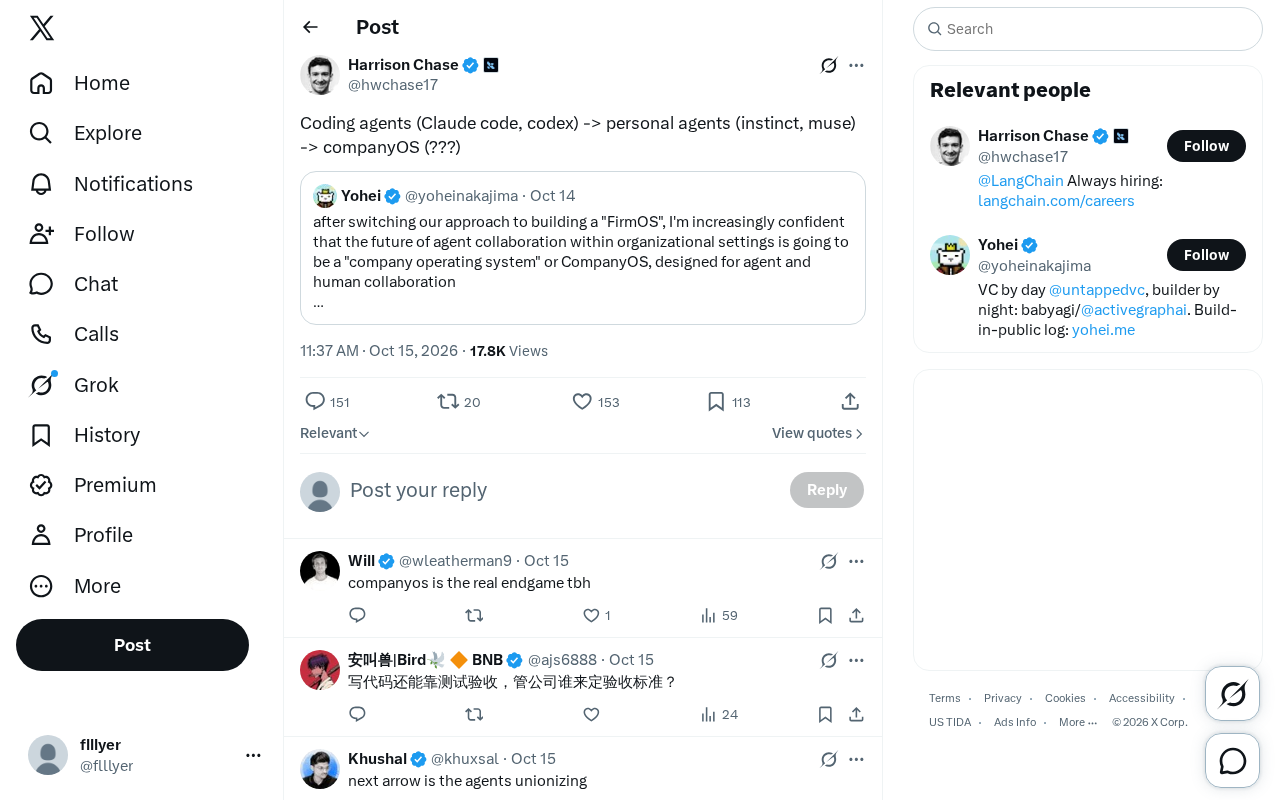
AI agents are evolving along a three-phase path: coding agents, personal agents, and Company OS, with multi-agent collaboration reliability as the biggest bottleneck.
Based on an evolutionary framework from a tweet, the article analyzes the three-phase path of AI agents from coding tools to organizational operating systems. Phase 1 coding agents (e.g., Claude Code, Codex) matured first due to clear feedback signals and became daily tools; Phase 2 personal agents (e.g., Instinct, Muse) attempt to handle open-domain personal affairs, facing task ambiguity, privacy, and personalization challenges, with the core being a shift from 'tool' to 'partner'; Phase 3 Company OS remains a vision, requiring integration of various agents and business systems but limited by organizational data complexity, permission security, multi-agent collaboration reliability, and human trust. The evolution follows a logic from closed to open and from individual to organization, with key variables including model reasoning capabilities, standardization of agent communication protocols, security alignment technologies, and organizational acceptance. The article concludes with suggestions for developers and enterprises to monitor toolchain changes and plan ahead for agent governance.
AI agents are evolving from simple coding assistants into platforms capable of reshaping how entire companies operate. A tweet succinctly outlined this trend: Coding agents (Claude code, codex) -> personal agents (instinct, muse) -> companyOS (???). Though brief, the tweet reveals an evolutionary logic worth exploring in depth — from specialized tasks to personal assistants, and then to organizational-level operating systems.
Phase 1: The Rise of Coding Agents
Claude Code and Codex represent the most mature form of current AI agents. They focus on software development scenarios, capable of understanding codebases, generating code snippets, debugging issues, and even completing end-to-end development tasks. The core value of such agents lies in translating natural language intent into executable code, significantly lowering the barrier to programming.
Coding agents matured first because the code domain offers clear feedback signals (compilation success, test passage) and a structured knowledge system. Developers can quickly verify agent output, forming a human-AI collaboration loop. This accumulated important technical foundations and user trust for more general agents later.
According to the tweet author, coding agents have crossed the "usable" threshold and are becoming daily tools for many developers. But their limitations are also obvious: their scope is confined to code and cannot handle broader personal or organizational tasks.
Technical Background of Claude Code and Codex: Claude Code is a command-line coding agent launched by Anthropic in late 2024. It calls Claude models via the Anthropic API, runs in the local terminal, and can read files, execute commands, run tests, and iteratively modify code based on feedback. Codex is a series of code generation models launched earlier by OpenAI, later integrated into products like GitHub Copilot. Although different in form, both combine the reasoning capabilities of large language models with code execution environments to form a "generate-verify-correct" loop. This loop relies on sandbox execution and tool use mechanisms, enabling agents to act autonomously in real engineering environments rather than just generating static text. Understanding this technical architecture helps grasp why coding scenarios became the first breakthrough point for agent deployment.
Phase 2: Exploring Personal Agents
The Instinct and Muse mentioned in the tweet point to the next wave — personal agents. These agents are no longer limited to programming but attempt to become general-purpose personal assistants, handling scheduling, information retrieval, task automation, and other daily affairs.
The challenge of personal agents lies in the ambiguity of open-domain tasks. Unlike code, personal affairs often lack clear success criteria and involve privacy, permissions, and personalized preferences. Products like Instinct and Muse are trying to break through these bottlenecks through memory mechanisms, context understanding, and proactive suggestions.
Agents at this stage need to build an understanding of users' long-term preferences and intervene proactively when appropriate. The leap from coding agents to personal agents is essentially a shift from "tool" to "partner" — agents need more autonomy and situational awareness.
Phase 3: The Unknown Frontier of Company OS
The tweet ends with "companyOS (???)," leaving the biggest悬念. Company OS (Company Operating System) suggests a vision: AI agents are no longer just personal tools but become the coordination layer of the entire organization, connecting departments, processes, and systems.
It is imaginable that Company OS will integrate coding agents (technical teams), personal agents (individual employees), and various business systems into a unified intelligent hub. It may handle resource scheduling, decision support, cross-team collaboration, and even automate some management functions. But realizing this phase faces enormous challenges: the complexity of organizational data, permissions and security, the reliability of multi-agent collaboration, and human trust in AI decisions.
The question marks in the tweet precisely reflect the uncertainty of this phase. There is no mature product form yet, but technological trends and capital investment both point in this direction. From coding agents to personal agents to Company OS, each layer requires the capability accumulation and ecosystem validation of the previous layer.
Evolutionary Logic and Key Variables
The value of this tweet lies in providing a clear evolutionary framework. The division into three phases is not accidental but follows an expansion path from closed to open, from individual to organization. The success of coding agents provided technical components (such as tool calling and planning capabilities) for personal agents, and the proliferation of personal agents will accumulate user behavior data and collaboration patterns for Company OS.
Key variables determining the pace of evolution include: improvements in model reasoning capabilities, standardization of inter-agent communication protocols, maturity of security and alignment technologies, and organizational acceptance of AI agents. Among them, the reliability of multi-agent collaboration may be the biggest bottleneck for Company OS deployment — when dozens of agents need to work together, how to ensure goal consistency and error recoverability remains an open problem.
Multi-Agent Collaboration and Communication Protocols: The reliability of multi-agent collaboration mentioned in the article involves a key technical concept — inter-agent communication protocols. In multi-agent systems, each agent needs to share goals, exchange states, and coordinate actions, which typically relies on standardized message formats and protocols, such as Google's A2A (Agent-to-Agent) protocol and Anthropic's MCP (Model Context Protocol). MCP aims to standardize how agents connect to external tools/data sources, while A2A focuses on task delegation and collaboration between agents. These protocols are still in early stages, lacking unified semantic conventions and error handling specifications, causing multi-agent systems to easily fall into deadlocks or redundant work when goals conflict or environments change. Therefore, protocol standardization is not just an engineering issue but关乎 whether Company OS can achieve a reliable coordination layer.
Implications for Developers and Enterprises
For developers, paying attention to the evolution of coding agents can help anticipate changes in the toolchain; for enterprises, the proliferation of personal agents will change how employees work, and the prototype of Company OS may emerge in the next few years. Starting to think about agent governance, data permissions, and process restructuring now will help gain an early advantage in the next phase.
The tweet author did not specify the concrete form of Company OS, but the questions raised are valuable in themselves: as AI agents expand from writing code to managing companies, we need to redefine the relationship between humans and organizations, tools and platforms.
One-line Summary
AI agents are evolving along a three-phase path from coding agents to personal agents to Company OS, with multi-agent collaboration reliability as the biggest bottleneck.
Paragraph Summary
Based on an evolutionary framework proposed in a tweet, the article analyzes the three-phase path of AI agents from coding tools to organizational operating systems. In Phase 1, coding agents (such as Claude Code and Codex) matured first due to clear feedback signals and became daily tools for developers; in Phase 2, personal agents (such as Instinct and Muse) attempt to handle open-domain personal affairs, facing challenges of task ambiguity, privacy, and personalization, with the core being a shift from "tool" to "partner"; in Phase 3, Company OS remains a vision, requiring integration of various agents and business systems but limited by organizational data complexity, permission security, multi-agent collaboration reliability, and human trust. The evolution follows a logic from closed to open and from individual to organization, with key variables including model reasoning capabilities, standardization of agent communication protocols, security alignment technologies, and organizational acceptance. The article concludes with suggestions for developers and enterprises to monitor toolchain changes and plan ahead for agent governance.
Related articles

Free Unlimited Claude Code Solution: Agnes AI + CC Switch Setup Guide
No paid subscription needed — pair the free AI platform Agnes AI with the open-source tool CC Switch to provide a backend for Claude Code, enabling unlimited free calls to text, image, and video models. This guide covers the full setup, test results, and usage boundaries.

A Complete Zero-Cost Guide to Getting Started with Claude Code for Beginners in China
A beginner's guide to Claude Code for users in China: two installation methods (command line and IDE plugin), full configuration steps for replacing the official API with the free domestic LongCat model, and a hands-on demo of building a small tool with natural language, plus tips.

When the NSA Gets Involved: The AI Supply Chain Crisis Behind Open-Source CVEs and API Key Hijacking
Multiple open-source projects disclosed severe CVEs in one day, PHP flaws alarmed the FBI, and Railway and OpenCode were breached with API keys stolen. This article breaks down the vulnerability window, AI-accelerated exploitation, and the AI supply chain crisis behind the API key black market, with a developer defense checklist.