From Copilot to Agentic AI: A Practical Guide to Enterprise Autonomous Agent Development

A four-stage AI evolution from chatbots to Agentic AI, covering multi-agent systems and autonomous decision-making.
This article summarizes a Bilibili course for Java/Spring AI developers, tracing the four stages of AI from chatbots and Copilot mode to AI Agents and Agentic AI — with production control gradually shifting from humans to agents. Using Manus and Claude Code as examples, it explains multi-agent collaboration, self-correction via ReAct, MCP tool protocols, and Agent Skills systems within the Spring AI Alibaba ecosystem.
The AI Evolution: From Chatbots to Autonomous Agents
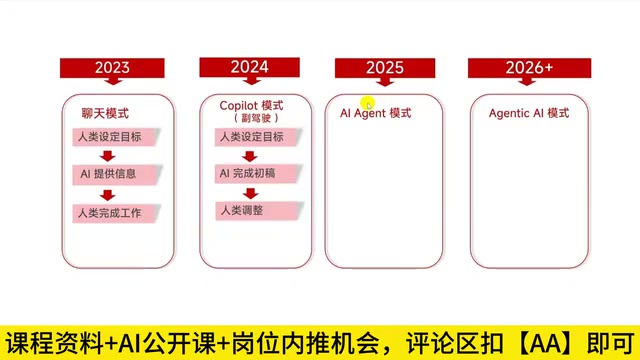
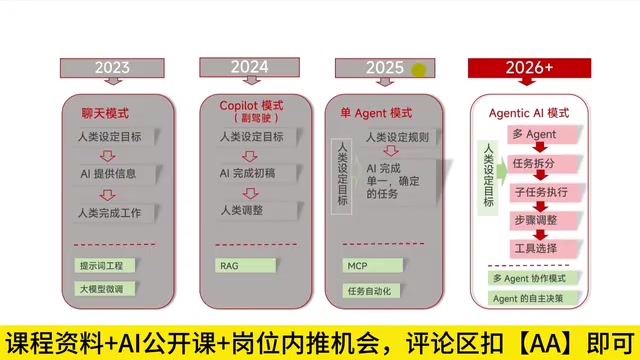
Before diving into Agentic AI, it's worth tracing how AI applications have evolved over time. This Bilibili course maps out a clear timeline showing AI's transformation from a supporting tool to a primary producer.
In the earliest stage, AI was essentially a "glorified search engine." Users typed questions into a chat interface, the large language model interpreted the intent and returned relevant information — but the actual work still fell to humans. You had to open Excel or PowerPoint yourself and manually copy in whatever the AI summarized. At this stage, AI represented only a tiny fraction of the overall production chain; humans remained the dominant force.
AI then began making inroads into the production process itself, most visibly in software development. AI-powered editors like GitHub Copilot enabled developers to write code through natural conversation. However, these tools could only operate on localized code segments — overall project architecture, file creation, and debugging still required human involvement. This phase, commonly called "Copilot mode" (or co-pilot mode), had AI handling roughly one-third of the workload, with humans still doing most of the heavy lifting.
The Year of the Agent: Flipping the Production Dynamic
The course identifies two landmark products as the inflection point that disrupted both earlier paradigms.
The first is Manus. It can autonomously complete complex, end-to-end tasks without any human intervention. The course offers a concrete example: ask Manus to present a company's Q3 business data, and it will automatically scrape web data, filter for Q3 information, write the results into a local Excel file for analysis, and finally present everything as charts — all without human input.
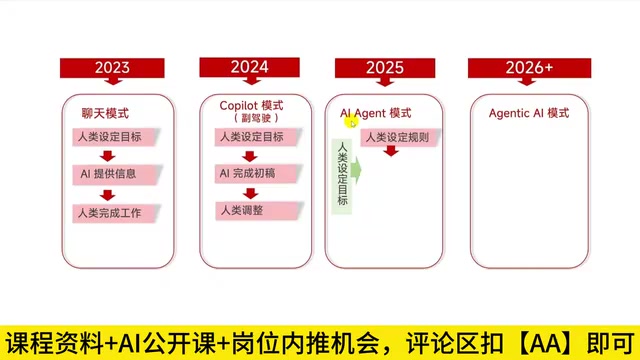
The second is the AI code editor Claude Code. Unlike traditional AI editors, it offers nothing but a single chat interface — users simply describe the feature or project they want built, and Claude Code handles the code writing, file generation, and project architecture from start to finish.
This is what's known as "AI Agent mode." In this paradigm, AI handles roughly two-thirds of the process, while humans are responsible only for setting goals, providing resources, issuing instructions, and defining rules. The primary operator shifts from human to Agent. Agents can invoke tools and leverage large language models for logical reasoning. While early Agents were limited to well-defined, predictable workflows, they established a critical trend: Agents replacing humans as the primary operators in production processes. This is the origin of the term "Year of the Agent."
Agentic AI: Multi-Agent Collaboration and Autonomous Decision-Making
The Agent paradigm continued to evolve — moving from single Agents to multiple Agents working in concert. When faced with complex tasks, the system can decompose them and assign each subtask to an Agent with the relevant expertise.
More importantly, Agents gained the ability to reflect and self-correct during execution: execute a step, evaluate whether the result meets the target, adjust course if it doesn't, and repeat until alignment is achieved. This mode — featuring autonomous decision-making and self-correction — is what the course defines as "Agentic AI mode."
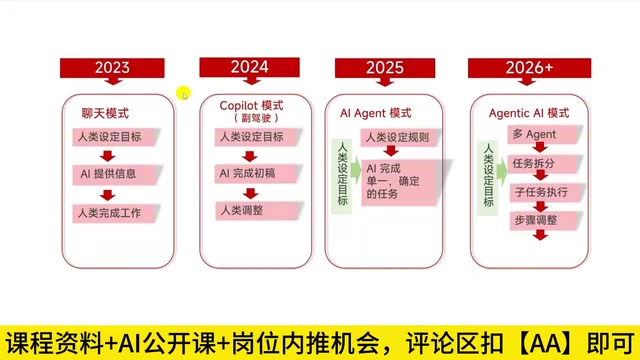
From this trajectory, we can infer the direction AI is heading: Agent-centric systems — specifically, multiple Agents collaborating with a division of labor — capable of using tools, leveraging large models, exercising autonomous decision-making, and drawing on domain-specific knowledge systems to independently solve complex tasks for users.
The course also cites market research data: the AI Agent market is growing year over year, with roughly 75% of enterprises already piloting or deploying AI Agents in their production workflows. Some analysts suggest that with AI Agents, a single person could effectively have an entire company's worth of "digital employees."
What Skills Will Keep You Relevant?
The course author raises a thought-provoking question: AI evolves at a breakneck pace, and concepts that were hot just a year or two ago — prompt engineering, RAG-based personal knowledge bases, local LLM deployment, fine-tuning — are rarely mentioned today. So what should you actually learn to stay relevant?
The author's answer: avoid chasing surface-level skills that are easily replaced by the next wave of technology. Instead, focus on what sits at the core of AI's long-term trajectory — namely, the Agentic paradigm. Regardless of how AI continues to evolve, the underlying logic of multi-agent collaboration and autonomous decision-making frameworks is unlikely to change. This perspective offers a useful filter for developers trying to choose where to invest their learning efforts.
Course Tech Stack: ReAct, Multi-Agent, and Agent Skills
The course uses travel planning as its business scenario, and is structured around two core pillars of Agentic AI.
Core 1: Multi-Agent Collaboration
The course introduces two design philosophies for multi-agent coordination. The first centers on workflow orchestration using a Graph engine-based application framework. The second — and the main focus — is the autonomous Agent design philosophy. For this approach, the course covers two Agentic-core application frameworks: JManus (essentially a Java implementation of Manus) and AgentScope, the flagship framework in the Spring AI Alibaba ecosystem. Since both involve Spring AI Alibaba, the course also covers relevant foundational concepts.
Core 2: Autonomous Reasoning and Execution
This section is divided into two areas. Autonomous reasoning is grounded in the ReAct (Reasoning + Acting) framework — a key focus of the course, and the foundation that enables Agents to think independently. Autonomous execution covers tool usage (via the MCP protocol) and the Agent Skills professional capability system. The significance of the latter: Agents don't just call tools — they follow a complete professional workflow to get the job done, which is an area attracting significant attention right now.
ReAct (Reasoning + Acting) is a large model reasoning framework proposed by a Google Research team in 2022. Its core idea is to interleave "thinking" and "acting" rather than producing a single output all at once. The flow works like this: the Agent reasons about the current situation (Reasoning), generates a thought step (Thought), then executes a concrete action (Action) based on that thought. The result of the action (Observation) is fed back to the model to drive the next reasoning cycle. This loop allows the Agent to dynamically correct course during execution, rather than relying on a single pass of reasoning to reach a final conclusion. Compared to traditional Chain-of-Thought (CoT) prompting, ReAct's key difference is that it allows Agents to invoke external tools — such as search engines, code executors, or databases — during the reasoning process, incorporating real information returned by those tools into subsequent reasoning. This breaks through the limitations of pure language models that rely solely on internal knowledge and are prone to hallucinations. It is also the foundational mechanism behind Agentic AI's autonomous decision-making and self-correction capabilities.
MCP (Model Context Protocol) is a standardized protocol proposed and open-sourced by Anthropic in late 2024, designed to unify the interaction interface between large models and external tools and data sources. Previously, connecting different AI applications to external systems — such as file systems, databases, or third-party APIs — typically required writing large amounts of custom adapter code, with no universal standard. MCP functions like a "USB interface" for AI tool integration: as long as a tool provider packages its capabilities according to the MCP specification, any MCP-compatible Agent or model can call it directly without additional adaptation work. A growing number of open-source MCP Servers now cover common scenarios including browser control, file operations, code execution, and database queries. The tool-calling capabilities covered in this course are built on this protocol; understanding MCP helps developers grasp the current standardization direction of the AI tooling ecosystem.
Who Is This Course For?
Overall, this course is designed for developers who want hands-on enterprise-grade Agentic AI skills, with a focus on the Java/Spring AI ecosystem. Upon completion, learners can expect to understand the ReAct autonomous decision-making paradigm, multi-agent collaborative architecture design, engineering-level Agent Skills packaging, and a complete AI application deployment methodology. For backend developers with some existing experience who want to go deep on the Agent track, this course's trend-first approach to curriculum planning is a solid reference point.
Related articles

Automate Job Search with AI Agents and Residential Proxies for Precise Matching
Build an AI Agent with MCP and residential proxies to bypass recruitment site anti-scraping and geo-restrictions, scrape thousands of DevOps jobs, then have Claude score and rank each against your resume. Includes proxy comparison experiments, project structure, and cost analysis—filtering only, no auto-submission.

The AI Task Assistant That Knows When to Back Off: A Cure for Activation Struggles
One Small Step is an AI assistant for task initiation struggles, using agentic decisions for guilt-free reminders, timely retreat, and cross-platform task management. The developer shares real test results on 13 tasks and architectural trade-offs.

FastAPI: A High-Performance Python Framework and a Production-Ready API Development Powerhouse
FastAPI is a high-performance web framework based on Python type hints, supporting async and automatic OpenAPI docs. With over 100k GitHub stars, this article analyzes its core strengths, production readiness, and selection advice.