From Deepfakes to DNA: How AI Watermarking Technology Protects Truth and Safety

How DeepMind's SynthID watermarks AI-generated content from media to proteins to protect truth and biosecurity.
As AI-generated content grows ever more convincing, Google DeepMind's SynthID offers a systematic response: statistical biasing in text generation, adversarially trained invisible signals in images and video, and — most breakthrough of all — watermarks embedded in AI-designed proteins by subtly substituting similar amino acids. Wet lab results confirm watermarked proteins retain full binding function, providing a traceable safety layer against AI-assisted biosecurity threats. The system depends on key-sharing and isn't foolproof, but represents proactive action against threats before they fully materialize.
When "Is This Real?" Becomes the Question of Our Age
Scrolling through social media, you come across slow-motion footage of a volcanic eruption, a tornado tearing through a village, or footage of a protest march — and the same question flashes through your mind: is this real? Was it filmed by a person or generated by a machine? As AI becomes increasingly convincing at generating text, images, audio, and video, determining whether content is authentic has become one of the most pressing challenges of our time.
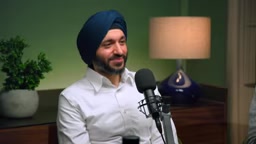
In the Google DeepMind podcast, host Professor Hannah Fry sits down with two guests to explore AI watermarking technology in depth: Pushmeet Kohli, VP of Science at DeepMind and one of the architects of SynthID, and biosecurity researcher Jeremy Radcliffe, who has applied the technology to the biological domain. Their conversation reveals a more complex new battleground — AI can now not only generate media content, but also design biological molecules that have never existed in nature, some of which could potentially be used to cause harm.
The answer may be hiding in plain sight — embedded in the content you're viewing, or in the molecule you're about to synthesize: a watermark. Not the kind of block logo stamped on stock photos, but something far more subtle and mathematical.
What Makes a Good Watermark
When most people think of watermarks, they picture the security features on banknotes or passports. But AI watermarks operate on an entirely different set of principles. Both guests independently converged on strikingly similar core criteria.
Kohli distilled eight years of designing watermarking systems at DeepMind into three key properties: imperceptibility (it must not degrade content quality, or no one will use it), robustness (it must survive transformations like scaling, cropping, and adding noise, making it difficult to remove), and scalability (it must be easy to integrate and easy to detect).
Radcliffe's criteria from the biological domain are strikingly consistent: imperceptible to humans, high detectability, and strong generalizability — a single method that works across multiple systems rather than requiring a custom solution for each data type. This alignment is no coincidence: the biological implementation directly reuses open-source SynthID text library code, adapting it for the new domain.
Text Watermarking: Hidden in the Pattern of Word Choices
Tools already exist that claim to identify AI-generated text, but Kohli points out they follow a conventional approach — training machine learning classifiers to distinguish AI-generated writing from human writing. Early large language models had distinctive verbal tics (overusing certain words or fixed sentence patterns) that classifiers could exploit. But as models become more convincing, those telltale signs disappear, and classifier accuracy falls with them.
Watermarking takes a fundamentally different approach. When a large language model generates each word, it is actually working with a probability distribution — there are often multiple equally plausible options for what comes next. Text watermarking exploits this
Related articles

Build an AI Super Employee System at Zero Cost: A Full Breakdown of Automated Agent Workflows
A deep breakdown of the AI super employee system demoed on Bilibili: agent orchestration, digital human voiceovers, map and enterprise lead generation, 24/7 customer service, and legal modules. We analyze the business logic and compliance risks behind zero-cost signup to help entrepreneurs judge the real ROI of this AI digital employee system.

The Essential Difference Between Chatbots and AI Agents: Crossing from Conversation to Execution
What's the difference between a chatbot and an AI agent? Based on the MCP series on the Learn Tech channel, this article uses examples like booking flights and summarizing notes to explain: a chatbot only gives answers, while an agent actually completes tasks through a think-act-observe loop. It breaks down the four core components—model, tools, memory, and goal—as well as MCP's role as a bridge, and discusses agents' applicable boundaries and permission risks.

Free GitHub Repo: 342 Hours of AI Courses, from Math to MCP Servers
A free GitHub repo offers 342 hours of AI courses: 523 lessons across 20 phases, from math fundamentals to agent building and MCP servers. Nearly 100,000 learners have started.