From Frontend to AI Full-Stack: Salary-Doubling Roadmap and Skill Checklist

Frontend-to-AI full-stack offers high pay and reusable skills, but needs 2-3 months of study, not 7 days.
The article analyzes the feasibility and path of transitioning from frontend to AI full-stack. Core insight: enterprises most need practical developers who can ship AI products, not model training talent — and frontend engineering and interaction skills match perfectly. Salaries: newcomers 12K, 1-3 years 20-40K, tech leads 500K/year, big tech core roles 50K+/month, though platform ceiling data should be viewed rationally. The advantage lies in reusable tech stacks and JavaScript fundamentals accelerating learning. The three-stage path covers foundation (prompt engineering, Function Calling, LangChain), practical (RAG, commercial agent projects), and advanced (multi-agent collaboration, workflow orchestration). Realistically requires 2-3 months of practice, not 7 days. AI agent roles have a 107% CAGR, and the window remains open.
Is It Worth Transitioning from Frontend to AI Full-Stack?
Recently, a tutorial video on Bilibili titled "Frontend to AI Full-Stack" went viral. The creator claimed to have spent three days reviewing over 2,000 AI full-stack job postings on BOSS Zhipin, compiling real salary data and skill requirements. Setting aside marketing hype like "master it in 7 days" or "10x better than paid courses," transitioning from frontend to AI application development is genuinely a direction worth taking seriously right now.
The core logic is this: what enterprises lack most when implementing AI isn't model training talent — it's practical developers who can turn AI capabilities into products, polish interaction experiences, and actually ship projects. This happens to be a natural extension of a frontend engineer's comfort zone.
Salary Truth: How Much Do AI Full-Stack Roles Actually Pay?
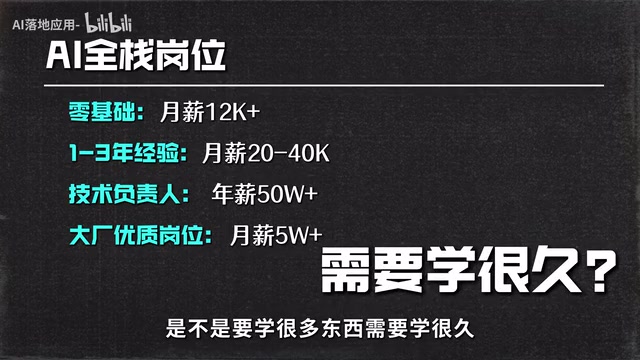
Based on data compiled in the video, AI full-stack salaries show a clear tiered distribution:
- Frontend newcomers transitioning from scratch: AI full-stack roles start at 12,000 RMB/month
- After 1-3 years of AI implementation experience: Salaries stabilize at 20-40K, with some emerging-track roles not requiring prior experience
- Tech leads who can independently own AI project delivery: 500K RMB annual salary is the industry norm
- Core roles at big tech companies: Monthly salaries can exceed 50K
What needs to be viewed rationally: these figures come from the upper end of salary ranges listed on recruitment platforms. Actual negotiations are still affected by city, company size, personal project experience, and other factors. But AI roles pay significantly more than traditional frontend pixel-pushing positions — this is reflected in multiple industry reports.
The Natural Advantage of Frontend Transition: Change Direction, Not Tech Stack
One point repeatedly emphasized in the video deserves deeper analysis: transitioning from frontend to AI application development doesn't require abandoning your existing tech stack.
The engineering capabilities, component encapsulation experience, and interaction development intuition accumulated by traditional frontend engineers can all be reused when building AI products. Compared to pure backend or algorithm developers who can only call APIs but don't understand user experience, frontend developers are better at packaging AI capabilities into products users actually want to use.

This advantage is especially pronounced in scenarios like AI agents, AI Q&A, and enterprise knowledge bases — users don't care what model you used; they only care whether answers are accurate, interactions are smooth, and the interface is usable.
Moreover, a solid JavaScript programming foundation and logical thinking allow frontend developers to learn concepts like AI workflows and tool calling far more efficiently than those starting from zero.
Three-Stage Learning Path: From Mindset Shift to Independent Delivery
The learning roadmap presented in the video is divided into three stages, designed to align with frontend foundations and highly targeted:
Stage One: Build the Foundation
Thoroughly understand large model application principles, prompt engineering, and core Function Calling logic. Master AI API integration, frontend AI component encapsulation, and LangChain basics. The goal is to complete the mindset shift from traditional frontend to AI frontend and be able to handle basic agent feature development.
Function Calling refers to a large language model's ability to proactively invoke external functions or APIs based on user intent when generating responses. For example, if a user asks "What's the weather tomorrow?", the model can automatically call a weather query API and integrate the returned result into its answer. Its core value lies in upgrading the model from a "pure text generator" to an "agent capable of executing actions." When frontend developers integrate this capability, they typically need to define function descriptions (JSON Schema), handle the model's returned call instructions, and pass execution results back to the model. Mastering Function Calling is the foundation for building AI agents and automated workflows, and a key step from "knowing how to call APIs" to "being able to build products."
LangChain is an open-source framework for building large model applications, providing modular components such as prompt templates, memory management, tool calling, and retrieval augmentation. It abstracts away differences between model vendors' APIs, allowing developers to orchestrate complex AI workflows in a unified way. For frontend developers, LangChain's JavaScript/TypeScript version (LangChain.js) can run directly in Node or browser environments, seamlessly integrating with existing tech stacks. Learning LangChain can significantly lower the barrier to agent development.
Stage Two: Focus on Core Practical Skills
Master chain-of-thought invocation, tool integration, short/long-term memory mechanisms, and RAG knowledge base implementation. Combine Vue/React to build commercial projects like AI Q&A, enterprise knowledge bases, and AI content generation. Projects produced at this stage can go directly on your resume and match enterprise hiring standards.

RAG (Retrieval-Augmented Generation) is a technique that combines external knowledge bases with large models. The process: first split and vectorize enterprise documents into a vector database. When a user asks a question, retrieve the most relevant fragments, then feed these fragments as context to the large model to generate an answer. RAG effectively solves the "hallucination" and outdated knowledge problems of large models, and is the mainstream solution for enterprise knowledge bases, intelligent customer service, and similar scenarios. Frontend developers need to understand concepts like vector retrieval, embedding models, and document splitting, and learn to link retrieval results with frontend interfaces.
Chain-of-Thought refers to guiding a model through step-by-step reasoning via prompts, rather than giving an answer directly. For example, in math or logic tasks, ask the model to "first analyze the conditions, then calculate step by step, and finally draw a conclusion." This technique can significantly improve accuracy on complex tasks. In AI application development, chain-of-thought is often combined with tool calling and multi-step planning to build agents capable of handling multi-turn interactions. When implementing this on the frontend, developers can visualize the reasoning process through streaming output to enhance user trust.
Stage Three: Advanced Elevation
Learn multi-agent collaboration, task decomposition, and workflow orchestration to achieve integrated frontend-backend AI delivery. Independently develop high-end projects like automated office tools and code generation tools, targeting mid-to-senior AI full-stack roles.
Multi-agent collaboration refers to multiple AI agents each taking on different roles (such as product manager, programmer, tester) and collaborating through message passing to complete complex tasks. For example, one agent breaks down requirements, another generates code, and a third reviews it. This pattern suits high-end scenarios like automated office work and code generation. Frontend developers need to master communication protocols between agents, task scheduling, and state management — skills highly transferable from frontend state management and component communication experience.
Workflow orchestration refers to organizing multiple AI steps (such as prompts, tool calls, and conditional logic) into an executable flowchart in logical order. It's similar to a frontend workflow engine, but executes AI tasks. Common tools include LangChain Expression Language, Dify, Coze, and others. After mastering workflow orchestration, frontend developers can independently build a complete loop from user input to AI processing to result display, truly achieving full-stack AI delivery.
Rationally Viewing "7-Day Mastery" and the Transition Window
The video title's "7 days from beginner to master" is clearly exaggerated. The knowledge scope involved in AI application development — from prompt engineering to RAG, from agents to workflow orchestration — requires continuous practice to truly master. Completing the three-stage path, calculated at 2-3 hours per day, takes roughly 2-3 months to reach interview-ready level.
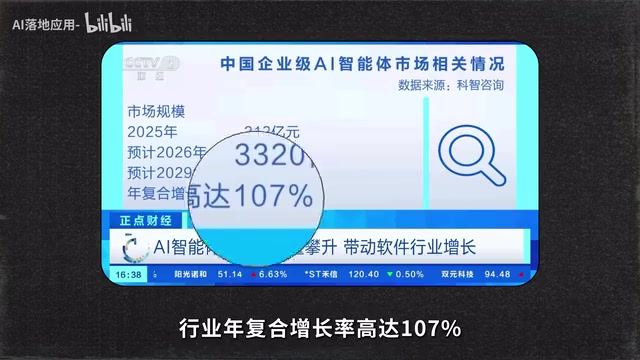
But the direction itself is sound. AI agent job demand has a compound annual growth rate of 107%, the job gap continues to widen, and frontend developers happen to be in a favorable position of "understanding interactions, capable of delivery, and low learning cost."
For frontend developers who don't want to spend their entire career on repetitive business development, now is still the time to enter the AI application track. The key is choosing the right learning path, replacing empty theory with project-driven practice, and treating every exercise as a portfolio piece on your resume.
One-line Summary
Frontend-to-AI full-stack offers high salaries and reusable tech stacks, but requires 2-3 months of systematic learning — not 7-day mastery.
Paragraph Summary
The article analyzes the feasibility and path of transitioning from frontend to AI full-stack. Core insight: enterprises most need practical developers who can ship AI products, not model training talent — and frontend engineering and interaction skills match perfectly. On salary: newcomers start at 12K, 1-3 years experience earns 20-40K, tech leads earn 500K annually, big tech core roles pay 50K+/month — but platform ceiling data should be viewed rationally. The transition advantage lies in reusable tech stacks, with JavaScript fundamentals and component experience accelerating learning. The learning path has three stages: foundation (prompt engineering, Function Calling, LangChain), practical (RAG, commercial agent projects), and advanced (multi-agent collaboration, workflow orchestration). Realistically requires 2-3 months of continuous practice, not the 7 days in marketing hype. AI agent roles have a 107% CAGR, and the window is still open.
Related articles

Uber Deploys ChatGPT Work Company-Wide: AI in the Workplace Enters the Scaled Implementation Phase
Uber deploys ChatGPT Work to 30,000+ employees, extending it from engineering to all roles. We analyze its expert-engineer pairing, end-to-end automation, and questions of AI control and power concentration—insights for scaling AI in the workplace.

Shift at Midnight Hands-On: When "ID Verification" Becomes Alien Hunting
Shift at Midnight blends ID verification with horror survival in a four-player co-op game. We break down its inspection mechanics and chaotic humor.

Zelensky Recounts the Outbreak of War: I Need Ammunition, Not a Ride
Zelensky recalls the first day of war in a YouTube interview: farewell to family, rejecting Biden's evacuation offer with "I need ammunition, not a ride," and how Bucha shaped his stance on compromise and peace talks.