From Geometry to Algebra and Back Again: 4000 Years of Mathematical Thought

How mathematics evolved over 4000 years by oscillating between geometric intuition and algebraic abstraction.
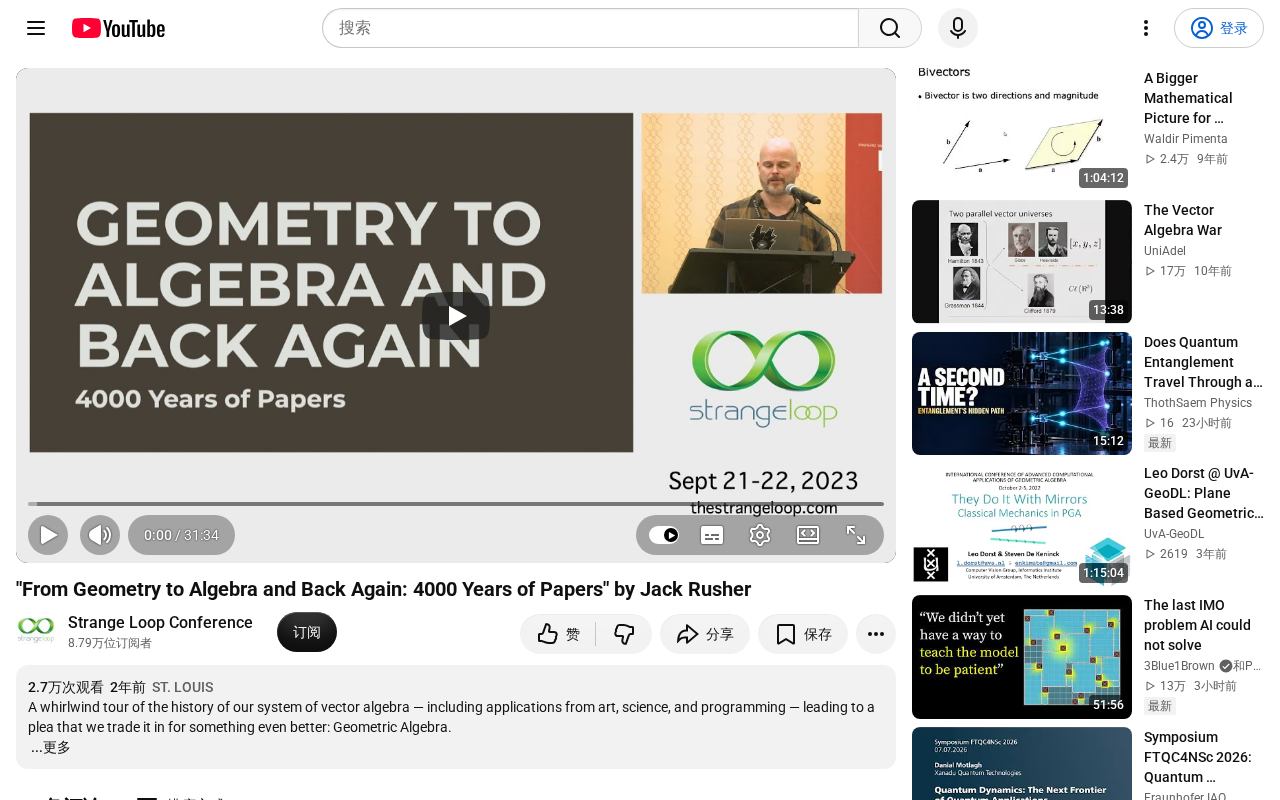
Using the video *From Geometry to Algebra and Back Again: 4000 Years of Papers* as a starting point, this article traces the broad arc of four millennia of mathematical thought. It argues that mathematics advances not linearly, but by oscillating between geometric intuition and algebraic abstraction — from Babylonian measurement and Greek axiomatics, through al-Khwārizmī's symbolic algebra, to Descartes' analytic geometry reuniting the two. The article concludes by connecting this historical pattern to modern AI and machine learning, where the interplay of high-dimensional manifolds and matrix operations echoes the same fundamental tension.
A Mathematical Journey Spanning Four Millennia
The video From Geometry to Algebra and Back Again: 4000 Years of Papers attempts to trace a single thread through four thousand years of human mathematical development — from ancient civilizations' intuitive understanding of geometric shapes, to the gradual construction of algebraic symbolic systems, to the deep fusion of geometry and algebra in modern mathematics.
The title itself hints at a fascinating phenomenon: mathematics doesn't progress in a straight line. Instead, it oscillates between geometric intuition and algebraic abstraction. Each shift in perspective provides new tools for solving old problems — and sparks entirely new branches of mathematics.
Given that this content currently has limited traction on Hacker News (7 points, 0 comments), the following analysis is based on the thematic framework suggested by the title, and is intended as a reference for readers interested in the history of mathematics.
The Ancient Tradition: Geometry First
In ancient Babylon and Egypt, mathematics was nearly inseparable from geometric measurement. Land surveying, architectural planning, and astronomical observation all required working with lengths, areas, and angles. There were no equation symbols in the modern sense — problems were posed and solved through geometric figures or verbal descriptions.
Ancient Greece took this tradition to its peak. Euclid's Elements constructed geometry as a rigorous axiomatic system, setting the standard for mathematical rigor for the next two thousand years. In the Greek conception, quantitative relationships often had to be demonstrated through geometric construction — the square of a number corresponded to the area of a square. This "geometric algebra" was their primary means of understanding abstract relationships.
The Greek approach to "geometric algebra" looks roundabout by today's standards, but it had its own internal logic: negative numbers and irrational numbers had no firm standing at the time, so geometric quantities (line segments, areas) were actually more "trustworthy" than pure numbers. For example, to prove that $a^2 + 2ab + b^2 = (a+b)^2$, the Greeks would assemble four geometric pieces to demonstrate the equality visually, rather than perform symbolic operations. While intuitive, this approach severely limited their ability to handle problems beyond the third degree — a cube could still be understood as a volume, but what geometric object would a fourth power correspond to? The Greek framework hit a fundamental ceiling here, and this is precisely the historical motivation that drove the development of algebraic symbolism.
The Rise of Algebraic Symbolism
The real turning point came as algebra gradually broke free from geometry's constraints and developed its own independent symbolic language. From al-Khwārizmī's systematic study of equations to Renaissance-era European mathematicians introducing letters to represent unknowns and coefficients, algebra began to develop its own operational rules and abstract power.
This transformation was profound: once quantitative relationships could be freely manipulated through symbols, mathematicians could handle high-degree equations, multi-variable systems, and even more abstract structures that geometric intuition struggled to grasp. Algebra became a "computational engine," making complex reasoning mechanical and generalizable.
al-Khwārizmī (c. 780–850 CE) was the pivotal figure in this transition. His treatise al-Kitāb al-mukhtaṣar fī ḥisāb al-jabr waʾl-muqābala was the first systematic treatment of solving quadratic equations, and the word "al-jabr" in its title is the etymological origin of the English word "algebra." Notably, al-Khwārizmī's algebra was still written in words rather than symbols — true symbolization had to wait until the 16th century, when François Viète introduced letters to represent both known and unknown quantities, and then the 17th century, when Descartes standardized the familiar notation of $x, y, z$ that we use today. From verbal description to symbolic manipulation, this process of symbolization spanned nearly eight hundred years, with each step significantly expanding the expressive frontier of mathematics.
The Reunion of Geometry and Algebra
The "Back Again" in the video's title points to another pivotal moment in mathematical history. The invention of the Cartesian coordinate system established a one-to-one correspondence between geometric figures and algebraic equations: a curve could be written as an equation, and an equation could be drawn as a curve. Analytic geometry was born.
This two-way translation capability only deepened over time. Modern fields such as algebraic geometry and differential geometry are products of the profound integration between geometric intuition and algebraic tools. Abstract algebraic structures gained geometric imagery, while complex geometric objects could be precisely characterized through algebraic means. This back-and-forth translation is itself a major source of mathematical creativity.
The Cartesian coordinate system (1637) was revolutionary because it transformed "position" — a geometric concept — into an "ordered pair" — an algebraic object — allowing curves to be "captured" by equations. But this mutual translation was not an endpoint; it was a beginning. In the 19th century, Riemann algebraized the concept of curvature, giving rise to differential geometry. In the 20th century, Grothendieck rebuilt algebraic geometry on the theory of schemes, enabling number-theoretic problems to be approached with geometric intuition — the ultimate proof of Fermat's Last Theorem was completed within exactly this framework. Every new reunion of geometry and algebra has not merely added tools, but has opened entirely new mathematical vistas.
Why This History Still Matters
Understanding the interplay between geometry and algebra remains relevant for anyone learning or doing mathematics today. When we get stuck in one perspective, switching to another often brings a breakthrough — this is not just a historical pattern, but an effective method of thinking.
For readers interested in AI and scientific computing, this theme has immediate practical relevance: modern machine learning makes extensive use of the combination of geometric intuition (such as manifolds in high-dimensional spaces) and algebraic operations (such as matrix transformations), which is in some sense a continuation of this four-thousand-year-long story into the present day.
(Note: Since the original material consists only of a video link and title, please refer to the original video for specific historical details, timelines, and paper citations.)
In machine learning, the idea of translating between geometry and algebra manifests with particular concreteness. Neural networks are fundamentally about function approximation in high-dimensional spaces, and the "Manifold Hypothesis" holds that real data lies on low-dimensional manifolds — a purely geometric intuition, yet one implemented through algebraic operations like matrix multiplication and gradient descent. Graph Neural Networks (GNNs) directly bind the topological structure of a graph (geometry) with linear transformations of feature vectors (algebra). From this perspective, the mathematical foundations of deep learning and the core tension ancient mathematicians faced four thousand years ago — how to translate back and forth between intuitive imagery and abstract symbols — are fundamentally the same problem in a contemporary guise.
Related articles

Build an AI Super Employee System at Zero Cost: A Full Breakdown of Automated Agent Workflows
A deep breakdown of the AI super employee system demoed on Bilibili: agent orchestration, digital human voiceovers, map and enterprise lead generation, 24/7 customer service, and legal modules. We analyze the business logic and compliance risks behind zero-cost signup to help entrepreneurs judge the real ROI of this AI digital employee system.

The Essential Difference Between Chatbots and AI Agents: Crossing from Conversation to Execution
What's the difference between a chatbot and an AI agent? Based on the MCP series on the Learn Tech channel, this article uses examples like booking flights and summarizing notes to explain: a chatbot only gives answers, while an agent actually completes tasks through a think-act-observe loop. It breaks down the four core components—model, tools, memory, and goal—as well as MCP's role as a bridge, and discusses agents' applicable boundaries and permission risks.

Free GitHub Repo: 342 Hours of AI Courses, from Math to MCP Servers
A free GitHub repo offers 342 hours of AI courses: 523 lessons across 20 phases, from math fundamentals to agent building and MCP servers. Nearly 100,000 learners have started.