From NumPy to Transformer: A 5-Month Open-Source Machine Learning Self-Study Roadmap

A developer's 5-month daily-commit repo maps the full journey from NumPy to Transformer.
A developer shared ML-Foundations on Reddit — a machine learning repository built over 5 months of daily commits, covering NumPy/Pandas, scikit-learn/XGBoost, deep learning with TensorFlow/Keras (ANN, CNN, RNN, LSTM), NLP fundamentals, Transformer basics, data visualization, statistics, and SQL. Its standout quality is not just content breadth but form: the daily commit history provides a credible learning trail, and the public notebooks reveal real thinking and trial-and-error, offering fellow self-learners a practical rhythm to follow.
The biggest challenge when getting started with machine learning isn't a lack of resources — it's having too many resources without a clear path forward. A developer recently shared their learning repository ML-Foundations on Reddit, documenting a complete learning journey from NumPy to Transformer through 5 months of daily commits turned into public notebooks. This isn't a tutorial library — it's the authentic growth trail of a learner, and it's a genuinely useful reference for those just starting out.
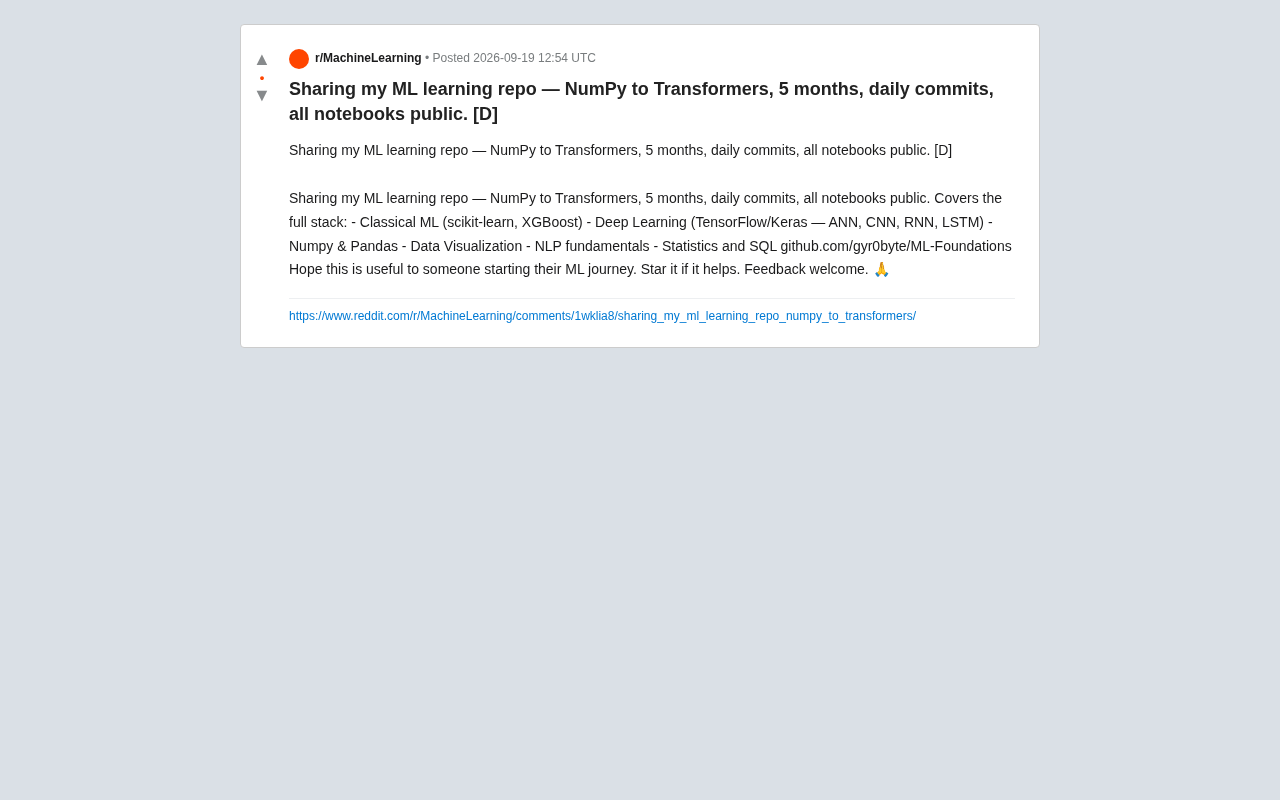
A Full-Stack Machine Learning Map
The author positions this repository as a "full stack" foundation in machine learning. Its scope is impressively comprehensive, covering nearly every key milestone on the traditional learning path:
- Numerical and data processing fundamentals: NumPy and Pandas — the foundation for everything that follows
- Classical machine learning: scikit-learn and XGBoost, covering the mainstream supervised learning algorithms
- Deep learning: ANN, CNN, RNN, and LSTM implemented with TensorFlow/Keras
- Data visualization: Turning analytical results into readable charts
- NLP fundamentals: Building the groundwork for understanding Transformer
- Statistics and SQL: Essential underlying skills no data scientist can skip
This structure itself embeds an implicit learning recommendation: first master data manipulation and statistical intuition, then move into classical algorithms, and finally transition to deep learning and sequence models. Many beginners make the mistake of jumping straight to large language models, neglecting these "unglamorous but ceiling-defining" fundamentals.
The underlying logic of this path deserves a closer look. NumPy provides multi-dimensional array operations and is the low-level dependency of nearly every Python ML framework. Pandas builds on top of it, wrapping tabular data reading, writing, and cleaning capabilities. scikit-learn unifies classic algorithms — linear regression, decision trees, random forests, SVM — under a single fit/predict interface, letting learners quickly compare model behavior without needing to implement the math from scratch. XGBoost is an efficient implementation of gradient boosted trees that has long dominated structured data competitions; mastering it means having a practical weapon for real-world business data. In the deep learning section, the progression of ANN (fully connected networks) → CNN (convolutional networks, great for images) → RNN/LSTM (recurrent networks, for sequential data) maps to a conceptual upgrade from "static features to temporal dependencies" — laying the necessary groundwork for ultimately understanding the attention mechanism in Transformer.
Why "Daily Commits" Matter
More interesting than the content itself is the format: 5 months of daily commits. Consistency is often rarer than raw intelligence when it comes to self-study. A GitHub commit history functions as a public learning log, adding two layers of extra value.
The first is credibility. A repository claiming full-stack coverage that was uploaded all at once is hard to evaluate — did the author actually go through the whole process? A commit curve that builds day by day gives a tangible, visual picture of how knowledge was assembled piece by piece. The second is a reproducible sense of rhythm. For others who are also self-studying, seeing someone reach Transformer through a "a little every day" approach is itself a replicable methodology — not chasing speed, but relying on the compound interest of daily accumulation.
The Two-Way Value of Public Notebooks
Having all notebooks public means readers don't just see the final code — they also see the intermediate thinking, trial and error, and annotations. For readers, this is far closer to what learning actually looks like than a polished textbook. For the author, making things public also creates a feedback mechanism and a form of accountability. As the post's closing line reads, "Feedback welcome" — opening up private notes to community scrutiny is itself part of closing the learning loop.
Practical Advice for Beginners
If you're thinking of using resources like this to get started, a few things are worth keeping in mind.
First, repositories like this are best used as a reference roadmap and a parallel practice resource, not as a sole textbook. The depth of learning notes varies by person, and pairing them with official documentation and established courses will yield better results. Second, don't just read the notebooks — reproduce them hands-on. Intuition in machine learning is almost exclusively built through repeated debugging and running experiments. Finally, consider borrowing the author's "daily commit" approach: set up your own public or private learning repository, and use visible progress to fight the inertia of giving up halfway through.
It's worth noting that this share comes from a single source (a Reddit post), and the actual quality, depth, and maintenance status of the repository still needs to be verified by visiting it directly. Its greatest value may not lie in how complete the content is, but in the self-study paradigm it demonstrates: a clear path + a consistent rhythm + a public record.
Transformer is the core architecture behind nearly all modern large language models (such as GPT and BERT), with its key innovation being the Self-Attention mechanism: rather than processing sequences step by step like RNN, it allows every token in a sequence to simultaneously attend to all other positions, enabling parallel modeling of long-range dependencies. Understanding Transformer typically requires first getting comfortable with word embeddings, positional encoding, multi-head attention, and feed-forward sub-modules. People who jump straight into Transformer without this background often get stuck on these concepts — and the NLP fundamentals and LSTM sequence model experience that this repository builds are precisely designed to lower that barrier.
Summary
From NumPy to Transformer, this learning path is nothing new — but actually walking through it completely over 5 months of daily commits and making it all public is still something worth celebrating. For those just entering the world of machine learning, it serves as both a reusable learning map and a concrete example of what "sticking with it" looks like in practice. Interested readers can head directly to the GitHub repository to explore, and take from it whatever fits their own situation.
Related articles

GPT-Next Leak, Gemini 4 Argon Imminent: AI News Roundup
GPT-Next leak suggests extreme efficiency; OpenAI's 28-day shipping pledge boosts speed 50%; Gemini 4 Argon nears release; Anthropic subscription value report sparks debate.

GPT-Next Leaked, Gemini 4 Argon Speeds Up, Fable 5.5 May Launch Today
OpenAI's GPT-Next model leaks, expected to be extremely low-cost and possibly part of the 28-day release plan; Gemini 4 Argon internal testing accelerates, NanoBanana 2.1 is live; Semi Analysis tests show Claude Max's equivalent API value is about 5 times that of ChatGPT Pro; Fable 5.5 may launch today.

Gemini 4 Argon Launches Globally: Key Highlights from the AI Daily Brief
Google opens Gemini 4 Argon globally across Pro and Ultra subscriptions and the API, and demonstrates robot control. This article rounds up open-source models, Agent infrastructure, cost transparency, and safety governance updates.