From RAG to Agent: A Comprehensive Guide to Enterprise-Grade AI Agent Implementation

A comprehensive guide to the evolution from RAG to AI Agents and enterprise-grade implementation strategies.
This article traces the four-stage evolution of LLM deployment—from native models and prompt engineering to RAG and AI Agents—explaining why Agents represent the critical leap from passive Q&A to proactive task execution. It details Agent architecture (planning, memory, tool use, reflection), four commercial tracks (tool-type, character-type, utility, and industry-specific), career opportunities, common development pitfalls, and a recommended learning path for developers.
Why Developers Must Master Agent Development
Many developers still think of large language models (LLMs) in terms of "writing better prompts" or "building a local knowledge base." But when it comes to enterprise interviews and real-world project delivery, the gaps become painfully obvious. When an interviewer asks, "Can you build an intelligent system that automatically processes orders and follows up with customers?" those who only know prompt engineering and basic RAG often freeze on the spot.
The reason is that these two approaches solve fundamentally different classes of problems. Prompt engineering and RAG essentially solve "how to make an LLM answer questions well," while Agents solve "how to make an LLM proactively think and solve problems." The former is passive response; the latter is active execution. This is precisely why traditional enterprises pursuing digital transformation no longer want simple Q&A chatbots—they need automated systems that reduce costs, boost efficiency, replace manual labor, and handle end-to-end business workflows.
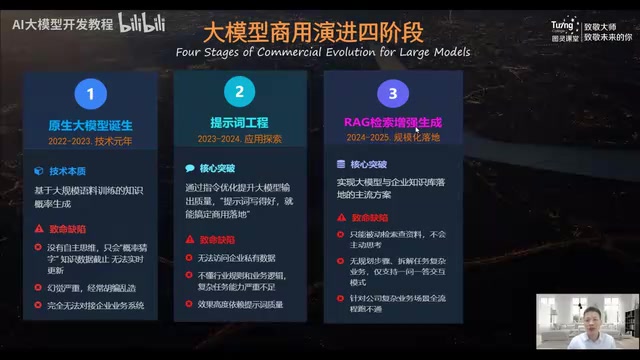
The Four Stages of LLM Implementation
To understand the value of Agents, you first need to grasp the complete evolution path of LLM deployment.
Stage 1: Native LLMs
This is where it all begins. Native LLMs generate answers by learning from massive amounts of publicly available internet data. The explosion of ChatGPT amazed people with its seemingly encyclopedic knowledge. But its limitations soon became apparent: no autonomous reasoning capability, a knowledge cutoff date, a tendency to hallucinate, and no ability to interface with enterprise business processes. It was still far from real commercial deployment.
"Hallucination" refers to the phenomenon where LLMs fabricate information that appears plausible but is factually incorrect. This happens because LLMs are fundamentally next-token prediction machines based on probability—they don't truly "understand" knowledge but have learned the statistical distribution patterns of language. When training data for a particular domain is insufficient, the model will "confidently make things up." This characteristic makes native LLMs difficult to apply directly in industries like healthcare, law, and finance, where accuracy is paramount.
Stage 2: Prompt Engineering
To optimize output quality, the industry went through a phase of obsessing over prompt engineering—structured instructions, chain-of-thought, tree-of-thought, and countless other techniques emerged. Chain-of-Thought (CoT), proposed by Google in 2022, guides LLMs to show intermediate reasoning steps by including step-by-step reasoning examples in prompts, significantly improving accuracy on mathematical reasoning and logic problems. Tree-of-Thought (ToT) is its advanced variant, allowing the model to explore multiple reasoning paths simultaneously and backtrack—similar to a human's "trial-and-error" strategy when solving complex problems.
However, prompt engineering has three core deficiencies: it cannot access enterprise internal data, it cannot handle complex business workflows, and output quality is heavily dependent on human skill. While these techniques are effective, they fundamentally rely on manually crafted prompt templates and cannot automatically adapt to new scenarios.
Interestingly, prompt engineering is no longer a bonus skill—it's a baseline competency for LLM application engineers. It's like how knowing how to type is a prerequisite for using a computer, but being able to type doesn't make you an IT engineer.
Stage 3: RAG (Retrieval-Augmented Generation)
To address the private enterprise data problem, RAG became the go-to solution for many traditional businesses. The RAG technical pipeline involves three key steps: first, document chunking and vectorization—enterprise documents are converted into high-dimensional vectors via embedding models and stored in vector databases (such as Milvus, Pinecone, ChromaDB, etc.); second, semantic retrieval—the user query is similarly vectorized, and the most relevant document chunks are found using cosine similarity or ANN (Approximate Nearest Neighbor) algorithms; finally, augmented generation—the retrieved context is concatenated with the user's question and fed into the LLM to generate the final answer.
In simpler terms, fixed and repetitive enterprise business data (spreadsheets, images, etc.) is stored in a knowledge base. Before answering, the LLM performs a relevance search within the knowledge base and then returns results. Knowledge Q&A systems in finance, law, and manufacturing are mostly built on this approach.
But RAG's inherent limitations are equally obvious: it can only passively retrieve information—it cannot proactively think, it cannot decompose complex tasks, and it only supports single-turn Q&A interaction patterns. The core bottleneck of this architecture lies in retrieval quality—if the vectorization process loses semantic information, or if document chunking granularity is poorly calibrated, you get the "retrieved something but answered the wrong question" problem. Take e-commerce as an example: the complete workflow from customer inquiry, order placement, inventory check, to address modification is simply beyond RAG's capability. This is why many enterprises invest heavily in Q&A systems that end up providing limited value to overall business operations.
Stage 4: The Agent Explosion
As technology evolved, Agents emerged. They possess capabilities for task planning, execution, and reasoning—upgrading from "Q&A tools" to "digital employees" that can invoke various tools to complete complex tasks and support multi-agent collaboration. This is the technology approach mainstream enterprises are currently adopting for digital transformation.
From a technical architecture perspective, a complete Agent system typically consists of four core modules: the Planning Module decomposes complex tasks into executable sub-task sequences, with common implementations including the ReAct (Reasoning+Acting) framework and Plan-and-Execute patterns; the Memory Module is divided into short-term memory (current conversation context) and long-term memory (persistent user profiles and historical interactions), typically implemented using a combination of vector databases and relational databases; the Tool Use Module leverages the Function Calling mechanism to let the LLM decide when and which external API to invoke—OpenAI, Anthropic, and other providers have all established standardized function calling protocols; the Reflection Module enables the Agent to evaluate its own execution results and automatically correct its approach when errors occur. Open-source frameworks like LangChain, LangGraph, CrewAI, and AutoGen provide standardized development paradigms built around these modules.
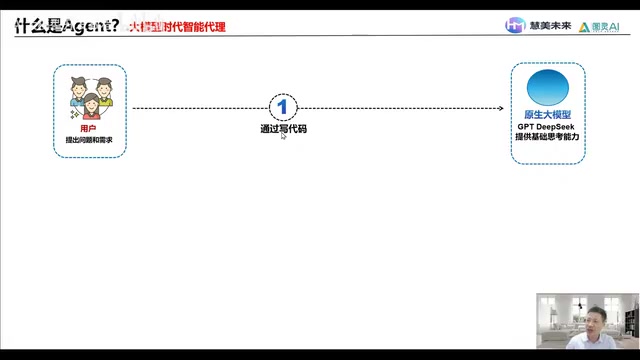
What Exactly Is an Agent: Core Concepts Explained
Here's a straightforward analogy: An Agent is the translator and bridge between the user and the LLM. Just as communication between a Chinese speaker and an English speaker requires a translator, after a user poses a question, the Agent understands the requirements, invokes various tools, completes complex tasks, and returns the results to the user.
Without Agents, native LLMs have several inherent shortcomings:
- No memory: Can't remember previous content after multiple conversation turns
- Knowledge cutoff: Can't answer questions about information after the training data cutoff
- No internet access: Can't retrieve real-time data (e.g., stock prices, policy updates)
- Can't manipulate files: Can't read local files or invoke external tools
Real enterprise scenarios almost always involve multi-turn conversations, multi-step operations, and real-time data requirements—things native LLMs simply cannot handle on their own.
The Four Core Problems Agents Solve
- Translator: Converts natural language requirements into instructions the LLM can understand, then transforms outputs into directly usable results
- Tool Expert: Helps the LLM call APIs, fetch online data, manipulate files, and interface with enterprise systems—transforming the model from "can only talk" to "can take action." The core technology here is Function Calling—during the response generation process, the LLM can output a structured function call request (including function name and parameters), and the Agent framework handles the actual execution and returns results to the model for continued reasoning. This mechanism breaks the LLM's "text-only output" limitation, giving it genuine capability to interact with the external world.
- Memory Manager: Remembers context, user preferences, and conversation history, enabling coherent interactions without amnesia
- Task Manager: Decomposes complex problems into multiple planned and executed steps, proactively adjusting plans when issues arise
In fact, products we use daily already have built-in Agents. For example, with Doubao (ByteDance's AI assistant), the questions you send don't go directly to the raw LLM—they're processed by an Agent that invokes the model and then returns the result. Claude Code, widely used by programmers, can remember entire project structures and call compilers to fix errors—this is powered by Agent tool-calling and memory capabilities.
Four Major Commercial Tracks for AI Agents
Currently, commercially viable Agents fall into four main categories. Whether you're aiming for high-paying employment, freelance projects, or entrepreneurship, you can find your niche among them.
Tool-Type Agents
A typical scenario is a dedicated customer service Agent on an automaker's website, embedded in the brand's app and website, replacing employees with 24/7 responses covering everything from model pricing and configurations to after-sales service. This is the mainstream approach for enterprises of a certain scale undergoing digital transformation. The technical core of these Agents lies in deep integration with existing enterprise IT systems (CRM, ERP, ticketing systems, etc.), typically requiring the development of extensive API adaptation layers and permission management mechanisms to ensure data security and operational compliance when the Agent accesses internal systems.
Character-Type Agents
These include digital humans, virtual livestreamers, and similar applications, using a "Agent capabilities + digital human" technology stack. Short-video and e-commerce companies are already deploying them at scale. These agents require not only LLM conversational abilities but also the integration of multimodal technology stacks including TTS (text-to-speech), voice cloning, and digital human rendering (lip-sync, facial expression generation, etc.).
Utility Agents
Characterized by single-function depth—doing one thing extremely well—such as AI writing assistants or resume generators. These are suitable entry points for individuals, monetized through subscriptions or traffic, with a relatively low barrier to entry.
Industry-Specific Agents
Targeting B2B traditional enterprise transformation, this is the track with the highest ceiling. Any industry—healthcare, finance, e-commerce, logistics, manufacturing, legal—can deeply integrate with LLMs. An industrial Agent, for example, can cover the entire workflow from customer inquiry, inventory checking, to order address modification, penetrating every link of the enterprise's business processes.
In industry-specific Agents, Multi-Agent collaboration is the key technical enabler. Its core idea simulates team-based division of labor: an Orchestrator Agent handles task allocation while multiple Specialist Agents each handle their own domain. For example, in an e-commerce scenario, a Customer Service Agent handles user interactions, an Inventory Agent interfaces with warehouse systems, a Logistics Agent tracks delivery status, and a Finance Agent processes refunds—each focusing on their own domain knowledge and toolset, collaborating to complete end-to-end business processes. Microsoft's AutoGen framework and Andrew Ng's Agentic Workflow concept are important driving forces in this direction. This is also the core focus area for enterprise-grade Agent development.

Industry Trends and Career Opportunities
According to industry reports, the AI Agent market is growing rapidly, with leading vendors seeing business growth exceeding 100%. National-level policies have also explicitly prioritized supporting the widespread deployment of LLM applications.
From the job market perspective, demand is extremely strong. Huawei offers monthly salaries of 20,000–40,000 RMB for RAG positions and 40,000–70,000 RMB for Agent development roles. Companies like JD.com, Meituan, Tencent, Alibaba, Baidu, and Xiaomi are all aggressively hiring for LLM-related positions—and universally struggling to find qualified candidates. The salary gap reflects the difference in technical barriers: RAG positions primarily involve data processing, vectorization, and retrieval optimization, while Agent development roles require mastery of system architecture design, multi-module coordination, toolchain integration, exception handling, and fault-tolerance mechanisms—far more complex engineering capabilities.
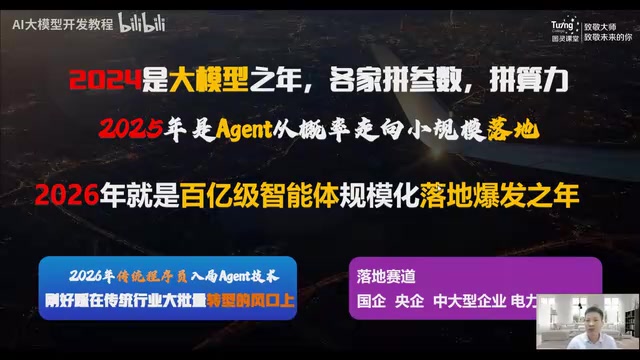
It's worth emphasizing that the core criterion in enterprise hiring is hands-on implementation experience. Candidates who only learn from videos and memorize theoretical interview prep material will struggle to pass interviews—practical ability is what matters. For professionals with standard undergraduate degrees, focusing on the LLM application track offers the best ROI as an entry point.
Common Pitfalls of Traditional Agents: A Travel Planning Example
The best way to understand Agent optimization is to first see the shortcomings of traditional Agents clearly. Consider a travel planning request: the user asks, "Three-day trip to Qingdao, total budget 2,500 RMB, please plan it for me." The requirements are very clear—destination Qingdao, duration three days, budget 2,500.
But the first major pitfall of traditional Agents is hardcoded keywords: putting all code in a single file with "Qingdao" hardcoded into the project. On the surface, the workflow runs fine, but the moment a user rephrases, it completely breaks. This approach is known as the "Magic String" anti-pattern in software engineering, and it's particularly fatal in Agent development.
For example, if the user instead asks, "I want to visit Shandong for three days, a short beach trip to Qingdao," the hardcoded "Qingdao" check fails because even one extra character throws off the match. LLMs have extremely poor literal generalization abilities, and hardcoded approaches can neither adapt to expression variations nor support new cities or diverse user queries.
The correct approach for production-grade Agents is to leverage the LLM's own natural language understanding capabilities for intent recognition and entity extraction (NER), rather than using regex or keyword matching. For example, by designing a dedicated intent-parsing Agent that uses Structured Output to convert the user's free-form expression into standardized JSON parameters (destination, duration, budget, etc.), which are then passed to downstream planning Agents. This "semantic parsing first" architectural design not only adapts to diverse user expressions but can also continuously improve parsing accuracy through few-shot examples. This is the critical dividing line between the many Agents that remain "toy demos" and truly production-ready systems.
Conclusion: Seize the Optimal Window for Agent Development
We are currently at a critical inflection point in the explosion of AI Agents at a massive scale. Compared to the earlier competition focused on "bigger models, more parameters," the industry focus has fully shifted to application deployment. For traditional programmers, entering Agent development now is perfectly timed with the industry's large-scale transformation wave—abundant positions, scarce talent. But to truly seize this opportunity, you must master production-grade implementation skills from architecture to deployment, rather than staying at the surface level of prompt engineering and basic RAG.
For a recommended technical learning path, follow this progressive roadmap: "Prompt Engineering Fundamentals → RAG System Development → Single Agent Development → Multi-Agent Collaboration → Industry-Specific Deployment." Among these, proficiency in at least one mainstream Agent framework (such as LangChain/LangGraph), understanding the Function Calling mechanism, and possessing the engineering ability to integrate with existing enterprise systems represent the core leap from "getting a demo to run" to "delivering a production project."
Key Takeaways
Related articles

Apple Watch ECG Detects Atrial Fibrillation, Saves Triathlete's Life: A Real-World Story
Triathlete Connor's heart rate spiked to 219 bpm during a race. His Apple Watch ECG detected AFib, leading to open-heart surgery that fixed a hidden heart condition.

Norcross Maine Forest Fire Maps: A Century-Old Cartographic Legacy and Data Visualization Pioneer
Explore Archie G. Norcross's 1918–1922 Maine forest fire maps—a hand-drawn cartographic masterpiece that pioneered early data visualization and remains valuable for climate research, historical GIS, and AI fire monitoring.

Apogee: A Privacy-First Browser Summarization Extension Rebuilt with Local AI After Mozilla Killed Orbit
After Mozilla killed Orbit, an indie developer rebuilt a fully local AI browser summarization extension called Apogee using Ollama, WebGPU, and Transformers.js—no user data ever leaves your device.