From Retrieval to Typed Decisions: Unpacking System One Models Built from Biomedical Sentence Encoders

Architecture choice determines retrieval prior value; C head plus cross-entropy remains the winning combo for biomedical decision models.
This paper systematically investigates the feasibility and optimal strategies for transferring biomedical sentence encoders (Sentence-Transformers) into typed decision models. The SBERT2S1 framework adapts retrieval encoders into three architectures — bi-encoder, cross-head (C), and prior-fused residual (PFR) — and releases the BIODECIDE benchmark and MEDLINE-S1 dataset. Key findings show strong architecture dependence: retrieval training significantly helps PFR but often hurts C; yet C outperforms PFR under every training objective. RLCD trails cross-entropy by 2.5–3.0 points due to reward normalization amplifying noise, a gap addressable via leave-one-out estimation. Temperature-scaled cross-entropy remains the calibration baseline none can surpass.
Background: What Are Typed Decision Models?
In natural language processing, Typed Decision Models are emerging as an efficient paradigm for text understanding. These models can answer schema-constrained questions in a single forward pass and return probability values suitable for threshold-based decisions. In other words, they don't require complex multi-round reasoning — instead, they output structured, immediately actionable decisions in one computation. This aligns well with the growing industry interest in "System One" (fast-thinking) models.
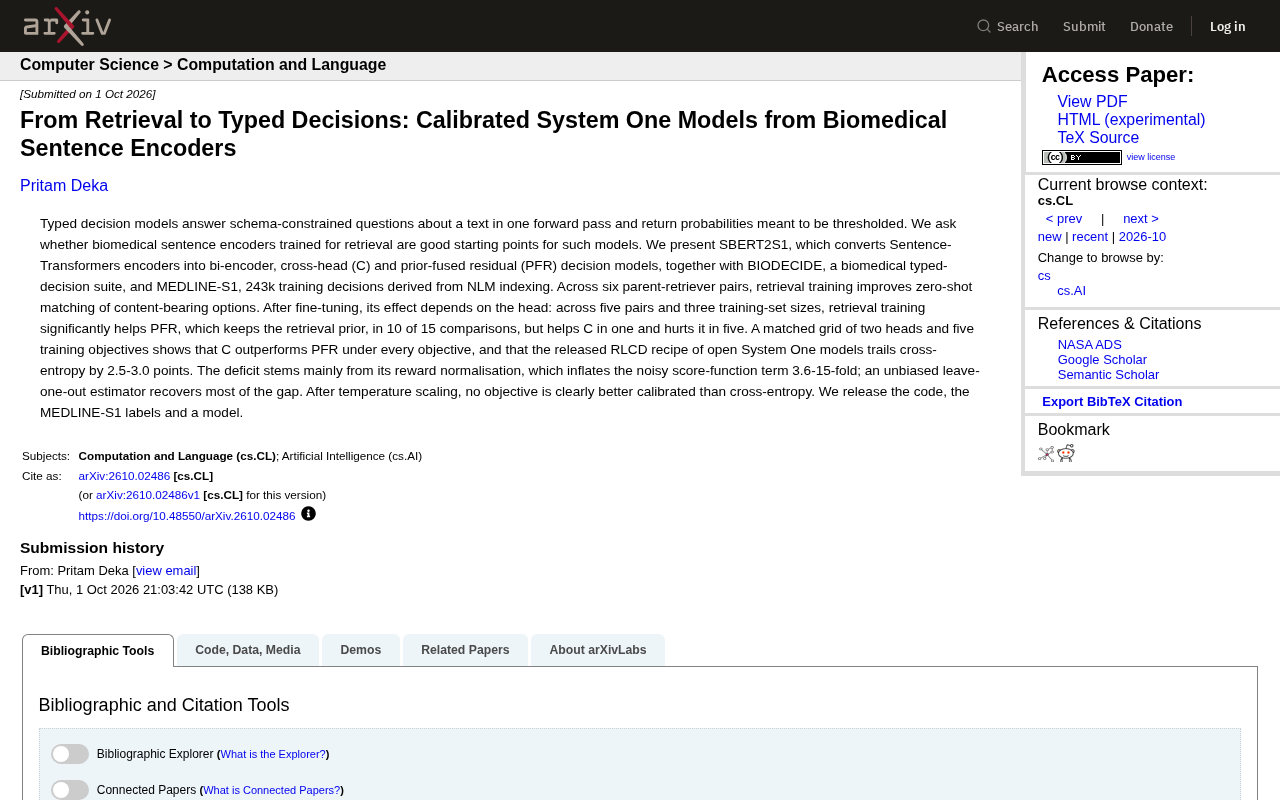
A new arXiv paper (arXiv:2610.02486v1) poses a central question: can biomedical sentence encoders trained for retrieval tasks serve as strong starting points for building such decision models? The significance is clear — retrieval training has produced a wealth of mature pretrained models, and if these can be transferred to decision tasks, the cost of building specialized models drops substantially.
The term "System One" (fast thinking) borrows from psychologist Daniel Kahneman's dual-process framework in Thinking, Fast and Slow: System One is intuitive, rapid, and automatic; System Two is deliberate, slow, and requires step-by-step reasoning. Mapped onto NLP, "System One models" refer specifically to lightweight models that output decisions directly in a single forward pass — as opposed to "System Two" architectures that rely on multi-step chain-of-thought reasoning or multi-round retrieval-augmented generation. In biomedical settings, System One models are especially attractive: tasks like clinical literature indexing and adverse drug reaction monitoring often require high-throughput batch judgments over massive text volumes. Architectures that return probability values in a single computation offer lower latency, and their outputs can be used directly for threshold filtering without additional post-processing.
Core Method: SBERT2S1 and Three Decision Heads
The research team proposes the SBERT2S1 framework, which converts Sentence-Transformers encoders into decision models with three distinct architectures:
- Bi-encoder: Preserves the typical structure of retrieval models
- Cross-head (C): Processes text and options via cross-attention
- Prior-Fused Residual (PFR): A residual structure that retains retrieval prior information
These three architectures represent different degrees of "preservation" versus "reconstruction" in the transition from retrieval to decision-making. PFR deliberately retains the retrieval prior, while C leans more toward relearning decision logic from scratch.
To support the experiments, the team also released two key resources: BIODECIDE — a biomedical typed decision test suite — and MEDLINE-S1 — a dataset containing 243,000 training decisions derived from NLM (National Library of Medicine) indexing data. Deriving training labels from authoritative medical indexing ensures both professional quality and scale.
Sentence-Transformers (SBERT), introduced by Nils Reimers et al. in 2019, adds a pooling layer on top of pretrained BERT and fine-tunes it via a Siamese network structure using contrastive learning or natural language inference tasks. The result is sentence vectors whose semantic distance can be measured directly with cosine similarity. This framework dramatically reduces the inference cost of semantic retrieval — unlike original BERT, which requires cross-encoding every text pair, SBERT can precompute document vectors offline and perform a single vector lookup at query time. However, whether this "retrieval-friendly" representation space is naturally suited for classification and decision-making is precisely the question this paper aims to answer systematically. Training labels in the MEDLINE-S1 dataset come from NLM's MeSH (Medical Subject Headings) indexing system, in which human annotators assign controlled vocabulary terms to each article in the MEDLINE database — widely considered the gold standard source for biomedical literature auto-indexing.
Key Finding: The Double-Edged Sword of Retrieval Training
Experimental results reveal a nuanced and important phenomenon: the value of retrieval training is highly dependent on the decision head architecture it is paired with.
In zero-shot settings, retrieval training does improve a model's ability to match "content-bearing options" — which is intuitive, since retrieval models are inherently good at semantic matching.
But after fine-tuning, the picture becomes more complex. The team ran comparisons across five model pairs and three training set sizes:
- For PFR, which retains the retrieval prior, retrieval training provided significant benefits in 10 out of 15 comparison groups
- For the C head, retrieval training helped in only 1 group, while hurting performance in 5
This shows that the benefits of retrieval training only materialize when the model architecture can "inherit" that prior. Once an architecture is designed to relearn decision logic (as with the C head), stacking retrieval priors on top can actually interfere with training.
Architecture Showdown: Why C Head Wins Overall
Despite retrieval training favoring PFR, the paper reaches the opposite conclusion on absolute performance. Through a matched grid experiment covering two decision heads and five training objectives, results show that the C head outperforms PFR under every training objective.
This finding is illuminating: while retrieval priors provide an early advantage, an architecture capable of fully relearning the task (C) ultimately has a higher performance ceiling. For practitioners, this means that if sufficient training data and compute are available, directly training a cross-head model is likely the better choice.
Training Objective Comparison: Why RLCD Falls Short
The paper also offers a detailed analysis of different training objectives, including pointed criticism of the RLCD (Reinforcement Learning from Contrastive Distillation) recipe used in some open-source System One models.
Experiments show that the RLCD recipe lags behind standard cross-entropy by 2.5 to 3.0 percentage points. The team further diagnoses the cause: this gap stems primarily from RLCD's reward normalization mechanism, which amplifies noisy score function terms by a factor of 3.6 to 15×.
More valuably, the team proposes a fix — using an unbiased leave-one-out estimator — which recovers most of this performance gap. This provides a concrete engineering path toward improving reinforcement learning-style training objectives.
RLCD (Reinforcement Learning from Contrastive Distillation) is a class of training recipes that combines contrastive learning with reinforcement learning signals. The basic idea is to use a teacher model's (typically a larger language model's) output distribution as a reward signal, guiding the student model to learn decision preferences via policy gradient updates rather than direct supervised label fitting. This approach has been used in some open-source System One projects to improve judgment on ambiguous boundary cases. However, when its reward normalization step standardizes scores within a batch, if the in-batch sample distribution is uneven or the teacher scores are noisy, the normalization factor amplifies that noise proportionally, distorting the gradient signal. The leave-one-out estimator proposed in this paper addresses this by excluding each sample from its own baseline computation, reducing variance from within-batch autocorrelation and providing more stable policy gradient estimates — a technique consistent with variance reduction methods in the REINFORCE algorithm.
Calibration Perspective: Cross-Entropy Remains Hard to Beat
On the dimension of model calibration, the paper delivers a pragmatic conclusion: after temperature scaling, no training objective shows a clear calibration advantage over cross-entropy.
This result is especially important for typed decision models that aim to produce "thresholdable probabilities" — because their output probabilities must be reliably used for threshold-based decisions, and calibration quality directly determines practical utility. Since cross-entropy, after simple temperature scaling, can match the calibration level of more complex objectives, this effectively endorses the simpler approach.
Model calibration measures how well predicted probabilities align with actual frequencies: a perfectly calibrated model should have exactly 70% true positives among samples it predicts with 70% confidence. Temperature scaling is the most commonly used post-processing calibration method — it divides logits by a scalar temperature parameter T before the softmax, searching for the optimal T by minimizing negative log-likelihood on a validation set. T > 1 smooths the distribution (reducing overconfidence); T < 1 does the opposite. This operation is computationally cheap and does not change the model's ranking performance (AUC remains unchanged) — it only adjusts probability magnitudes. For typed decision models, calibration quality directly affects threshold portability: if probability scales are consistent across different data sources, practitioners only need to set a single global threshold once and reuse it across scenarios — a significant engineering advantage in deployed medical information systems.
Summary and Open-Source Contributions
This study provides a systematic empirical analysis for the biomedical NLP field, answering several key questions about transferring retrieval encoders to decision models. The core conclusions can be summarized as: the value of retrieval training depends on whether the architecture preserves the prior; the C head achieves superior absolute performance; and at the training objective level, cross-entropy with temperature scaling remains a formidable baseline that is difficult to beat.
The team has open-sourced the complete code, the MEDLINE-S1 label dataset, and a pretrained model, lowering the barrier for follow-up research and practical applications. For researchers working on automated medical text indexing, clinical decision support, and related tasks, these resources offer direct practical value.
Related articles

Cursor AI Programming in Practice: Build a Student Management System from Scratch in 30 Minutes
A Bilibili creator demonstrates Cursor AI programming: generating a student management system in 30 minutes with natural language. Details on Agent mode, Claude selection, prompt techniques, and thresholds.

Top 20 AI Coding Tools Ranking: From Rock-Solid to Lackluster, a Scored Matrix
Bilibili creator releases top 20 AI coding tools ranking, tiered T0–T4 from rock-solid to lackluster, with Claude Code and Codex tied at T0. This article details the scoring dimensions (capability, reliability, robustness, durability, cost, domestic availability) and tool performances to help developers choose the right AI coding assistant.

Vibe Coding Systematic Tutorial: Master AI-Assisted Programming from Zero
A three-month Vibe Coding tutorial from a Bilibili creator covering Codex, ClaudeCode, and Cursor, from core logic to commercial project practice for beginners.