From Solo to Team Player: The Journey of an AI/LLM Self-Learner
A skilled AI/LLM self-learner faces the universal hurdle of transitioning from solo developer to team engineer.
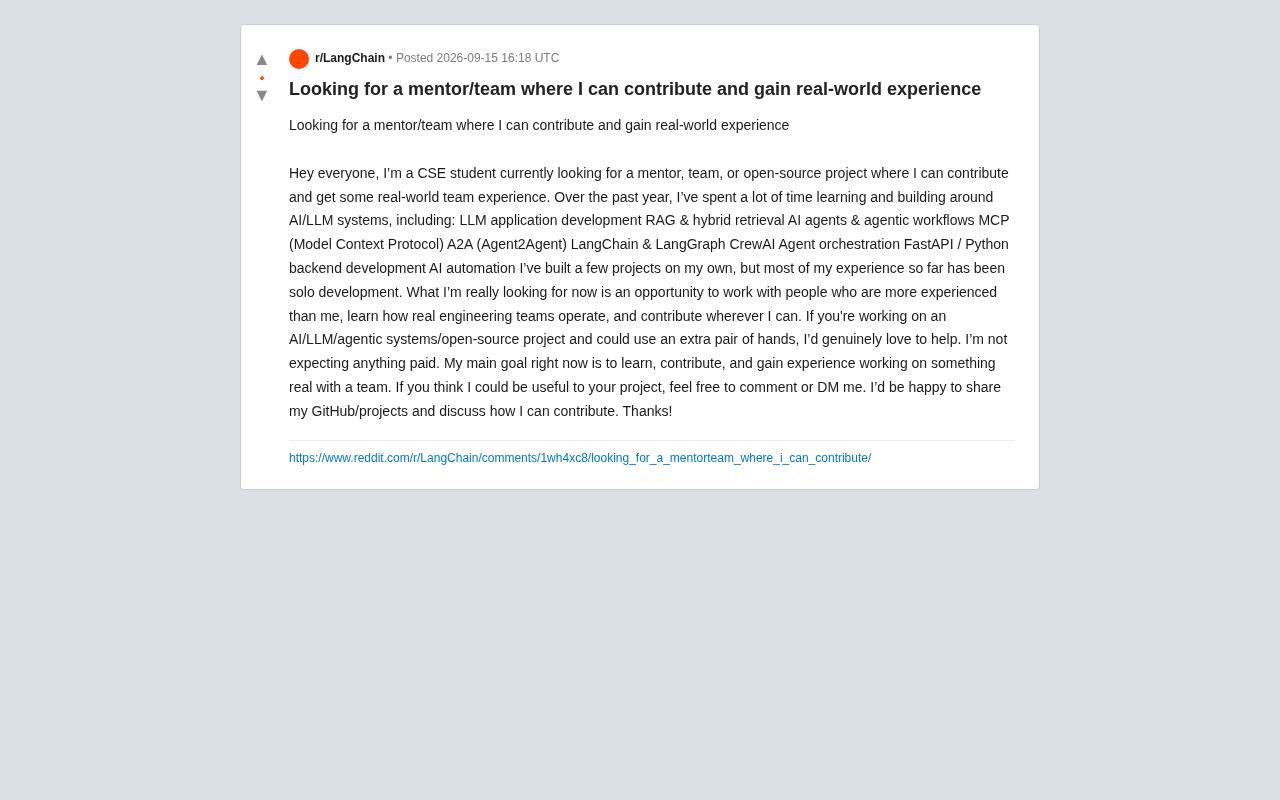
A CSE student proficient in LLM, RAG, AI Agent, MCP, A2A, LangChain, and CrewAI posted on Reddit seeking team collaboration. The article identifies a shared pain point among AI self-learners: personal projects prove coding ability but can't develop collaborative engineering skills like code review or technical trade-offs. Contributing to familiar open-source projects like LangChain and CrewAI is the most practical path forward — low-barrier, transparent, and buildable into a verifiable track record. The key insight: in an era of democratized AI, the ability to build alone is common; what's truly scarce is the collaborative judgment that only real teams can teach.
A computer science student posted on Reddit looking for mentors, teams, or open-source projects — hoping to transition from solo developer to a real engineering team. The post may seem ordinary, but it reflects a growth bottleneck that's increasingly common among AI/LLM self-learners: a solid tech stack, but virtually no hands-on collaborative experience.
A Skill Set That Defines the Era
The skills this CSE (Computer Science and Engineering) student listed cover nearly every major direction in modern AI application development:
- LLM application development: Practical deployment of large language models
- RAG and hybrid retrieval: Retrieval-Augmented Generation — the core technique for tackling hallucination and knowledge staleness
- AI Agents and agentic workflows: Intelligent agents and their orchestration
- MCP (Model Context Protocol): A protocol for standardizing model-tool interactions
- A2A (Agent-to-Agent): Inter-agent communication
- LangChain and LangGraph: Leading orchestration frameworks
- CrewAI: A multi-agent collaboration framework
- FastAPI / Python backend development: Engineering fundamentals
- AI automation
Notably, protocols like MCP and A2A only entered widespread discussion recently. The fact that a current student independently learned and experimented with these topics speaks to how accessible quality learning resources have become — given enough self-motivation, an individual can build a comprehensive understanding of modern AI in a remarkably short time.
RAG (Retrieval-Augmented Generation) is the dominant engineering solution to two fundamental flaws in large language models: "hallucination" (the tendency to fabricate plausible-sounding answers when uncertain) and knowledge staleness caused by training data cutoffs. The core idea is to retrieve relevant document chunks from an external knowledge base (typically a vector database) before generation, then pass those chunks as context to the model — grounding the response in verifiable sources. "Hybrid retrieval" combines semantic vector search with traditional keyword-based search (like BM25), blending the strengths of semantic understanding and exact matching.
MCP (Model Context Protocol) is an open protocol introduced by Anthropic in late 2024, designed to standardize how AI models interact with external tools and data sources — think of it as the "USB standard" for AI tool-calling. A2A (Agent-to-Agent) is a protocol released by Google in 2025, focused on communication and task delegation between different AI agents, enabling multiple independent agents to collaborate across systems on complex tasks. Both are emerging standards that only entered engineering practice in 2024–2025, and actively tracking and experimenting with them as a student reflects genuine technical awareness.
The Core Pain Point: The Lonely Solo Developer
The most honest line in the post is: "I've worked on several projects, but most of my experience comes from solo development."
This is the shared struggle of many self-taught developers. Personal projects can demonstrate that you can write code and get a demo running — but they can't answer the more critical questions:
- How do you manage branches and resolve conflicts in a multi-person codebase?
- How do you understand and build on modules written by others?
- How do you make technical trade-offs when real requirements change?
- How do you conduct code reviews, and how do you handle criticism?
Engineering competency is, to a large degree, about internalizing collaboration practices and engineering norms — and these are nearly impossible to develop by coding alone. This student clearly stated that their primary goal isn't compensation, but "learning, contributing, and working with a team on real projects" — a grounded and realistic mindset.
Open Source: The Most Practical Path Forward
For developers at this stage, contributing to open-source projects is often the highest-leverage way to grow. Here's why:
Low barrier to entry, high transparency. Open-source communities generally welcome new contributors. Issue trackers regularly feature tasks labeled good first issue, designed for gradual onboarding.
Exposure to real engineering practices. Reading the PR discussions, architecture decisions, and review comments in a mature project teaches engineering thinking that far exceeds what personal projects can offer.
A verifiable contribution record. Compared to "I built a RAG demo," a merged PR in a well-known AI framework carries much more weight — especially when the tech stack already includes active open-source ecosystems like LangChain and CrewAI, making direct contribution a natural next step.
From this angle, the poster already holds the key to their goal: LangChain, LangGraph, and CrewAI are all open-source projects. Rather than casting a wide net asking for mentorship, diving deep into one of these communities — starting with documentation fixes and bug reproductions — is a more direct path to building credibility.
For those looking to start contributing to LangChain or CrewAI, a few concrete entry points are worth knowing. good first issue is a standard GitHub label that maintainers use to flag contributor-friendly tasks — typically documentation improvements, better error messages, or small bug fixes. Before submitting a PR, an even lower-stakes starting point is "reproducing an issue" — confirming a reported bug locally and leaving a comment with reproduction steps. This kind of contribution involves no code changes, yet it helps maintainers quickly isolate problems and is genuinely appreciated as a way to establish a community presence. Joining PR review discussions — even just to ask questions or confirm understanding — also accelerates absorption of a project's code style and design philosophy.
Advice for Learners in the Same Boat
This post is valuable precisely because it represents the situation of a large and growing group. If you're also stuck at "lots of technical skills, zero collaborative experience," here's a practical roadmap:
Let Your Work Speak
The poster mentioned being willing to share their GitHub and projects — that's exactly right. When reaching out for help, linking to a concrete, runnable project with a clear README is far more persuasive than listing a string of technology names.
Approach as a Contributor, Not a Receiver
"Here's how I can help" gets more responses than "who can mentor me?" Picking an open-source project you care about and submitting one or two small PRs is almost always more effective than posting publicly asking to be taken under someone's wing.
Participate in Communities, Don't Just Lurk
Joining relevant Discord servers, GitHub Discussions, or technical communities — and consistently engaging, answering others' questions, and showing up — naturally builds both skills and connections over time.
Conclusion
This student's post contains no groundbreaking technical achievement, but it honestly documents a critical inflection point on the self-learner's growth curve in the AI era — the shift from "I can build it" to "I can build it well with others." In a world where AI technology is increasingly democratized, the ability to build things independently is no longer rare. What's rare is the capacity for collaboration, communication, and engineering judgment — and those can only be developed inside a real team.
Related articles
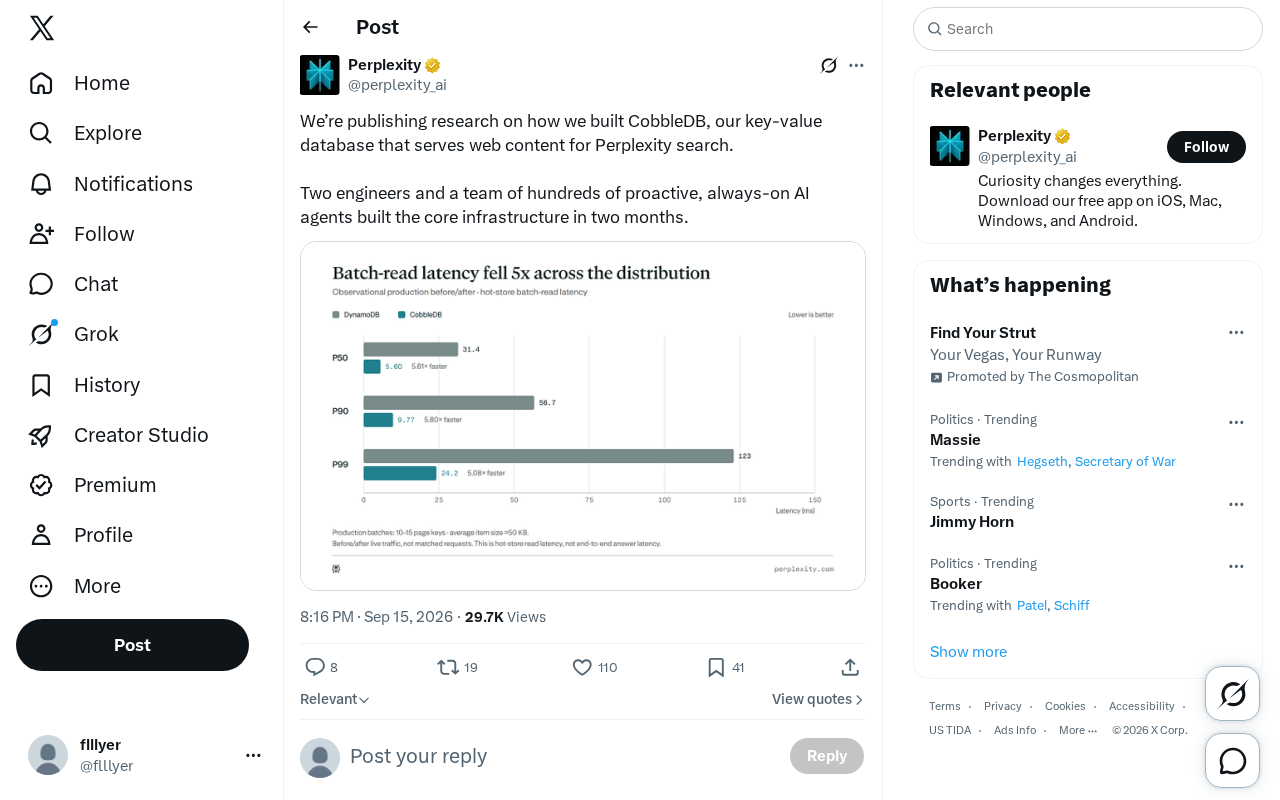
Perplexity's In-House CobbleDB: 2 Engineers + Hundreds of AI Agents Built Search Infrastructure in 2 Months
Perplexity reveals CobbleDB, an in-house key-value database built by just 2 engineers and hundreds of AI agents in two months, signaling a new era of AI-driven software development.

Complete Guide to Running Your Own Local DeepSeek: Web Access, Knowledge Base & Privacy
Step-by-step guide to deploying a private DeepSeek locally using Ollama, Chatbox, and AnythingLLM — with web access, RAG knowledge base, and full privacy.
AI Agent Development: A 4-Stage Learning Roadmap from Beginner to Enterprise-Level Practice
A complete AI Agent learning roadmap from zero to enterprise-level: covering ReAct, multi-agent collaboration, Prompt tuning, RAG, MCP, and real-world projects.