From Transductive to Inductive: How the AI Reasoning Paradigm Shift Is Powering Coding Agents

AI is moving from direct token completion to on-the-fly reasoning chains — the key shift enabling real coding agents.
This article unpacks a viral technical claim: AI is shifting from a transductive paradigm (token-by-token answer completion, essentially pattern-matching) to an inductive paradigm (on-the-fly reasoning chain synthesis). The transductive approach struggles with multi-step logic as errors compound across tokens. The inductive approach lets models invest test-time compute into intermediate reasoning steps before committing to answers. The core argument is that this shift is precisely what makes coding agents viable — programming requires planning, backtracking, and structured reasoning across files, tasks where direct completion reliably breaks down. The article also notes the framework originated as a condensed tweet, making it an insightful metaphor rather than strict academic terminology.
A Paradigm Debate Behind a Single Image
A tweet making the rounds put forward a weighty claim: AI is undergoing a shift from a transductive paradigm to an inductive paradigm — and this shift is precisely what makes coding agents actually work.
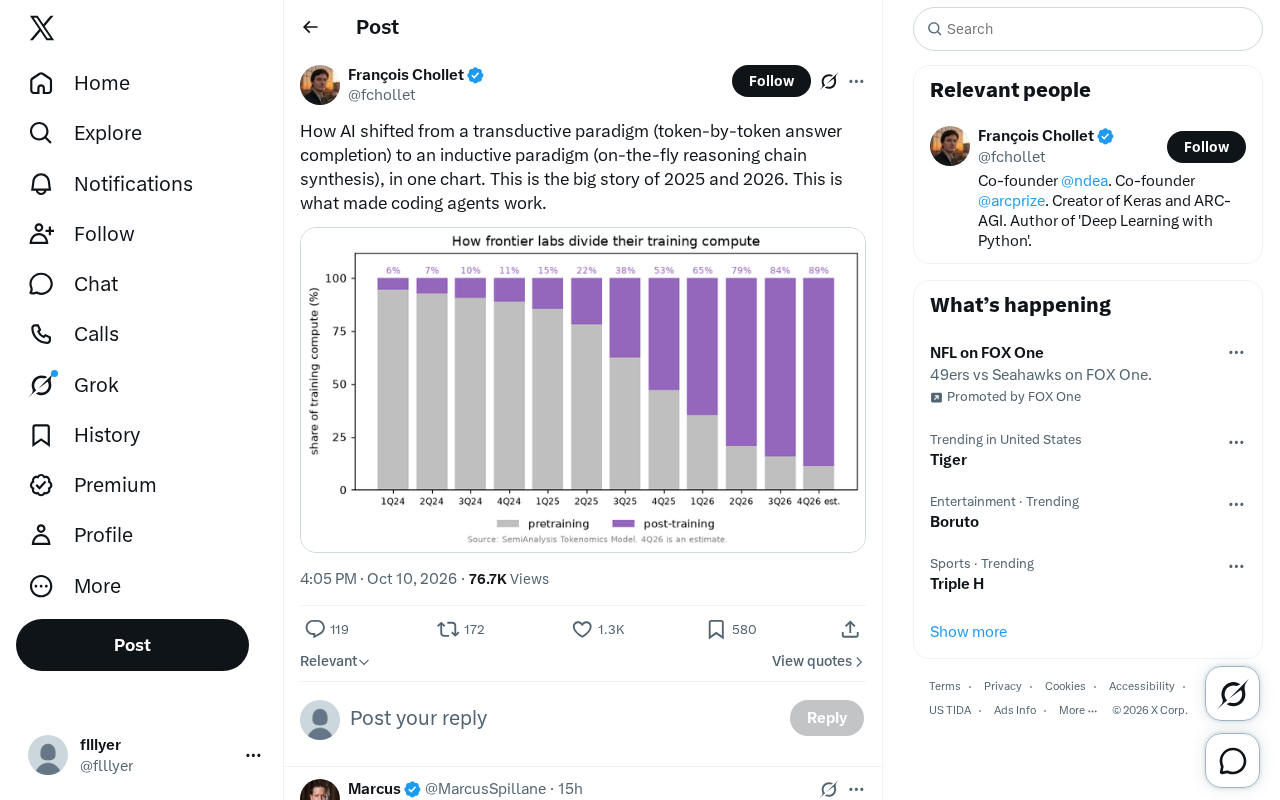
According to the original post, this is the big story running through everything right now. Though brief, this comparative framework cuts to a core evolution in how large language models operate, and it's worth unpacking in full.
What Is the Transductive Paradigm
The transductive paradigm refers to models generating answers directly through token-by-token answer completion. You provide a prompt, and the model outputs a response one word at a time, drawing on existing context — essentially performing a pattern-matching continuation.
This works well in many scenarios: writing polished copy, answering factual questions. But it has a structural weakness: the model doesn't engage in substantial "thinking" before generating an answer. Compute is spread evenly across every token rather than allocated dynamically based on the difficulty of the problem. For complex tasks requiring multi-step logic, this "blurt it out" style of generation tends to go wrong midway, with errors compounding across subsequent tokens.
The term "transductive" originates in statistical learning theory, introduced by Vladimir Vapnik in the 1990s. Unlike inductive learning — which extracts generalizable rules from training samples — transductive learning makes no attempt to build a universal model, instead reasoning directly from known training samples to specific test samples. Vapnik's original context was semi-supervised classification: since what we actually care about is predicting a specific test point, why bother learning a complete function as an intermediate step?
The original post borrows this term as an analogy for LLMs' autoregressive generation mechanism: each output step is heavily dependent on the current specific context window, with no mechanism for systematic planning before generation begins. The core insight of this analogy is that autoregressive completion is fundamentally "respond in place" rather than "model first, then output." Understanding this term's disciplinary background helps clarify the contrast the author is trying to draw.
What the Inductive Paradigm Brings
The central change in the inductive paradigm is on-the-fly reasoning chain synthesis. Rather than rushing to a final answer, the model first constructs a chain of reasoning during generation — decomposing complex problems into a series of intermediate steps and working toward a conclusion incrementally.
This aligns closely with the trajectory of chain-of-thought reasoning and inference models that have attracted so much attention in recent years. The distinction here is one of perspective: the original post elevates this to the level of a paradigm shift — not simply adding "let's think step by step" to a prompt, but a fundamental change in how the model operates, from "answer directly" to "build a solution on the spot."
This shift means the model can invest more compute at inference time (test-time compute), spending more steps on hard problems and fewer on easy ones. Making the reasoning process explicit also gives the model space for self-checking and error correction, rather than committing blindly to a single path.
Test-time compute is the key technical concept for understanding this paradigm shift. Traditionally, scaling model capabilities has meant investing more data and parameters during training (the scaling law), but the marginal returns on this approach have been diminishing. The arrival of OpenAI's o1 series marked the maturation of an alternative route: having the model generate extensive intermediate reasoning steps at inference time, trading increased inference compute for higher accuracy.
Mechanically, this corresponds to two different compute allocation strategies. In the transductive paradigm, computation is distributed evenly across each output token. In the inductive paradigm, the model can invest heavily in "thinking tokens," while the final answer tokens become relatively lightweight. Work from models like DeepSeekAd-R1 and Claude's extended thinking mode shows this approach delivers especially significant gains on structured tasks like math and code — exactly the core use cases for coding agents.
Why This Makes Coding Agents Work
The most striking claim in the original post is: this is precisely what makes coding agents work.
The causal link is worth examining. Programming tasks are exactly where the transductive paradigm is most prone to failure — writing code requires understanding requirements, planning architecture, handling edge cases, and debugging errors. It's a quintessential multi-step, logic-heavy task. If a model is just "guessing" what the next line of code should be token by token, it will struggle with anything beyond trivially simple engineering work.
When a model can synthesize reasoning chains on the fly, it can operate more like a human engineer: first analyze the problem, then decompose the task, then implement step by step, and backtrack to adjust when errors arise. The reason coding agents can handle real development tasks spanning multiple files and involving repeated trial and error is precisely this kind of structured reasoning capability — not simple text completion.
The essential difference between a coding agent and earlier code completion tools (like early GitHub Copilot) lies in task granularity and execution depth. Code completion tools could already perform well under the transductive paradigm — they handle local, context-clear continuation tasks. Coding agents, by contrast, face complete engineering problems: understanding natural language requirements, formulating an implementation plan, modifying code across files, running tests, and iterating based on error messages.
These tasks are characterized by asymmetric error costs — early planning mistakes can require scrapping large amounts of subsequent code, and the transductive paradigm has no mechanism for "rehearsing" before generation. The ability of Cognition's Devin, Anthropic's Claude Code, and various tool-calling agent frameworks to handle real repository-level tasks depends on the model's capacity for multiple rounds of internal reasoning before executing specific actions, decomposing sub-goals, and replanning when obstacles arise.
A Framework Worth Scrutinizing
It must be noted that this is a highly compressed take from a tweet, using the classic ML pairing of "transductive" and "inductive" as an analogy for the evolution of current inference models — more an illuminating conceptual metaphor than a rigorous academic definition. The original post provides no accompanying paper or extended argument, and the specific data in the diagrams are not elaborated in the text.
That said, the value of this framework lies in how it captures a real technical trend in a single sentence: the shift from models "giving answers directly" to models "figuring things out on the spot." This shift does correspond to the rise of reasoning models, and it does coincide with the timeline of coding agents graduating from "toy" to "actually useful."
For those tracking AI applications in practice, this perspective offers a useful heuristic: when assessing the capability ceiling of an AI system, ask whether it is completing or reasoning.
Related articles

LLaMA-Factory in Practice: A Complete No-Code Guide to Fine-Tuning Large Models
An introduction to LLaMA-Factory, the open-source fine-tuning tool: its 60.1K-star background, supported models and algorithms, local vs. cloud deployment, and CUDA setup steps.

Zeng Ming's Deep Retrospective: Why OpenAI May Not Be the Ultimate Winner — and Why the Corporate System Will Disappear
Zeng Ming's deep retrospective on the AI endgame: model companies are just infrastructure, OpenAI and Anthropic won't be the final winners; the next battle is the Agent entry point standard; the corporate system will disappear as AI restructures collaboration, and only mission-driven companies can survive the cycle.

OpenHands v1.28.0: OpenCode and PI Added as Built-in Agents, API Keys Requestable In-Conversation
OpenHands ships 5 releases in 21 days: v1.27.0 adds OpenCode and PI as built-in agents, v1.28.0 enables in-chat key requests. ACP integration, credential reuse, model list changes, and upgrade advice.