From Video to Notes to Knowledge Base: A Practical Guide to AI-Assisted Learning Workflows

Turn videos into structured notes and a searchable AI knowledge base with Dify—an end-to-end learning workflow.
This guide breaks down a complete AI-assisted learning workflow connecting video download, auto-transcription (Whisper), AI note generation, and a Dify-powered knowledge base with intelligent Q&A. It shows how to build a personalized, lightweight RAG system that transforms scattered video content into a searchable, traceable personal knowledge base.
In an era of information overload, turning massive amounts of video content into reusable knowledge is a common pain point for many learners. This article breaks down a complete AI-assisted learning workflow that chains together "video download → automatic transcription → AI-generated notes → knowledge base retrieval → intelligent Q&A" into a closed loop, helping you build your own AI learning system.
Core Idea: From Passive Viewing to Active Knowledge Accumulation
Traditional video learning has a fundamental flaw—once you've watched the content, it's hard to search and review. You might remember that a certain point appeared in a certain video, but you have to repeatedly drag the progress bar to find it. The core value of this workflow lies precisely in transforming "videos consumed once" into "structured knowledge that can be continuously retrieved."
The entire process is divided into three key stages: content acquisition (video download and transcription), knowledge processing (AI-generated structured notes), and knowledge retrieval (knowledge base search and Q&A). Each stage is handled by dedicated tools, and ultimately all notes are connected through a Q&A workflow built on Dify.
What is Dify? Dify is an open-source large language model application development platform. Since its release in 2023, it has quickly gained widespread attention in the developer community. Its core feature is visual workflow orchestration, allowing users to build multi-step AI applications by dragging and dropping nodes—no coding required. Dify natively supports knowledge base management, multi-model switching (compatible with OpenAI, Anthropic, local Ollama, etc.), and API publishing, and includes built-in observability tools that record the input, output, and latency of each call—this is precisely the technical foundation that allows the "debug branch" described later to quickly pinpoint issues.
Step One: Batch Download and Audio Transcription
The process starts with content acquisition. Using a tool like BBDown, you simply paste in the video URL, and whether it's a single video or an entire collection, everything can be captured at once—a significant efficiency boost compared to manually copying URLs one by one.
BBDown is an open-source command-line download tool developed specifically for the Bilibili video platform. Behind it lies deep reverse-engineering adaptation to the platform's proprietary protocols: Bilibili videos are distributed using the DASH (Dynamic Adaptive Streaming over HTTP) segmented streaming protocol. DASH is an adaptive bitrate technology formally standardized by MPEG in 2012. It splits video into small segments and provides multiple bitrate versions, with the client dynamically selecting the optimal quality based on real-time network bandwidth—which is precisely why download tools need to specifically parse and reassemble these segments to restore the complete video file. Bilibili applies permission tiers to resources of different resolutions (e.g., 1080P60 requires premium membership), and BBDown achieves automated capture by parsing the platform's API interfaces. It supports multiple encoding formats including AVC/HEVC/AV1, and can recognize Bilibili's unique BV number system and its content organization hierarchy such as collections/series/courses, automatically categorizing and storing files by directory.
It's worth noting that BBDown's deep adaptation to Bilibili's content structure makes it fundamentally different from general-purpose download tools (such as yt-dlp). Beyond protocol-layer adaptation, BBDown also handles Bilibili's unique authentication process: Bilibili's high-definition resource URLs are dynamically issued on the server side based on membership tier and are time-sensitive. BBDown carries the user's Cookie to make authentication requests, obtaining segment addresses for the corresponding resolution within the scope of legal authorization. The logic for handling this authentication mechanism is a platform-specific capability that general-purpose download tools cannot directly reuse, and it is also the core reason BBDown serves as an efficient starting point for the content acquisition stage in a video learning workflow.
Why does DASH make downloading complex? The adaptive nature of the DASH protocol means video and audio tracks are typically stored as separate segments across different CDN nodes. Taking Bilibili as an example, a 1080P video actually consists of dozens of 2–10-second video segments (in .m4s format) and an equal number of audio segments, described through an MPD (Media Presentation Description) manifest file that maps the relationship between each segment's URL and timestamp. BBDown's core work is precisely this: parse the MPD manifest → concurrently download all segments → invoke FFmpeg to merge the video and audio tracks into a complete MP4 file. Doing this manually would require considerable technical expertise, but BBDown encapsulates it into a single command, greatly reducing the operational complexity of batch collection.
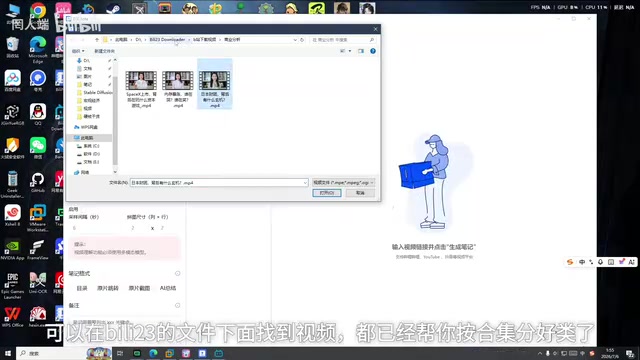
After downloading, videos are automatically stored by collection category, laying a solid foundation for subsequent management. Next comes the crucial audio transcription stage.
The technical principles of audio transcription Modern audio transcription primarily relies on the Whisper model series, open-sourced by OpenAI in 2022. Whisper uses a Transformer encoder-decoder architecture: the encoder converts the audio's Mel Spectrogram into semantic vector representations, and the decoder generates the transcribed text word by word in an autoregressive manner. A Mel Spectrogram is a way of representing audio that mimics the nonlinear perceptual characteristics of the human ear—the human ear is more sensitive to low-frequency changes than high-frequency ones, and the Mel scale is a mathematical model of this physiological trait, allowing the model to focus on the frequency ranges where speech information is most densely concentrated. This architecture was trained on 680,000 hours of multilingual audio data and supports transcription and translation in 99 languages. Models are categorized by parameter count into tiny, base, small, medium, large, large-v3, and other specifications, ranging from 39 million to 1.55 billion parameters. Larger parameter counts yield higher recognition accuracy but also multiply memory requirements—the large-v3 model requires about 10GB of VRAM during inference. Notably, Whisper employs a weakly supervised learning strategy, with training data drawn from the vast amount of subtitled audio and video on the internet. This gives the model strong generalization for natural speech, accents, and technical terms, but it also means recognition of proprietary terms in certain vertical domains (such as medicine and law) still has limitations—which is precisely the deeper reason behind the assertion that "transcription quality directly determines the information density of subsequent notes." For users with limited local compute, the faster-whisper library combined with the CTranslate2 engine can achieve transcription quality close to FP16 precision under INT8 quantization while running 2–4 times faster, making it a practical solution for balancing quality and compute cost.
There's a trade-off worth noting here: using a smaller model can significantly improve transcription speed, but to extract video content as completely as possible, it's recommended to choose the largest model your hardware can handle. Transcription quality directly determines the information density of subsequent notes—if local compute is limited, you can also opt for an online transcription service without relying on a local GPU.
Step Two: AI-Generated Structured Notes
The transcribed text is handed over to a note-taking tool (such as BiliNote) for AI summarization. BiliNote is an AI note-generation tool designed specifically for Bilibili videos. It integrates Whisper transcription capabilities with large language model summarization, supports customizable note styles (such as technical or plain-language), and formatted output. It serves as the key intermediate layer that transforms colloquial video content into structured, searchable notes. This step is not just simple text compression—users can adjust the style of the video content, customize the note format, and make the output better fit personal needs.
It's worth mentioning that the note-taking tool itself also supports generating notes directly via URL, but it's still recommended to first batch-capture collections with a download tool—batch processing of collections avoids the repetitive labor of copying URLs one by one. This reflects a simple yet important principle in workflow design: front-load and batch repetitive operations.
Once notes are generated, they can be converted into Markdown format with one click. This step is crucial—Markdown is a lightweight markup language designed by John Gruber in 2004, with a design philosophy of "readability first": even without rendering, plain text is easy for humans to read. In the AI era, Markdown's status has been further elevated: mainstream large language models have been extensively exposed to Markdown-formatted documents (such as GitHub repositories and technical blogs) in their training data, so they can accurately recognize and generate headings, lists, code blocks, and other structures; at the same time, Markdown files are plain text, making them easy to process in batch via scripts, to version-control, and to import into various knowledge base systems (such as Dify, Obsidian, and Notion). This makes Markdown the "universal currency" of the entire knowledge circulation chain—independent of any proprietary platform, it can be read and processed losslessly by any toolchain.
Markdown's status in the knowledge management ecosystem Markdown's lightweight syntax (
#for headings,-for lists, ``` for code blocks) was originally designed to let non-technical users quickly get started with document writing. However, in the context of AI knowledge management, its value has gone beyond usability itself: First, its plain-text nature keeps file sizes extremely small—the storage overhead of thousands of notes is far lower than that of Word or PDF. Second, structured markup (especially multi-level headings) provides natural boundaries for automatic chunking in knowledge bases—tools like Dify can split text blocks by heading hierarchy, avoiding cutting in the middle of semantically complete paragraphs. Third, Markdown's frontmatter (YAML header information) can carry metadata (such as source URL, creation date, and tags), providing a structured index for precise filtered retrieval later. Together, these three points make Markdown the optimal foundational format for engineering a personal knowledge base.
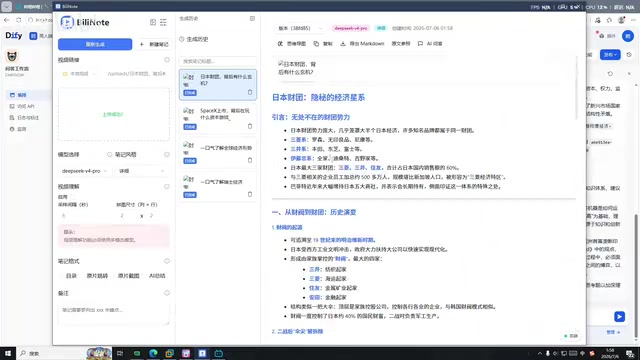
Step Three: Dify Knowledge Base and Retrieval Q&A Workflow
The most technically sophisticated part of this process is the intelligent Q&A workflow built on Dify. After batch-importing Markdown notes into the Dify knowledge base (Dify automatically deduplicates, so even selecting everything won't add duplicates), you can then intelligently query all your note content.
The Workflow's Retrieval Logic
The core of the workflow is a two-stage retrieval mechanism:
- Stage One: Keyword Extraction—first use the large model to extract keywords from the user's question, then use these keywords to search for relevant notes in the knowledge base.
- Stage Two: Content-Based Answering—based on the retrieved note snippets, have the large model provide a complete answer to the user's question.
Keyword Retrieval vs. Vector Retrieval The two-stage keyword retrieval in this article and the more advanced vector retrieval represent two technical approaches to knowledge base retrieval. Keyword retrieval (such as the BM25 algorithm) is based on word frequency statistics—it's fast and highly interpretable, but has limited ability to handle synonyms and semantically similar expressions. Vector retrieval, on the other hand, first uses an embedding model to convert text into high-dimensional vectors, then finds the most semantically similar snippets through metrics like cosine similarity, and can better understand that "苹果公司" (Apple Company) and "Apple Inc." refer to the same entity.
From the perspective of RAG engineering evolution, current practice has advanced from naive single-pass retrieval (Naive RAG) to Advanced RAG, which introduces query rewriting and reranking, and even to Modular RAG, which offers pluggable strategy combinations. The limitation of Naive RAG is that it uses the user's original question directly for retrieval, but users' natural language expressions often have a vocabulary mismatch with the writing style of knowledge base documents. Advanced RAG significantly improves recall by first rewriting and expanding the query before retrieval (Query Rewriting/Expansion). Currently, mainstream RAG systems typically adopt a "hybrid retrieval" strategy, merging keyword and vector retrieval results through Reciprocal Rank Fusion (RRF), then applying a reranking model for a second round of filtering, balancing speed and semantic accuracy. RAG performance bottlenecks typically concentrate in three areas: the text chunking strategy—if chunks are too large they introduce noise, if too small they lose context; the choice of embedding model; and the quality of the reranking model (e.g., BGE Reranker can significantly improve the final answer quality after coarse recall). This is precisely the background for the suggestion in the closing "areas for optimization" section to introduce more mature RAG strategies.
In addition, the workflow also includes a debug branch specifically designed to observe which stage an answer comes from—this is equivalent to adding observability to the workflow. Once answer quality has issues, you can quickly determine whether the error is in retrieval or generation, which is very practical when actually deploying AI applications.

Answers with Sources and Reflection Question Generation
After a question is asked, the system not only provides an answer based on the notes but also includes source citations—that is, which note files the answer came from. This solves the biggest trust issue with AI Q&A: traceability. Users can return to the knowledge base to view the original text via the returned filenames and verify the answer's accuracy for themselves.
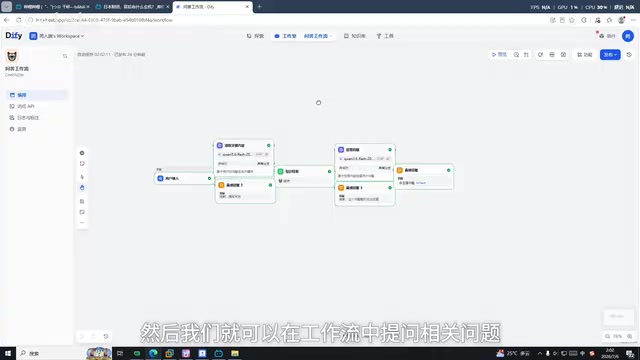
Going a step further, this workflow can also automatically generate reflection questions based on the note content, upgrading "looking up information" to "active learning," so the system does more than passively answer—it guides learners to think deeply.
Behind this feature lies the large language model's Instruction Following capability—by explicitly requiring the model in the prompt to "generate 3 open-ended reflection questions based on the following content," the model can identify core concepts from the retrieved note snippets and construct questions with graduated difficulty. This graduated design aligns with Bloom's Taxonomy, proposed by educational psychologist Benjamin Bloom in 1956 and revised in 2001: this framework divides cognitive objectives into six progressive levels—remember, understand, apply, analyze, evaluate, and create.
The reason Bloom's Taxonomy has regained practical value in the AI era is that it provides an actionable language system for cognitive objectives. In traditional classrooms, teachers rely on experience to judge the level of questions; but in the context of prompt engineering, these six levels can be directly translated into structured instruction constraints, transforming the LLM's question-generation behavior from a random distribution into a controllable cognitive gradient distribution. The key to this transformation is: the LLM itself has the ability to understand the difference between "analytical questions" and "memory-based questions," but if not explicitly specified in the prompt, the model tends to generate a question set with uniform difficulty and a single level. Encoding the Bloom framework into the system prompt is essentially using the model's meta-cognitive capability to constrain its output distribution.
Notably, these six levels have a direct operational mapping in prompt design:
| Cognitive Level | Example Prompt Instruction |
|---|---|
| Remember | "Please list the core definitions of X" |
| Understand | "Please explain how Y works in your own words" |
| Apply | "How can Z be used in a real project?" |
| Analyze | "In which dimensions do the core differences between X and Y manifest?" |
| Evaluate | "Compared to other approaches, what are the limitations of this approach?" |
| Create | "Please design a solution that combines multiple concepts" |
Explicitly encoding this framework into the prompt template can guide the LLM to automatically generate a question set covering different cognitive levels, avoiding content that stays at the shallow level of factual questions, thereby truly upgrading AI Q&A from an information-extraction tool to a higher-order cognitive-development tool.
The Value of the Workflow and Room for Optimization
The greatest highlight of this process is connecting multiple independent tools (downloader, transcription tool, note-taking tool, Dify) through a clear data pipeline, forming a complete knowledge production loop. The output of each stage becomes the input of the next, ultimately settling into a personal knowledge base that is searchable, queryable, and traceable.
As a lightweight solution built by an individual, there are still several areas for optimization:
- Balancing transcription speed and quality: Local large-model transcription is relatively slow, so you might consider cloud GPU inference or optimized quantized models. Quantization technology (such as the GGUF format combined with llama.cpp) compresses neural network weights from high-precision floating-point numbers (FP16) to low-precision integers (INT4/INT8): its core principle is to approximate the weight distribution with low-precision values, roughly halving VRAM requirements with each drop in precision level. Taking Whisper large-v3 as an example, FP16 requires about 10GB of VRAM, dropping to about 5GB after quantizing to INT8, making it runnable on consumer-grade 8GB graphics cards. GGUF (GPT-Generated Unified Format) is a quantization container format promoted by the llama.cpp project, supporting inference in pure CPU or hybrid CPU+GPU modes, greatly lowering the barrier to local deployment. Among common quantization levels, Q4_K_M (4-bit mixed quantization) is the mainstream choice for balancing precision and speed, reducing VRAM requirements by over 60% with minimal precision loss—an important hardware reference for individual learners choosing local deployment solutions.
How does quantization precision affect transcription performance? Quantization is essentially a form of lossy compression: mapping 32-bit or 16-bit floating-point weights to 4-bit or 8-bit integers introduces slight numerical errors. For speech transcription tasks, this error is usually limited in impact—research shows that after INT8 quantization, Whisper large-v3's word error rate (WER, the proportion of words a transcription system recognizes incorrectly) rises by no more than 1 percentage point, while inference speed can improve by 2–3 times. WER is calculated by aligning the transcription result with the reference text and counting the sum of substitution, deletion, and insertion errors divided by the total number of words in the reference text; a 1-percentage-point rise in WER means about one additional recognition error per 100 words in practice, with an extremely limited impact on the overall quality of note generation. However, in content dense with technical terms (such as programming tutorials or medical lectures), quantization errors may cause misrecognition of individual low-frequency terms—which is precisely why it's recommended to use higher-precision models when conditions allow.
-
Retrieval precision: Two-stage keyword retrieval is less precise than vector retrieval when handling complex semantics, and can be optimized by combining more mature RAG strategies. At the engineering level, RAG performance bottlenecks typically concentrate in three areas: the text chunking strategy, the choice of embedding model, and reranking quality—if chunks are too large they introduce noise, if too small they lose context; reranking models (such as BGE Reranker) perform fine-grained filtering after coarse recall, significantly improving final answer quality.
-
Degree of automation: Some steps still require manual operation (such as importing into the knowledge base). In the future, this can be further connected through scripts or Dify's automation capabilities—for example, using Dify's Webhook trigger to monitor a new-file directory, achieving fully unattended "automatic ingestion upon download completion."
Summary
This "video-to-notes + knowledge base + intelligent Q&A" workflow is essentially a lightweight implementation of a personalized RAG (Retrieval-Augmented Generation) system.
What is RAG? RAG (Retrieval-Augmented Generation) is a technical architecture that combines an information retrieval system with a large language model. Traditional large language models have their knowledge "frozen" in the training data and cannot be dynamically updated; RAG remedies this flaw by retrieving from an external knowledge base before generating an answer. Its core process is: user asks a question → retrieve relevant document snippets → feed the document snippets and question together into the model → generate an answer that can be verified against sources. This architecture was formally proposed by Meta AI in the 2020 paper "Retrieval-Augmented Generation for Knowledge-Intensive NLP Tasks," after which it rapidly became the mainstream solution for enterprise-grade AI applications. The core value of RAG lies in organically combining the model's "parametric knowledge" (learned during training) with "non-parametric knowledge" (obtained through external retrieval)—parametric knowledge is stored in the model weights, endowing the model with language understanding and reasoning capabilities; non-parametric knowledge is stored in an external database as document vector indexes, which can be updated at any time without retraining the model. This allows the same base model to answer both general questions and provide precise domain-specific answers based on a private knowledge base, all without expensive fine-tuning. The workflow described in this article is precisely a transplant of this enterprise-grade architecture into personal learning scenarios using a combination of open-source tools.
It doesn't rely on complex commercial products but instead combines open-source tools into a practical learning loop. For those who frequently learn through videos but struggle to retain knowledge, this is a practical model worth emulating.
More importantly, it demonstrates a paradigm shift in learning in the AI era: AI is no longer just a tool for answering questions, but a knowledge management partner running throughout the entire "acquire—process—store—retrieve" pipeline.
Key Takeaways
Related articles

The Chaotic Aesthetics of Apple's HomeView Ad: A Marketing Code Only Parents Can Read
Apple's HomeView smart display ad ditches minimalist style for chaotic family mornings to win over parents. We analyze why it confuses most viewers but resonates instantly with families — and the trade-offs and risks of Apple's targeted marketing.

Cerebras CEO Pushes Back on AI Doomerism: Stop Spreading Panic
Cerebras CEO Andrew Feldman publicly pushes back on AI doomerism at TechCrunch Disrupt, arguing excessive risk focus drowns out AI's real opportunities.

Retooling in Minutes: Industrial Next Redefines Factory Robot Flexibility
Industrial Next aims to let factory robots retool in minutes instead of weeks, automating complex delicate tasks and advancing flexible manufacturing and small-batch production.