The Most Comprehensive Agent Development Tutorial on Bilibili: From Zero to Expert in Seven Days

A Bilibili creator offers a three-part zero-foundation Agent tutorial: cognition first, then coding, then hands-on practice.
The article introduces a zero-foundation AI Agent development tutorial billed as "the most detailed on the internet." Noting that over 90% of Agent tutorials are polarized—either piling on jargon or throwing code at learners—the course was polished over four months and divided into cognition, advanced topics, and hands-on practice. The cognition part uses everyday analogies to explain the difference between an Agent and an LLM conversation, covering ReAct, planning, and memory, ending with a first demo; the advanced part covers LangChain and AutoGen, multi-Agent collaboration, Function Calling, hybrid ReAct architectures, and evaluation, debugging, and safety boundaries; the hands-on part delivers three enterprise-grade projects: intelligent customer service, automated data analysis, and a multi-Agent collaborative production line. The course includes source code, courseware, Prompt templates, and a learning roadmap. The "seven days from beginner to expert" claim is marketing.
AI Agent development is one of the hottest areas in tech right now, but most tutorials on the market either pile on grand concepts like "autonomous planning" and "tool calling," or simply throw a code snippet at you and tell you to call an API. Beginners often never even figure out what problem an Agent is actually solving. A Bilibili creator has released a zero-foundation Agent development tutorial billed as "the most detailed on the internet," aiming to break this impasse with a systematically designed curriculum.
Why Most Agent Tutorials Fail to Teach
According to the creator, before making the course he went through nearly all Agent-related content on Bilibili and YouTube, from technical blogs to open-source GitHub projects, and identified a pattern: over 90% of tutorials are polarized—either they only cover concepts, piling up terms like "autonomous planning" and "tool calling" without ever getting concrete, or they jump straight into coding, so learners are already calling APIs before they even understand the essential difference between an Agent and an LLM conversation.
This fragmented teaching approach leaves many beginners stuck in the awkward position of being "able to run a demo but unable to design a system." This course takes the opposite approach: first help you build an Agent mindset, then step by step build a genuinely usable agent. The creator says he spent four months polishing the content, breaking the core knowledge into three parts: cognition, advanced topics, and hands-on practice.
Cognition Part: Understand Agent Fundamentals Instantly with Everyday Analogies
The goal of the first part, "Cognition," is to build foundational understanding of Agents. The course first answers a key question: what exactly is the difference between an Agent and an LLM conversation?
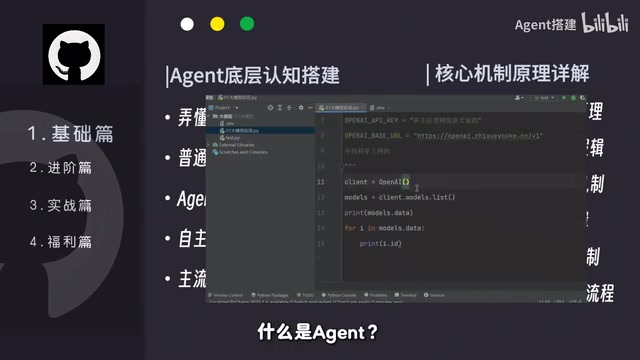
Around this question, the course unfolds concepts that sound intimidating—the ReAct framework, planning and reasoning, memory mechanisms, and more. The creator emphasizes using everyday analogies so learners grasp them instantly, rather than staying at the terminology level. The endpoint of the Cognition part is getting the first Agent demo running, letting learners personally experience what it feels like for an agent to "do work"—this step is crucial because it turns abstract concepts into tangible operations and prevents learners from falling behind later when they lack intuitive feel.
The ReAct framework is one of the most fundamental paradigms in the Agent field. Short for Reasoning and Acting, its core idea is to have the LLM advance a task in a "think—act—observe" loop: first output a piece of reasoning (Thought) to assess the current state, then decide which tool to call (Action), and after receiving the tool's result (Observation), continue to the next round of reasoning. Compared with having the model give an answer all at once, ReAct breaks complex tasks into verifiable steps, significantly reducing hallucinations and making debugging easier. It was first proposed by researchers from Princeton and Google in 2022 and is now the default implementation approach for Agent executors in frameworks like LangChain. Understanding ReAct's loop structure is the prerequisite for grasping later tool orchestration and multi-agent collaboration.
Advanced Part: Framework Practice and Engineering Skills
The second part, "Advanced," ramps up the intensity, covering hands-on practice with the LangChain and AutoGen frameworks, multi-Agent collaboration, Function Calling tool invocation, hybrid architectures of ReAct and Agents, as well as evaluation, debugging, and safety boundaries—topics many tutorials avoid.
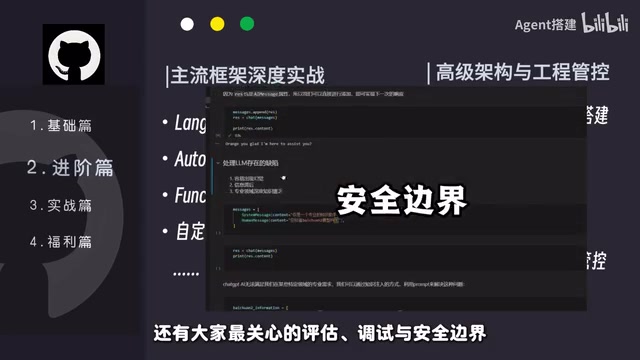
Every section includes companion code and courseware, and the creator promises to provide everything as a package to lower the barrier to following along. Judging from the course design, the focus of the Advanced part is not teaching you to call some framework's API, but helping you understand how multiple agents divide work, how tool calls are orchestrated, and how safety boundaries are set—these are the real difficulties when deploying enterprise-grade Agent applications.
Function Calling is the standardized interface through which LLMs interact with the outside world. Developers describe the names, parameters, and purposes of available functions using JSON Schema; the model decides during a conversation whether to call a function, which one to call, and generates parameters that match the schema; external code actually executes the call and then passes the result back to the model. It upgrades "the model outputs natural language" to "the model outputs executable instructions," and is the foundation for tool calling, database queries, and API integration. OpenAI first introduced this capability in June 2023, and mainstream model providers have followed suit. For Agents, Function Calling solves the key question of "how to let the model use tools reliably."
LangChain and AutoGen represent two different approaches to Agent development. LangChain is a comprehensive framework for building LLM applications, offering components such as model wrappers, prompt templates, chain orchestration, memory, retrieval, and Agent executors, suited to building single-agent or linear workflows. AutoGen, introduced by Microsoft Research, focuses on multi-agent conversation, modeling each agent as a configurable conversation participant and enabling division of labor and collaboration through message passing, suited to simulating team-style problem solving. The two are not mutually exclusive; in real projects, LangChain often provides tools and retrieval capabilities while AutoGen organizes multi-role collaboration. Understanding each one's positioning helps with technology selection.
Hands-on Part: Three Enterprise-Grade Projects
The third part, "Hands-on," goes straight to enterprise-grade projects in three directions: an intelligent customer service Agent system, from intent recognition to automatic ticket routing; an automated data analysis Agent that uploads Excel files and automatically produces reports and charts; and a multi-Agent collaborative production line where multiple agents divide and collaborate like a team.
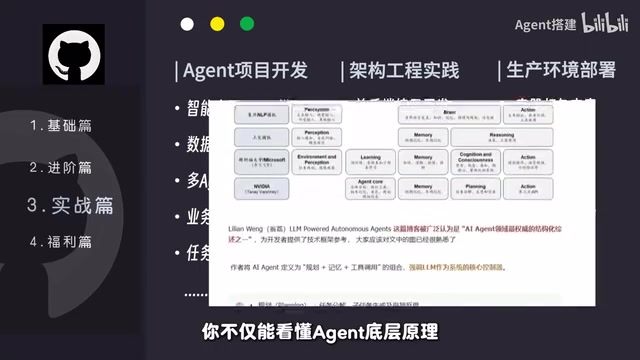
These three projects cover the most common Agent deployment scenarios: conversational services, data processing, and process automation. The creator says that after finishing the course, learners will not only understand the underlying principles of Agents but also be able to independently design and develop agent applications that solve real business problems. In addition, the course includes source code, courseware, Prompt templates, and an AI Agent developer learning roadmap.
The multi-Agent collaborative production line is the most challenging form of Agent engineering. Typical patterns include: the orchestrator-executor pattern, where a main agent breaks down tasks and dispatches them to specialized sub-agents; the pipeline pattern, where multiple agents relay tasks in a fixed order, such as requirements analysis, code generation, and test review; and the debate/review pattern, where multiple agents challenge each other to improve conclusion quality. The difficulty lies not in individual capabilities but in communication protocols, context sharing, failure retry, and conflict resolution. Enterprise deployments usually need to introduce message buses, state machines, and observability tools to ensure the multi-agent system is traceable and rollback-capable—which is also why evaluation and debugging are indispensable.
Who This Course Is For
Judging from its structure, the course is better suited to developers with zero foundation who want a systematic introduction to Agent development, and to those frustrated by fragmented tutorials who need a complete learning path. The claim of "from beginner to expert in seven days" is clearly marketing; the actual learning period depends on personal background and time invested. Nevertheless, its progressive design—cognition before coding, single Agent before multi-Agent, demo before enterprise projects—fits the laws of skill acquisition better than scattered tutorials. If you're looking for a structurally complete introductory Agent course, this content is worth adding to your learning list.
One-line Summary
A Bilibili creator offers a three-part zero-foundation Agent tutorial: cognition first, then coding, then hands-on practice.
Paragraph Summary
The article introduces a zero-foundation AI Agent development tutorial billed as "the most detailed on the internet." The author notes that over 90% of current Agent tutorials are polarized: either they pile on terms like "autonomous planning" and "tool calling" without getting concrete, or they throw code at you to call APIs, leaving learners "able to run a demo but unable to design a system." Polished over four months, the course is divided into cognition, advanced topics, and hands-on practice: the cognition part uses everyday analogies to explain the difference between an Agent and an LLM conversation, covering ReAct, planning and reasoning, and memory mechanisms, ending with getting the first demo running; the advanced part covers LangChain and AutoGen, multi-Agent collaboration, Function Calling, hybrid ReAct architectures, and evaluation, debugging, and safety boundaries; the hands-on part delivers three enterprise-grade projects: intelligent customer service, automated data analysis, and a multi-Agent collaborative production line. The course includes source code, courseware, Prompt templates, and a learning roadmap, and is better suited to zero-foundation developers who want a systematic introduction; the "from beginner to expert in seven days" claim is marketing.
Related articles

The Most Systematic Agent Development Course on Bilibili: From Zero to Enterprise-Level Practice
An in-depth look at a systematic Agent development course on Bilibili: prompts, tool calling, memory and context management, knowledge bases, and multi-agent collaboration, with practical projects aligned to enterprise hiring.

Career Switch to AI Agent Development from Zero: A Comeback Path for Non-Elite University Grads
A Bilibili UP host shares: computer science jobs are hard to land, but AI Agent development is inclusive of educational background — beginners need Python, RAG, Tool Use, and LangChain for opportunities at small and mid-sized companies.

Is the AI Bubble About to Burst? Users Angrily Ask When Local Models Will Catch Up to Opus
Reddit users complain about cut AI subscription usage, say Opus 5.5 is good enough, and want equal-quality local models—hoping they pressure subscriptions and pop the AI bubble.