From Zero to AI Agent: A Four-Week Hands-On Learning Roadmap, Broken Down

A rational breakdown of a four-week AI Agent roadmap: solid framework, but "instant engineer" is marketing hype.
This article breaks down a viral Bilibili roadmap claiming anyone can become an AI Agent engineer in one month. It analyzes four progressive stages: Week 1 covers the four core Agent components (LLM, Planning, Memory, Tool Use); Week 2 dives into the ReAct paradigm and Agent workflows; Week 3 addresses multi-agent collaboration and prompt tuning; Week 4 focuses on hands-on projects. The stage logic is sound for beginners, but "engineer in a month" is marketing exaggeration — treat it as an entry map, not a fast-track guarantee.
Can You Learn AI Agent Development in a Month?
A roadmap has been making the rounds on Bilibili with a bold claim: anyone under 45 who isn't easily discouraged can go from complete beginner to AI engineer in just one month by following a fixed learning path. The promise sounds aggressive, but strip away the marketing hype and the underlying framework is genuinely worth examining — it divides AI Agent knowledge into four progressive stages: LLM fundamentals, Agent principles, multi-agent collaboration, and hands-on projects.
Let's be realistic upfront: going from zero to "engineer" in a month isn't feasible, especially without a programming or machine learning background. But if you recalibrate the goal to "build a systematic foundation and get demo projects running," the logic behind the stage breakdown holds up. Here's a week-by-week analysis of this four-week plan.

Week 1: Build the Foundation, Master the Core Concepts
Week one focuses on understanding the underlying components of an Agent. The roadmap specifically calls out several key concepts: LLM fundamentals, Planning, Memory, and Tool Use.
These four pieces make up the industry-recognized classic Agent architecture. An Agent capable of autonomously completing tasks is essentially a combination of "LLM as the brain + Planning to decompose tasks + Memory to preserve context + Tools to execute actions." You don't need to write much code this week — the priority is clarifying how these abstract concepts relate to each other: Why isn't an LLM sufficient on its own? What problem does the Planning module solve? What does it mean for Memory to be divided into short-term and long-term?
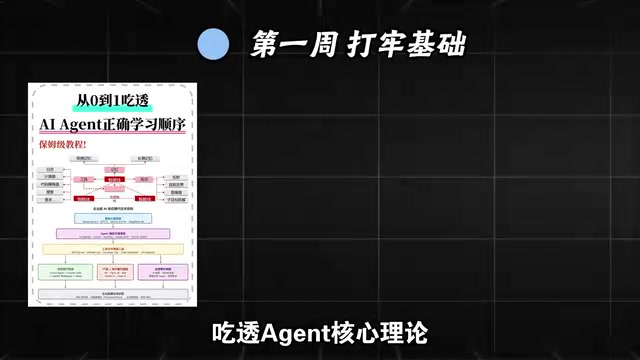
A practical suggestion: start this week by making a few LLM API calls to get a hands-on feel for the basic loop of "send a prompt, receive output." Then revisit the components conceptually — it's far more efficient than reading pure theory.
These four components carry more specific meaning at the architectural level. The Planning module is responsible for breaking complex goals into sequences of executable subtasks; common implementations include Chain-of-Thought reasoning and task tree decomposition. The Memory module splits into short-term memory (information within the conversation context window) and long-term memory (knowledge persisted through external storage like vector databases) — this distinction determines how far back an Agent can "remember." Tool Use is the interface through which an Agent interacts with the outside world, covering search engines, code executors, API requests, database queries, and more; without tool use, an LLM can only operate within language space and cannot actually affect external systems. Understanding the division of responsibilities between these three modules and the LLM itself is a cognitive prerequisite for learning any Agent framework that follows.
Week 2: Internalize Agent Principles and Classic Paradigms
Week two goes deeper into the principles layer — mastering the complete workflow and common problem-solving approaches, with a focus on learning classic Agent architecture paradigms like ReAct.
ReAct (Reasoning + Acting) is the best entry point for understanding how Agents operate: it has the model alternate between "reasoning" and "acting" — first thinking about what to do next, then calling a tool to execute, then continuing to reason based on the result. This "Thought → Action → Observation" loop is the foundation of the vast majority of Agent frameworks today.
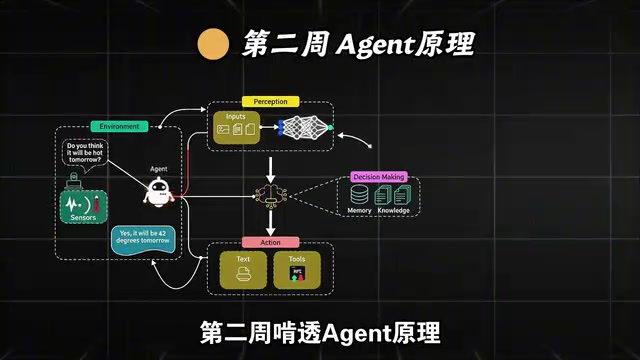
This week should also focus on building up a toolkit of "common problem solutions" — things like Agents getting stuck in loops, tool call failures, and hallucinated outputs. These are the issues that genuinely slow down progress in real projects, and having a mental model of how to handle them upfront saves enormous debugging time.
The ReAct paradigm was jointly proposed by Princeton University and Google Research in 2022, in a paper titled ReAct: Synergizing Reasoning and Acting in Language Models. Its core innovation is interleaving reasoning traces with external tool actions within the same generation sequence, rather than handling them separately. The concrete flow: the model first outputs a "Thought" — a piece of text explaining its current intent — then outputs an "Action" instruction to trigger a tool; the tool's return value becomes an "Observation" that feeds back into the model, driving the next round of reasoning. This explicit reasoning trace makes the Agent's decision-making process interpretable and far easier to debug. Major frameworks like LangChain and LlamaIndex both use ReAct (or variants such as ReAct + reflection mechanisms) as the core implementation logic in their Agent modules.
Week 3: Multi-Agent Collaboration and Prompt Tuning
Week three advances in two directions: the logic of multi-agent collaboration, and prompt engineering and tuning techniques.
Multi-agent collaboration is one of the hottest topics in the Agent space right now. The core idea is to have multiple specialized Agents work together to complete complex tasks — for example, one responsible for planning, one for coding, and one for review. The key to understanding collaborative logic is figuring out how Agents communicate with each other, how roles are assigned, and how conflicts are avoided.
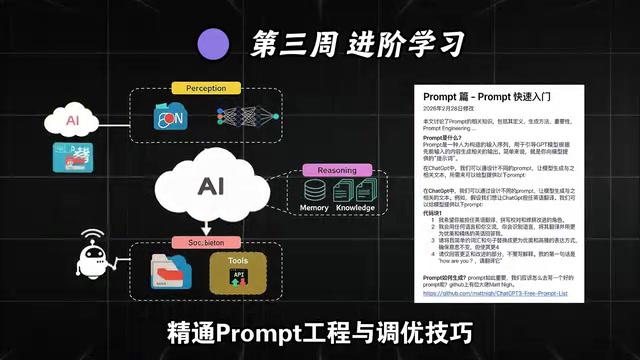
Prompt tuning is the most direct lever for making Agent outputs more accurate. With the same model, different prompt approaches can produce wildly different output quality. This week should involve heavy practice — iterate on prompts repeatedly, observe how outputs change, and develop intuition for model behavior.
Multi-Agent Systems have several common topological structures at the engineering implementation level: the centralized orchestration pattern has a single Orchestrator Agent dispatching sub-Agents — clear logic, but a single point of failure; the decentralized peer pattern has Agents autonomously negotiating through message passing — more flexible, but significantly harder to debug; the pipeline pattern passes tasks sequentially between Agents step by step, well-suited for automation scenarios with fixed workflows. Microsoft's open-source AutoGen framework and Stanford's AgentVerse are both important reference implementations for studying multi-agent collaboration — the former focuses on conversational multi-agent setups, while the latter emphasizes role division and task allocation mechanisms. The choice of topology directly affects system reliability, cost, and maintainability, making it one of the most important decisions to think through early in the architectural design phase.
Week 4: Hands-On Projects, Bringing Technology to Real Use Cases
The final week is about hands-on projects — taking the knowledge from the first three weeks and building a real LLM project that applies the technology to a concrete business scenario.
This step is both the most critical and the most easily overlooked part of the entire roadmap. Everything accumulated in the first three weeks represents "knowing." Only by actually building an Agent project that runs can that knowledge convert into "being able to do." The recommendation is to start with a small, clearly scoped scenario — an automated information retrieval assistant or a document Q&A Agent — get the minimal end-to-end loop working first, then incrementally add features.
A Realistic Assessment of This Roadmap
Overall, the stage breakdown of this four-week roadmap is sound: moving from concepts to principles, from single-Agent to multi-Agent, and finally to hands-on deployment follows a logical progression that builds naturally on itself. Its value lies in giving confused beginners a clear main thread to follow.
But there are a few limitations to be clear-eyed about: first, "become an engineer in one month" is classic marketing exaggeration — realistic onboarding typically requires much longer periods of repeated practice; second, the roadmap doesn't address the necessary prerequisite knowledge in programming and machine learning, so learners starting from scratch will need additional groundwork; third, content like this often exists primarily to funnel people into paid courses, so learners are better served by focusing on the framework itself rather than the promises attached to any accompanying materials.
Treat it as an "entry map" rather than a "fast-track guarantee," and you'll get far more out of it. What ultimately determines how far you go has never been how perfect the roadmap is — it's whether you can keep building things, keep hitting obstacles, and keep reflecting on what you've learned.
Related articles

JobRunner MCP Server: AI Agents Can Now Fix Failed Java Jobs
JobRunner launches an open-source MCP server enabling AI agents to view cluster status, diagnose failures, and recover Java jobs—incident response from any cloud coding environment or existing agent.

MLAI Digital Launches 9 Security Agents: MCP Server Safeguards the Full Lifecycle of Agentic AI
MLAI Digital launches Security MCP Server with nine built-in specialized security agents covering vulnerability discovery, attack simulation, prompt injection detection, API and infrastructure assessment, and accelerated remediation—embedding security validation across the full Agentic AI lifecycle from development to production.

Running Isaac Lab on H100 GPUs: Exploring Better Approaches
Exploring optimization methods for running Isaac Lab on NVIDIA H100 GPUs, including MIG configuration, mixed precision, TensorRT acceleration, and community experience to improve robotics simulation and reinforcement learning efficiency.