From Zero to Employed: A Complete AI Agent Development Learning Path

A four-stage AI Agent learning path: from core principles and RAG to hands-on projects and job readiness.
This article breaks down a systematic AI Agent development curriculum designed by a Bilibili creator to address the widespread problem of fragmented tutorials that leave learners unable to build independently. The curriculum spans four stages: Fundamentals (prompt engineering and workflow design), Advanced (RAG knowledge bases and tool calling), Hands-On Projects (a personal knowledge base assistant, intelligent customer service agent, and automated office assistant), and Career Preparation (job market analysis, resume polish, and interview prep). Key takeaways include mastering principles before frameworks, treating projects as the core unit of learning, and staying aligned with real industry hiring standards.
AI Agent development is rapidly becoming the core direction for deploying large language models in real-world applications. Yet most tutorials on the market tend to be fragmented and lack a systematic structure, leaving learners unable to build projects independently after finishing them. A Bilibili content creator, after researching a large number of Agent tutorials, has mapped out a complete learning path from fundamentals to job readiness — one worth referencing for beginners. This article breaks down that learning system in a structured way to help you navigate the key milestones of getting started with Agent development.
Why Most Agent Tutorials Leave You Still Unable to Build
According to the creator's observations, there has been no shortage of Agent tutorials on Bilibili — ranging from viral hits with millions of views to niche content with just a few hundred. Yet a common problem persists: knowledge is fragmented and unsystematic, leaving learners unable to independently build a working AI agent after going through the content.

This reflects a classic pain point in learning Agent development. Building agents isn't a single skill — it's a composite capability involving prompt engineering, workflow orchestration, knowledge base retrieval, tool use, multi-agent collaboration, and more. Picking up scattered knowledge points makes it hard to form a complete development loop in your mind. An effective learning path should follow a progressive structure from principles to frameworks to hands-on projects, so that every concept connects to a concrete application scenario.
The concept of an AI Agent upgrades large language models from "passive Q&A" to "actively completing tasks." A typical agent operates through four capability stages: perception (receiving user input or environmental signals), planning (decomposing tasks into steps), execution (invoking tools or sub-tasks), and reflection (adjusting plans based on results). This cycle is commonly referred to as the ReAct (Reasoning + Acting) framework. Unlike a single LLM call, agents often require multiple iterations, dynamic decision-making, and interaction with external systems — making them far more complex to develop than ordinary prompt calls. The most widely used Agent development frameworks today include LangChain, AutoGen, CrewAI, and Dify. These frameworks encapsulate common patterns such as tool calling, memory management, and multi-agent collaboration — but understanding the underlying principles remains essential for using them effectively.
A Four-Module Learning System
This curriculum divides the learning path into four progressive stages: Fundamentals, Advanced, Hands-On Projects, and Career Preparation.
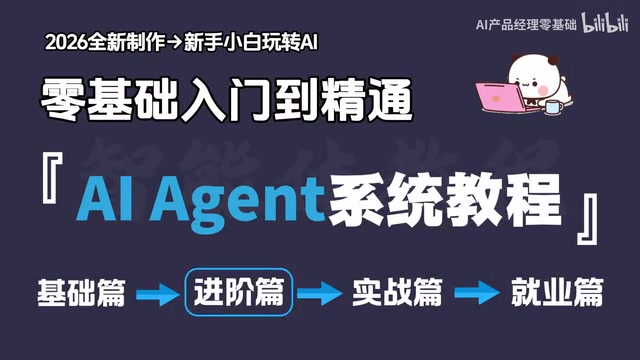
Fundamentals focuses on the core principles of agents, prompt engineering, and workflow design. The goal at this stage is to build an accurate mental model of AI agents — understanding how they perceive, plan, and execute tasks, and the role that prompts play throughout. Prompt engineering is the foundation of agent capability, while workflow design determines how an agent handles complex tasks.
Advanced introduces more critical technical modules: RAG (Retrieval-Augmented Generation) knowledge bases, agent architecture design, multi-agent collaboration, and tool calling — all practiced with mainstream frameworks. This is where the distinction between "knowing how to use" and "knowing how to build" is made. RAG enables agents to answer questions based on external knowledge; tool calling lets agents break free from the constraints of pure text; and multi-agent collaboration supports more sophisticated automation scenarios.
RAG (Retrieval-Augmented Generation) is one of the most important techniques in Agent development today. The core idea is: before querying a large model, first retrieve relevant document snippets from an external knowledge base, then feed those snippets along with the question to the model to generate a response. This approach allows the model to answer questions about proprietary knowledge outside its training data, while reducing "hallucinations" (i.e., the model fabricating facts that don't exist). A typical RAG pipeline involves four steps: document chunking, vector storage, semantic retrieval, and generation. Common tools include vector databases (such as Chroma and Pinecone) and embedding models. Understanding RAG fundamentals is a prerequisite for building knowledge base–driven Agent applications.
Tool calling (Tool Use / Function Calling) is the key mechanism that allows agents to go beyond pure text capabilities. Large models on their own can only process text input and output — but through tool calling, agents can execute code, query databases, call APIs, manipulate file systems, and more. Leading large models (such as GPT-4 and Claude) natively support the Function Calling interface. Developers define the names and parameter formats of tools, and the model autonomously decides during inference whether to invoke a tool and which one to call. This mechanism is the underlying engine that powers complex scenarios like "automated office workflows" and "intelligent customer service."
Hands-On Projects: Turning Knowledge into Capability
The Hands-On Projects stage is the core value of the entire curriculum. The creator designed three representative projects: a personal knowledge base assistant, an intelligent customer service agent, and an automated office assistant.
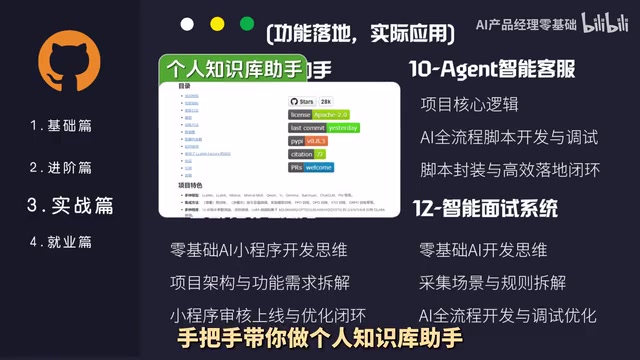
These three projects cover the most common Agent application scenarios. The personal knowledge base assistant trains RAG retrieval and document processing skills; the intelligent customer service agent involves intent recognition, multi-turn dialogue, and tool calling; and the automated office assistant tests workflow orchestration and external system integration. Only by fully completing these projects from start to finish can learners truly connect fragmented knowledge into reusable development experience.
This is the biggest differentiator between this curriculum and most scattered tutorials — learning is driven by projects, not by concept explanations alone. For those looking to enter the Agent development field, a complete portfolio is often far more persuasive than a collection of isolated knowledge points.
Career-Oriented: From Skills to Job Offer
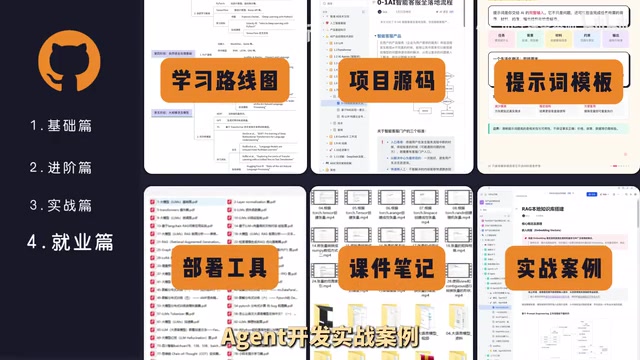
The Career Preparation module shifts the focus to job seeking — mapping out the talent landscape and employer requirements, guiding learners in polishing their resumes and portfolios, and covering high-frequency interview questions in depth.
The design philosophy behind this module is commendable. Technical learning ultimately needs to translate into career outcomes. Since Agent development is a relatively new direction, many learners have no clear picture of what companies actually need or what interviews will test. Incorporating job requirements analysis, resume refinement, and interview prep into the curriculum helps learners identify and close their specific gaps more effectively.
The creator has also compiled a set of supplementary learning resources, including a complete learning roadmap, project source code, prompt templates, deployment tools, course notes, and an interview question bank. For beginners, having hands-on materials to practice alongside lessons significantly lowers the barrier to getting started.
A Few Recommendations for Agent Learners
From the design of this learning path, several universal principles for getting started with Agent development emerge:
- Understand the principles before picking up a framework. Don't skip prompt engineering and workflow design — these are the foundation of agent capability.
- RAG and tool calling are the dividing line. Mastering these two techniques is what it truly means to be capable of building practical agents.
- Use projects as your unit of learning. Completing one project end-to-end is worth more than watching ten scattered tutorials.
- Pay attention to real job market demands. Stay aware of what the industry actually needs as you build your skills, so your learning stays directional.
A word of caution: this article is based on a single creator's course overview. The actual teaching quality and depth of content will need to be verified through direct learning. Agent technology evolves quickly, so staying attentive to the latest frameworks and tools is equally important. Overall, this four-stage "Principles → Frameworks → Projects → Career" structure offers a clear and actionable reference framework for systematically getting started with AI Agent development.
Related articles

Random Pruning of the DPO Computation Graph: 1.4x Training Speedup and Lower Peak Memory
DPO training too slow and memory-hungry? This paper proposes a random pruning framework for the DPO computation graph, sampling independently across position, sequence, and branch dimensions; branch pruning achieves a 1.426x step-time speedup and cuts training time by about 30%, with in-depth attribution of memory and time gains.

Why Does JEPA Underperform MLM in Longitudinal EHR Representation Learning?
New study compares JEPA and MLM for longitudinal EHR representation learning on MIMIC-IV: three JEPA variants train stably without collapse but underperform MLM; target size, not heterogeneity, drives prediction error.

Transfer Learning + Visible Light Communication: A New Approach to Energy-Efficient Indoor Positioning
A study proposes a transfer learning-based visible light communication indoor positioning method, achieving 47% accuracy improvement on the BOSCH factory dataset, 67.5% model efficiency under high noise, and introducing the ME composite metric for energy-efficient positioning in energy-constrained industrial IoT scenarios.