Frontend to AI Agent Development: A Complete Guide to Three Career Transition Paths

AI coding tools are killing pure frontend roles — here's how to pivot to Agent + full-stack development.
As AI coding tools like Codex and Claude Code mature, writing code has shifted from high-value to low-value work, causing pure frontend and backend roles to rapidly contract. Employers now want one or two AI-savvy engineers to replace entire dev teams, driving demand toward Agent + full-stack roles. Rather than fleeing to QA or DevOps — which face the same risks — developers are advised to master AI tooling and own the full delivery pipeline. Three transition paths are outlined: AI Agent developer, FDE (Front-End Deployment Engineer), and remote/freelance work. The core message: shift your goal from "frontend expert" to a composite "full-stack Agent" skill set.
Why Pure Frontend Roles Are Disappearing Fast
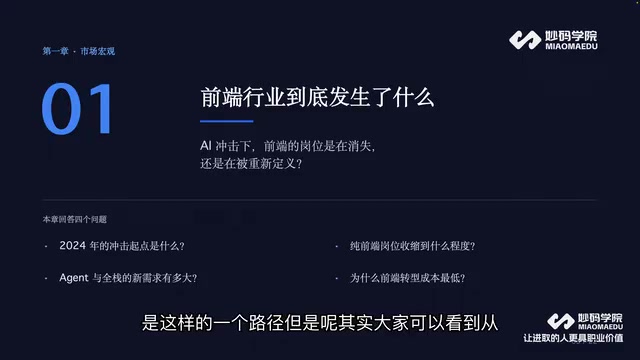
Recently, many frontend developers with three to five years of experience have found their resumes going unanswered — and even when they land interviews, passing them has become increasingly difficult. The problem usually isn't a decline in personal skill. Rather, the job market itself has undergone a structural shift: pure frontend roles are contracting rapidly.
According to one developer who transitioned from frontend management to AI architecture, AI's impact on frontend work didn't happen overnight. Signs appeared as far back as when code completion tools and Cursor first emerged — but at that point, these tools couldn't fully replace human coders, so the disruption seemed minor. The real inflection point came with the next major model iteration: the models powering tools like Codex and Claude Code leveled up, transforming "writing code" from high-value work into low-value labor.
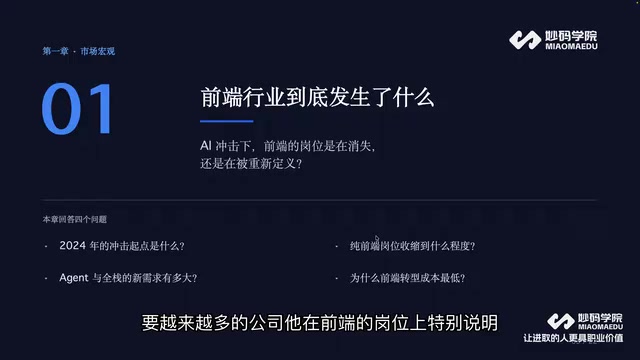
Pure frontend and pure backend roles were hit first. The author is blunt about it: most sub-senior frontend work is essentially CRUD — building pages, handling create/read/update/delete operations, plugging into frameworks, and copying and pasting. That's precisely what AI does best, and far more efficiently than any human. The result: more and more job postings no longer list "pure frontend" as a standalone role. Instead, you see new labels like "AI Frontend" or "Frontend Agent Track."
Codex is a code-focused large language model released by OpenAI in 2021. It serves as the underlying engine for GitHub Copilot and marked the moment AI-assisted programming moved from concept to large-scale practical use. Claude Code is a command-line coding agent from Anthropic that can read and write files, execute commands, and debug errors directly in a terminal environment — with far greater autonomy on complex programming tasks than early completion tools. Cursor is an IDE deeply customized on top of GPT/Claude-series models, supporting multi-file context awareness and natural language instructions to directly generate or refactor code. Together, these three tools represent three tiers of AI coding capability: snippet completion → single-file generation → cross-file autonomous execution. Once that final tier matured, the vast majority of low-to-medium complexity programming tasks — those requiring line-by-line human authorship — entered the realm of batch automation.
Why All the Hiring Has Shifted to Agent + Full-Stack
The change in job descriptions reflects a deeper shift in employer logic. The author explains it with a straightforward calculation: in the past, a dev team of five or six people in a tier-one Chinese city cost over 100K RMB per month once you factor in salaries averaging 20K each plus social insurance and housing fund contributions. Today, most employers want to hire one or two people who know AI — and have those people cover the workload that previously required four, five, or even six or seven engineers.
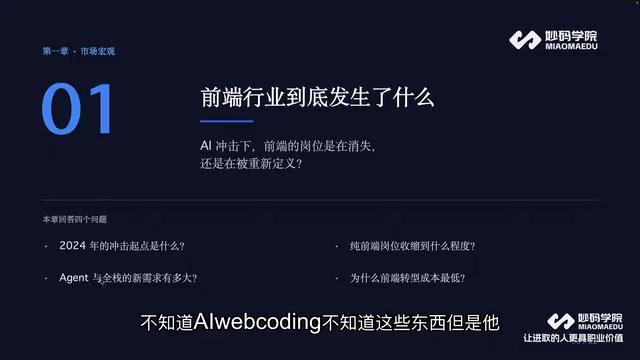
It's worth noting that most employers don't actually have a detailed understanding of what Agent development or AI Web Coding can do. But they firmly believe that "hiring one person who knows AI can replace an entire development pipeline." That belief alone has sent demand for Agent + full-stack roles through the roof.
The author draws a parallel to the frontend/backend split around 2015: back then, rapid business expansion drove the separation of frontend and backend, creating a wave of standalone frontend roles. Now the direction is reversed — roles are contracting and consolidating, with demand concentrating in Agent and full-stack positions. For developers with a bachelor's degree or above who want to stay in tech, pivoting to Agent + full-stack is, in the author's view, "the best investment you can make right now."
AI Agent refers to an AI system that can autonomously perceive its environment, plan tasks, and call external tools to complete multi-step objectives — as opposed to a standard large language model that only handles single-turn Q&A. In a software development context, an Agent can take a vague requirements description, automatically break it down into subtasks, and sequentially invoke tools for code generation, database operations, API calls, and test validation, ultimately outputting a complete, runnable feature module. AI Web Coding specifically refers to the practice of using natural language or low-code interfaces to drive AI in building frontend pages, backend APIs, and even full-stack applications — representative tools include Cursor, v0, and Bolt. The "AI-savvy engineer" that employers are looking for is fundamentally someone who can design Agent workflows, orchestrate multi-tool collaboration, and perform quality control on the output. This is a fundamentally different role from the traditional split where frontend handles UI rendering and backend handles business logic.
Testing and DevOps Are Just as Exposed
Some might ask: if frontend is dying, isn't pivoting to QA the cheapest escape route? The author's answer is no. AI-powered automated testing can already write scripts and run test suites. Testing roles not only tend to pay less — they face the same displacement risk.
His conclusion is more direct: if AI can replace pure frontend, pure backend, and QA, then rather than passively fleeing, you're better off acquiring AI capabilities yourself — putting yourself in a position to drive the entire frontend/backend/testing pipeline. That mindset shift is what separates "people being replaced" from "people wielding the tools."
The author returns repeatedly to one core point: learning is an investment in yourself. Working at a company means you're constantly outputting — but if you never take anything in, the moment your employer no longer needs you and shows you the door, it'll be too late to start job hunting. When the market was hot, companies competed for talent. Now they pick and choose like shoppers at a market stall — knowing AI, knowing Agents, knowing full-stack has become a hard baseline requirement.
Three Actionable Career Transition Paths
The author outlines several viable directions for developers at different stages:
AI Agent Developer
This is the most direct job-seeking path, suited for developers who want to join a company through the standard hiring process. The core requirement is building up skills in Agent development and AI Web Coding.
FDE (Front-end Deployment Engineer)
If you already have strong technical skills and meaningful business experience, FDE-type roles are worth pursuing. These positions demand stronger all-around ability and business understanding — and compensate accordingly.
Remote Work and Independent Contracting
For those who prefer flexibility, Remote Work and freelance contracting are also viable. The author notes that even in a seemingly tough market, plenty of people are landing annual packages of 300K–400K RMB or more. The key is closing your skill gaps and finding the right information advantage.
The author specifically warns that information asymmetry during a career transition is enormous — "what to learn, which things to prioritize, what to skip, and in what sequence" matters more than almost anything else. Everyone has limited time and energy; picking the wrong direction wastes months. As for the perennial debate over Java vs. Python vs. Node.js, he says don't overthink it. What matters is staying aligned with the Agent + full-stack track and building real, hands-on business experience through a structured learning roadmap and practical projects.
FDE (Front-End Deployment Engineer) is an emerging job title that gained traction over the past couple of years as AI deployment accelerated. There is no single standardized industry definition yet. Core responsibilities typically include: integrating AI model capabilities into product frontends, handling edge deployment and performance tuning for inference services, designing end-user interaction flows, and bridging the technical gap between model teams and product/business teams. The role requires candidates to combine frontend engineering, DevOps fundamentals, and hands-on AI deployment experience — and it commands salaries well above traditional senior frontend rates. Because the job definition is still evolving, requirements vary significantly across companies. When job hunting, read JD descriptions carefully to avoid conflating FDE roles with standard full-stack positions.
Practical Advice for Frontend Developers
Taken together, the role restructuring triggered by the leap in model capabilities is already underway — and for junior-to-mid-level frontend, backend, QA, and DevOps engineers, the collapse has felt nearly overnight. The author's advice is clear and pragmatic: stop aiming to become a "frontend expert" and instead build toward a composite skill set of "full-stack Agent + broad frontend."
The deep, niche, high-complexity frontend knowledge that used to command a premium has dropped in the current priority ranking. What provides real protection against displacement now is the ability to design solution architectures, maintain a holistic view of the system, and use AI tools to deliver across the full development lifecycle.
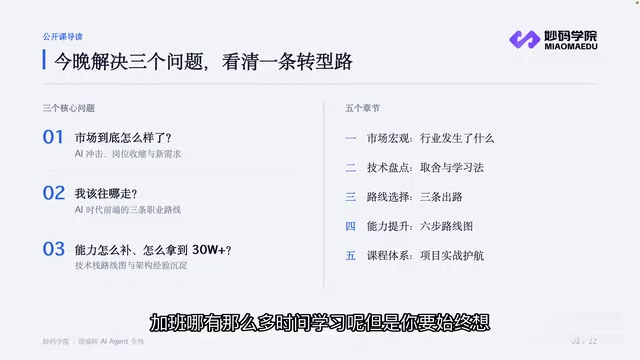
For anyone still on the fence, the author's call to action is simple: make the commitment, start seriously planning your move toward Agent + full-stack tomorrow, and build your own learning and practice roadmap as soon as possible.
Related articles

Free Unlimited Claude Code Solution: Agnes AI + CC Switch Setup Guide
No paid subscription needed — pair the free AI platform Agnes AI with the open-source tool CC Switch to provide a backend for Claude Code, enabling unlimited free calls to text, image, and video models. This guide covers the full setup, test results, and usage boundaries.

A Complete Zero-Cost Guide to Getting Started with Claude Code for Beginners in China
A beginner's guide to Claude Code for users in China: two installation methods (command line and IDE plugin), full configuration steps for replacing the official API with the free domestic LongCat model, and a hands-on demo of building a small tool with natural language, plus tips.

When the NSA Gets Involved: The AI Supply Chain Crisis Behind Open-Source CVEs and API Key Hijacking
Multiple open-source projects disclosed severe CVEs in one day, PHP flaws alarmed the FBI, and Railway and OpenCode were breached with API keys stolen. This article breaks down the vulnerability window, AI-accelerated exploitation, and the AI supply chain crisis behind the API key black market, with a developer defense checklist.