Fulcrum Trained Echo for $4,500: A Real-World Kimi K3 LoRA Fine-Tuning Breakdown

Fulcrum built Echo by fine-tuning Kimi K3 with rank-32 LoRA for just $4,500 using serverless training.
Fulcrum's Echo model offers a compelling low-cost model customization case study: using Kimi K3 as the base, rank-32 LoRA fine-tuning, and Fireworks' serverless training API, the team achieved a total training cost of just $4,500. LoRA compresses trainable parameters to under 2% of full fine-tuning, while serverless eliminates GPU infrastructure overhead. The team also employed a "persona post-training" method for lightweight personality alignment. This case demonstrates that combining mature base models, parameter-efficient fine-tuning, and managed training services makes high-quality model customization on a tight budget increasingly realistic.
A Low-Cost Training Case Study Hidden in a Tweet
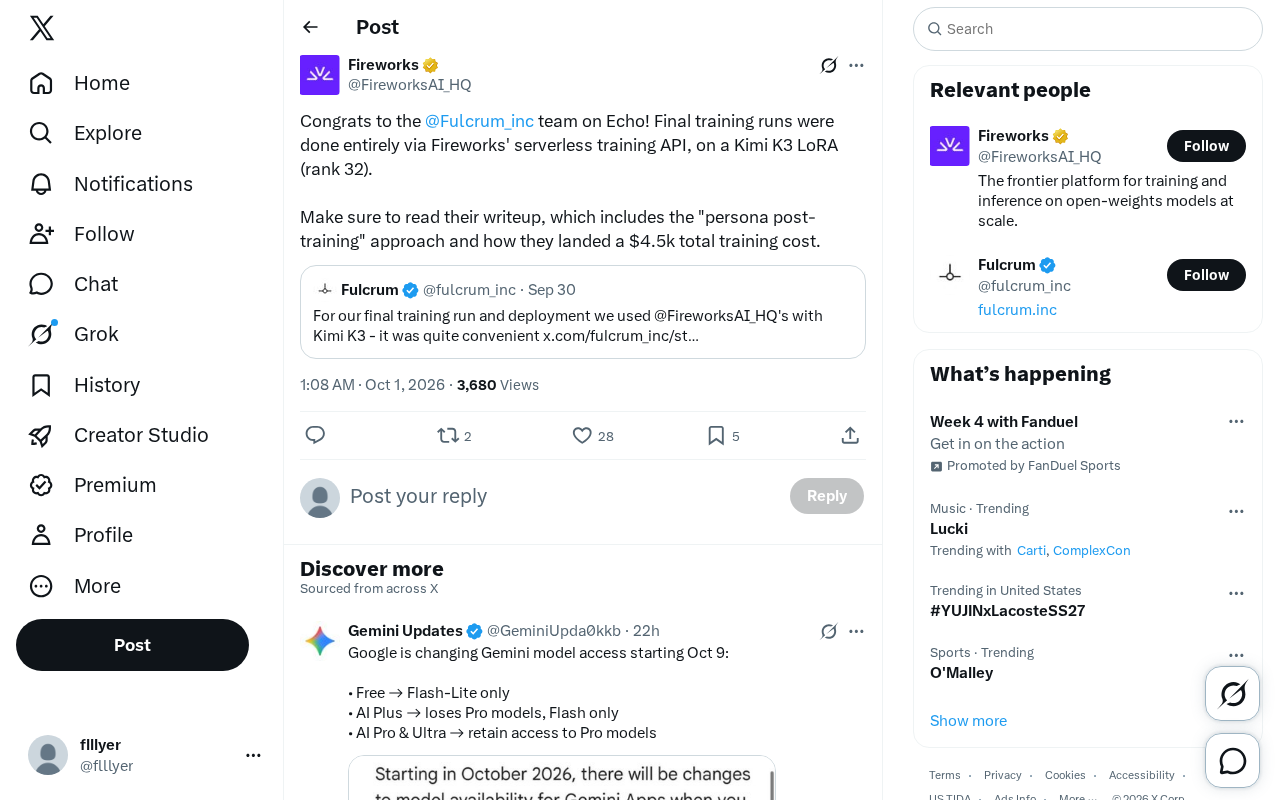
A tweet from the Fireworks AI community offers a genuinely valuable real-world data point for the industry: Fulcrum's Echo model completed its final training entirely through Fireworks' serverless training API, using a LoRA (rank 32) fine-tuning approach on top of Kimi K3 — with a total training cost of just $4,500.
That number deserves attention. It chips away at the assumption that training a capable model from scratch requires astronomical compute budgets. For resource-constrained startups and independent developers, a training budget in the low thousands means model customization is no longer a game reserved for tech giants.
Technical Breakdown: LoRA + Serverless Training
Why LoRA (rank 32)?
Echo uses LoRA (Low-Rank Adaptation) fine-tuning rather than full-parameter training. The core idea behind LoRA is to freeze most of the base model's weights and inject small, trainable low-rank matrices into specific layers — dramatically reducing memory usage and training overhead.
Rank 32 is a fairly typical mid-range setting that balances expressiveness against training cost. Higher ranks can capture more complex task characteristics but increase parameter count and overfitting risk. For style or capability customization on top of a strong base model like Kimi K3, rank 32 is generally more than sufficient. It's one of the key technical choices that kept costs in the low thousands.
LoRA was introduced by Microsoft Research in 2021. Mathematically, it decomposes the weight update matrix ΔW — which would otherwise require full-parameter updates — into the product of two low-rank matrices: ΔW = BA, where B and A have ranks far smaller than the original matrix dimensions. Take a 4096×4096 fully connected layer: a full-parameter update requires roughly 16.8 million trainable parameters, while rank-32 LoRA needs only 2×4096×32 ≈ 262,000 parameters — a compression of over 98%. This directly drives order-of-magnitude differences in memory usage, gradient computation, and training time. In practice, LoRA is typically applied only to the Attention module's Q, K, and V projection matrices rather than all layers, further reducing overhead. During inference, the trained low-rank matrices can be merged back into the original weights, adding zero extra latency — making LoRA one of the most widely adopted parameter-efficient fine-tuning (PEFT) methods in production today.
What Serverless Training Actually Means
The tweet specifically emphasizes that the final training run was completed "entirely" on Fireworks' serverless training API. The value of serverless here is straightforward: developers don't need to purchase, configure, or maintain GPU clusters. They call compute on demand and pay for what they use.
This model dramatically lowers the infrastructure barrier and lets small teams focus on data and methodology rather than DevOps. For frequently iterated fine-tuning tasks, managed training services like this are increasingly becoming the default option.
"Persona Post-Training": A Methodology Worth Watching
The tweet mentions that Fulcrum's technical writeup describes a method called "persona post-training." While the original source doesn't elaborate extensively, the name suggests an approach for aligning a model to a specific personality, tone, or character identity during the post-training phase — on top of an existing base model.
This kind of alignment is particularly important for conversational products, roleplay applications, and brand-specific assistants, where the consistency of how the model "speaks" and its "personality" is critical. Positioning persona alignment in the post-training phase rather than pre-training means you can rapidly shape a model's behavioral characteristics in a lightweight, low-cost way.
Readers who want the full methodology are encouraged to read Fulcrum's publicly available technical writeup, which covers the method details and cost breakdown.
From a technical implementation standpoint, persona post-training typically falls within supervised fine-tuning (SFT) or preference alignment (e.g., RLHF, DPO) as a specialized variant. Training data usually consists of dialogue examples embodying the target persona — covering specific tone and style, value orientations, knowledge boundaries, and refusal strategies. Unlike general capability fine-tuning, persona alignment is more concerned with output consistency than capability ceiling: the goal is for the model to consistently "sound like the same person" across different topics. The data scale requirements are typically far lower than capability fine-tuning — hundreds to a few thousand high-quality dialogue samples are often enough to drive noticeable style transfer. This is why it can be executed independently within a low-cost framework. Some roleplay products (like Character.AI) and enterprise-specific assistants already rely on similar approaches to build differentiated model personality layers.
What the $4,500 Price Tag Means for the Industry
The $4,500 total training cost is the most striking detail of this case. It points to several trends worth thinking about:
- The economics of fine-tuning are shifting: With mature base models and parameter-efficient fine-tuning methods like LoRA, the marginal cost of customizing a capable model continues to fall.
- Managed training services are maturing: Serverless training turns compute into an on-demand resource, further compressing startup costs and operational overhead.
- Methodology matters more than raw compute: Under cost constraints, thoughtful design choices like persona post-training often determine final quality more than throwing more compute at the problem.
A word of caution: cost figures from individual cases like this are highly dependent on the specific task, dataset size, and base model, and shouldn't be naively extrapolated to all scenarios. But it does provide a useful reference point — evidence that the path to low-cost, high-quality model customization is becoming increasingly practical.
Summary
Echo's release was just a brief congratulatory tweet, but the technical stack it reveals — Kimi K3 as the base model, rank-32 LoRA fine-tuning, a serverless training API, and a persona post-training methodology — sketches out an efficient, low-cost path for model customization that teams working on AI applications would do well to study. Since this article draws from a single, limited source, readers seeking a complete picture of the implementation should refer to Fulcrum's official technical documentation.
Related articles

Cursor AI Programming in Practice: Build a Student Management System from Scratch in 30 Minutes
A Bilibili creator demonstrates Cursor AI programming: generating a student management system in 30 minutes with natural language. Details on Agent mode, Claude selection, prompt techniques, and thresholds.

Top 20 AI Coding Tools Ranking: From Rock-Solid to Lackluster, a Scored Matrix
Bilibili creator releases top 20 AI coding tools ranking, tiered T0–T4 from rock-solid to lackluster, with Claude Code and Codex tied at T0. This article details the scoring dimensions (capability, reliability, robustness, durability, cost, domestic availability) and tool performances to help developers choose the right AI coding assistant.

Vibe Coding Systematic Tutorial: Master AI-Assisted Programming from Zero
A three-month Vibe Coding tutorial from a Bilibili creator covering Codex, ClaudeCode, and Cursor, from core logic to commercial project practice for beginners.