Full AI Comic Drama Workflow: Generate a Short Drama Trailer from One Sentence, Zero Prompt Writing Required
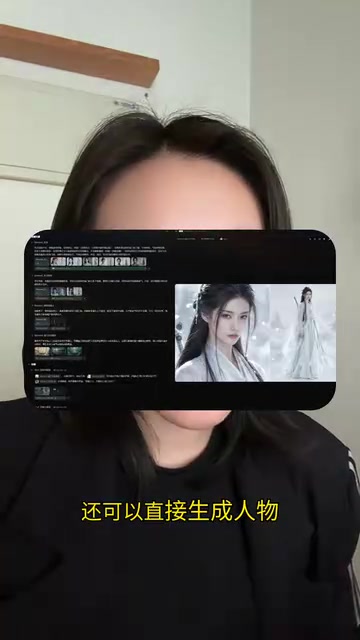
AI Agent handles the entire short drama trailer pipeline — creators just describe the idea and make judgment calls.
This article walks through an AI Agent-driven workflow for producing short drama trailers: using plain natural language, the Agent automatically handles scriptwriting, storyboarding, batch prompt generation, parallel video rendering, character replacement with cascading updates, and final editing with music — all within about two hours. Standout design choices include draft storyboards that don't consume rendering credits, parallel generation that dramatically cuts wait times, and automatic cross-shot updates when character assets change. The case reflects a broader shift in AI creative tools: the key barrier is moving from "knowing how to write prompts" to "knowing how to express creative intent and make aesthetic judgments."
From One Sentence to Finished Film — AI Agent Takes Over the Entire Pipeline
In traditional AI video creation, the most discouraging step is rarely the rendering — it's writing prompts. Painstakingly tweaking text descriptions for each and every storyboard shot is tedious and time-consuming. But the workflow shared by a Bilibili creator flips that logic entirely: from script to finished trailer, you barely need to write a single prompt yourself. An AI Agent handles the entire execution from start to finish.
The creator used a "powerful female xianxia" trailer as the demo case, and ran through the complete workflow in just two hours, starting from a plain-language description. The core idea is simple: humans handle "articulating the need" and "making judgment calls" — the machine handles everything else.
What is an AI Agent? An AI Agent refers to a system capable of autonomously planning and executing multi-step tasks — fundamentally different from a single-turn Q&A AI tool. Traditional AI tools require users to issue instructions step by step, with manual intervention at each stage. An Agent, by contrast, can take a high-level goal (e.g., "produce a xianxia trailer") and automatically break it down into subtasks — script generation, storyboard planning, prompt writing, video rendering, editing — then execute them sequentially or in parallel, pausing only at critical decision points that require human judgment. This "goal-driven, autonomous execution" model is what distinguishes an Agent from a Copilot or Chatbot, and it's the technical foundation that makes the workflow described here possible with minimal human intervention.
Script, Storyboards, and Assets — Generated in One Pass
The workflow begins with a single natural-language instruction. The creator tells the Agent to "generate a powerful female xianxia trailer," and the system immediately outputs a complete script and storyboard, along with character and scene assets ready for use.
The key step is batch prompt processing. Once the corresponding instruction is given, the Agent automatically generates prompts for all storyboard shots in bulk — the creator doesn't need to write a single one manually. At this stage, what's produced is a storyboard draft, not the final video, so no generation credits are consumed. This is a pragmatic design choice: separating the "trial" and "final production" phases means you don't burn precious rendering quota on drafts.
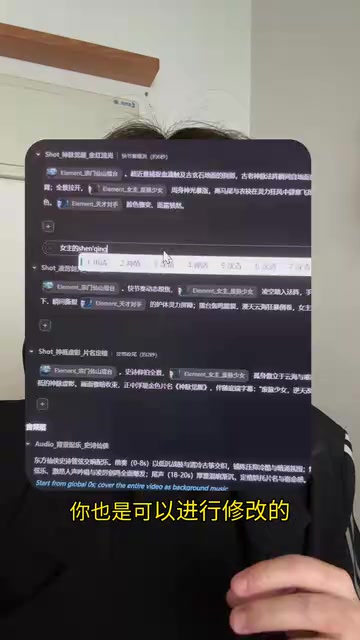
Storyboard drafts are editable. At this stage, creators can review composition and narrative pacing, and only proceed once they're satisfied. This layered logic — low-cost preview first, high-cost execution later — is the core efficiency driver of the entire workflow.
Batch Parallel Generation — No More Waiting in Line
Once the draft is confirmed, the Agent is instructed to batch-generate the storyboard videos. Notably, it supports running multiple videos in parallel simultaneously, rather than the traditional one-at-a-time queue model. For a short drama with dozens of shots, parallel processing saves a substantial amount of time — and it's a major reason the creator was able to complete the entire workflow in two hours.
Why parallel generation matters: AI video rendering is computationally intensive. A single storyboard shot can take anywhere from tens of seconds to several minutes to generate. For a short drama trailer with 20–30 shots, sequential processing means total wait time stacks up linearly. Parallel processing compresses this bottleneck from "number of shots × time per shot" down to roughly "time per single shot" (subject to compute resource limits). Whether true parallelism is achievable depends on whether the underlying platform supports concurrent task scheduling, as well as the user's account quota and compute allocation — actual performance may vary by platform and subscription tier.
Character Replacement: Change One Source, Update Everything
The step that best demonstrates the "Agent" capability in this workflow is character replacement. After the storyboard videos were already generated, the creator decided on the fly to change the "mysterious figure" from male to female.
The operation is still natural language: locate the relevant clip and tell the Agent what you want. The system then adjusts the character asset — syncing both voice and appearance.
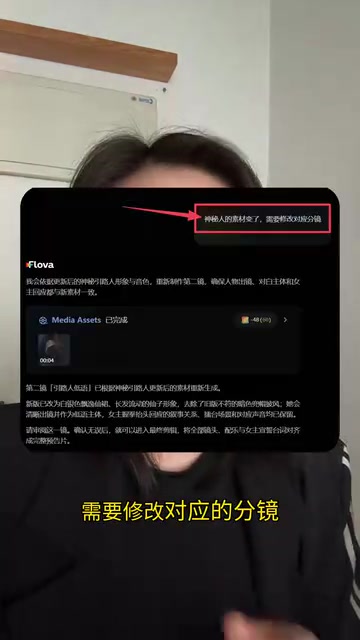
More importantly, there's a cascading update capability. After the character asset was changed, the creator simply told the Agent "the mysterious figure's asset has been updated — please revise the relevant storyboard shots," and the system automatically updated all affected shots. This "change the source, downstream updates itself" mechanism solves one of the most persistent headaches in AI-driven creative work: consistency. Previously, you'd have to manually redo every shot featuring that character. Now it's handled by the Agent in one go.
Music and Editing — Wrapped Up in One Command
With storyboards and character adjustments complete, the workflow is roughly 80% done. The BGM and final edit are also delegated to the Agent: simply tell it to add "an epic, high-energy BGM" and cut the final trailer — and the finished preview is ready.
The creator's summary of the whole process is spot-on: from start to finish, they personally did just two things — first, clearly articulated the need; second, made judgment calls. All the execution, generation, revision, and cascading updates were carried out by the AI, step by step.
What This Workflow Actually Means
This case illustrates a clear shift: the barrier to AI video creation is moving away from "knowing how to write prompts" and toward "knowing how to express what you want." Prompt engineering was once considered the core skill in AI-driven creative work — but when an Agent can automatically handle prompt generation, batch parallel rendering, and cross-shot consistency, the creator's value returns to something more fundamental: clear creative direction and the aesthetic judgment to evaluate the final output.
That said, demos like this tend to showcase ideal conditions. In real use, the quality of AI-generated storyboard drafts, the reliability of character consistency, and the success rate of parallel generation may all fall short of what's shown. Whether draft editing and asset cascading are truly as seamless as described will need to be verified in your own projects. But regardless, "wrapping complex workflows into conversational operations" represents an evolution in AI creative tools that's worth paying close attention to.
For anyone looking to get started with AI comic dramas or short-form drama creation, this workflow offers a clear reference framework: rather than agonizing over the exact wording of every prompt, get your story and visual style figured out first — then let the tools handle the heavy lifting of execution.
A note on Prompt Engineering: From roughly 2022 to 2024, prompt engineering was considered a specialized skill — dedicated "prompt engineer" roles even appeared in the job market. The core work involved guiding AI models toward expected outputs through precise wording, structured templates, and extensive trial and error. But as model comprehension has improved and the Agent layer has emerged, this skill is undergoing a rapid shift in value: models are increasingly able to infer user intent from vague natural-language requests, while Agents further take on the intermediate work of translating intent into effective prompts. This doesn't mean prompt knowledge is entirely obsolete — but creators no longer need to treat it as the primary barrier to entry. The ability to judge story, visual style, and pacing is once again the more essential competitive edge.
Related articles

CSS Anchor Positioning: A New UI Positioning Approach Without JavaScript
A deep dive into CSS Anchor Positioning: from anchor-name and position-anchor to the anchor() function, position-area shorthand, position-try-fallbacks, anchor-size, and upcoming anchor queries.

New AI Chart Interaction: Continuous Follow-up Questions and Visualization in Conversation
Explore a new AI interaction method for continuously generating charts in conversation. Use the /visualize command to ask follow-up questions and visualize answers in the same chat window, improving data analysis efficiency.

Cursor Merges Into X Subscription: Paid Plans Share Unified Usage Pool, Grok Model Coding Usage Doubled
Cursor joins The X Subscription with a unified usage pool and doubled Grok coding quota. Third-party models shift to API pricing. Existing users can keep or migrate plans.