Full Breakdown of Bilibili's 748-Episode AI Large Model Zero-to-Hero Course: From Beginner to Practice

Bilibili creator launches a 748-episode zero-background AI large model course covering principles to enterprise project deployment.
This article reviews a 748-episode zero-background AI large model course from a Bilibili creator. The course is divided into fundamentals (Transformer principles, environment setup, prompt engineering), advanced topics (RAG, Agent, deployment, efficient fine-tuning), and practice (Agent digital humans, enterprise Q&A, medical large models), with supplementary study materials. It best suits beginners and developers lacking large model practice, but the 748-episode scale requires a huge time investment and content timeliness must be judged independently.
Amid the flood of AI large model learning resources, a Bilibili creator has released a systematic course claiming "748 episodes total" for zero-background learners, attempting to offer a complete path from beginner to mastery. What exactly does this course cover, who is it suited for, and what should be viewed with a rational eye? Based on the course introduction video and screenshots, this article provides an objective overview.
The Starting Point Behind the Course Design

In the opening, the creator mentioned that he re-examined AI large model tutorials on the market from the perspective of a complete beginner. He spent a month studying various related courses on Bilibili and found quality to be highly uneven—some had tens of thousands of views, others only a few dozen or hundred. Overall, it felt like "a mixed bag."
Based on this observation, the creator decided to synthesize the main knowledge points of AI large model tutorials, using more accessible classroom-style explanations combined with hands-on cases, and spent three months completing this course. This motivation itself reflects a real pain point: the AI large model field updates quickly and has a high barrier to entry, so zero-background learners facing a sea of tutorials can easily lose direction.
The Three-Section Course Structure
Fundamentals: Principles and Environment Setup
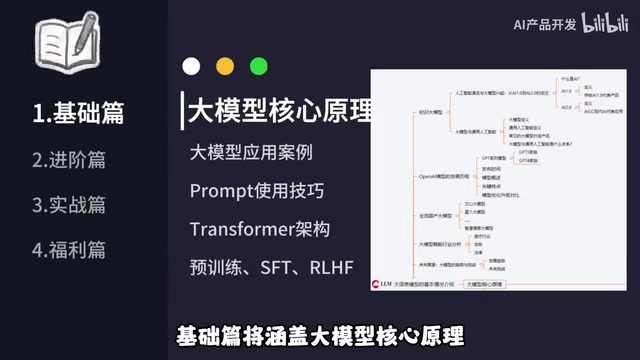
The fundamentals section covers core large model principles, AI development environment setup, and prompt engineering. Specific knowledge points include understanding the Transformer architecture and pretraining mechanisms. The creator emphasizes using "the most easy-to-understand methods" to help beginners get started, rather than piling up formulas and papers.
For zero-background learners, the value of this part lies in building a basic cognitive framework—understanding why large models work, how to set up a development environment, and how to write effective prompts. These three capabilities are the foundation for all subsequent learning and practice.
Transformer architecture is a neural network structure proposed by Google in the 2017 paper "Attention is All You Need." It replaced the recurrent structure of RNNs with the Self-Attention mechanism, enabling models to process long sequences in parallel and capture long-range dependencies. Today, almost all mainstream large models (GPT, LLaMA, Qwen, etc.) are based on Transformer variants.
Pretraining mechanism refers to the model first learning general language patterns from massive amounts of unlabeled text through self-supervised tasks (such as predicting the next word), then adapting to specific tasks through fine-tuning. This "pretraining + fine-tuning" paradigm is key to the emergent capabilities of large models and a necessary prerequisite for understanding advanced content such as RAG and fine-tuning. If zero-background learners skip these two concepts, it will be difficult to build intuition for later technical discussions.
Advanced: Model Deployment and Fine-Tuning
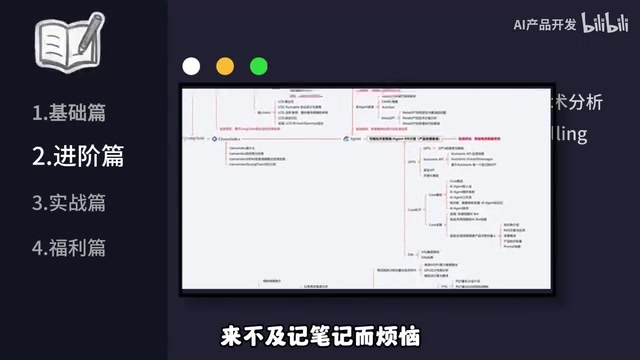
The advanced section involves various types of AI large model knowledge, RAG (Retrieval-Augmented Generation), Agent chain-of-thought and deployment, as well as model training and efficient fine-tuning. The course also includes a complete learning roadmap to help learners plan their progress.
The content at this stage has entered the engineering practice level. RAG and Agent are currently the two most mainstream technical paradigms for deploying large models. The former addresses knowledge timeliness and accuracy issues, while the latter addresses task automation and tool invocation issues. If the course can explain these concepts thoroughly and pair them with runnable code, it will indeed have practical value for learners.
RAG (Retrieval-Augmented Generation) works roughly as follows: before the model generates an answer, it first retrieves relevant document fragments from an external knowledge base, inserts them as context into the prompt, and then lets the model answer based on those fragments. It solves the problems of outdated knowledge and easy "hallucination" in large models, and does not require retraining the model, making it the most common deployment solution for enterprise knowledge base Q&A.
Agent gives large models the ability to autonomously plan and invoke tools: the model breaks down tasks according to goals, reasons step by step through Chain-of-Thought, and calls external tools such as search, code execution, and APIs to complete actions. Efficient fine-tuning usually refers to parameter-efficient fine-tuning techniques such as LoRA and QLoRA, which train only a very small number of additional parameters, greatly reducing VRAM and compute requirements, enabling individual developers to fine-tune models on consumer-grade GPUs.
Practice: Enterprise-Level Project Drills
The practice section guides learners step by step through enterprise-level deployment projects, with directions including Agent digital human projects, RAG enterprise knowledge base Q&A systems, and medical key-point large models. The creator hopes learners can apply the knowledge to work and life, and even help them find their ideal job.
Project practice is the best way to test learning outcomes. However, it should be noted that enterprise-level projects often involve a great deal of domain knowledge and engineering details. Video tutorials can mostly demonstrate ideas and key steps; true mastery still requires learners to practice repeatedly in real scenarios.
Supplementary Materials and Learning Threshold

The course provides supplementary materials such as study schedules, assets, e-books, and courseware. The creator says they can be obtained for free by commenting and leaving a message. From the perspective of lowering the learning threshold, the completeness of supplementary materials directly affects the learning experience—especially for environment setup and project practice sections that require following along.
What should be viewed rationally is that the sheer scale of 748 episodes itself means an extremely high time investment. Whether zero-background learners can persist to the end depends more on their personal learning pace and goal motivation than on the information density of the course itself.
Who This Course Is For
Judging from the course positioning, it is best suited for: beginners who have no concept of AI large models at all and hope to systematically understand the full picture from principles to applications; and developers who have some programming foundation but lack practical experience with large models.
For engineers who already have real project experience, the fundamentals and advanced sections of this course may be too shallow, while the project cases in the practice section can serve as reference ideas. In addition, the AI large model field iterates extremely quickly, and learners need to judge the timeliness of the course content themselves while watching.
When choosing learning resources, rather than pursuing the "most complete," it is better to first clarify your own goals: whether you want to understand principles, quickly get started building applications, or go deep into a particular technical direction. Different goals correspond to different learning paths, and one course cannot suit everyone.
Understanding course positioning also requires distinguishing several common learning goals: "understanding principles" corresponds to reading papers and derivations, "quickly getting started building applications" corresponds to calling APIs and prompt engineering, and "going deep into a technical direction" corresponds to specialized research such as fine-tuning, inference optimization, and Agent frameworks. The time and background required for the three differ greatly.
In addition, to judge whether a course is worth the investment, you can pay attention to several dimensions: whether the content distinguishes between "demo-level" and "production-level" practice, whether it explains the versions of the models and tools used, and whether it provides reproducible code and environment configuration. Since mainstream tools in the large model field iterate every few months on average, learners verifying against the latest official documentation while watching is often more effective than simply following the video.
One-line Summary
A Bilibili creator has released a 748-episode zero-background systematic course on AI large models, covering everything from principles to enterprise-level project deployment.
Paragraph Summary
This article reviews a systematic 748-episode zero-background AI large model course released by a Bilibili creator. Designed because tutorials on the market are a mixed bag, the course is divided into fundamentals (Transformer principles, environment setup, prompt engineering), advanced topics (RAG, Agent, model deployment and efficient fine-tuning), and practice (Agent digital humans, enterprise knowledge base Q&A, medical large models, etc.), and also provides study schedules, e-books, courseware, and other supplementary materials. The article points out that the course is best suited for zero-background beginners and developers lacking large model practice, but the scale of 748 episodes means an extremely high time investment, and because the field iterates quickly, learners must judge content timeliness themselves. The author emphasizes that before choosing a course, one should first clarify learning goals, because one course cannot suit everyone.
Related articles

M&M's Spent Millions Replacing Artificial Blue Dye — Why Is It So Hard?
Mars spent millions trying to replace artificial blue dye in M&M's with spirulina, but thick material clogs pipes and residue risks mold, forcing a full production-line rebuild. Here's the engineering behind the reformulation.
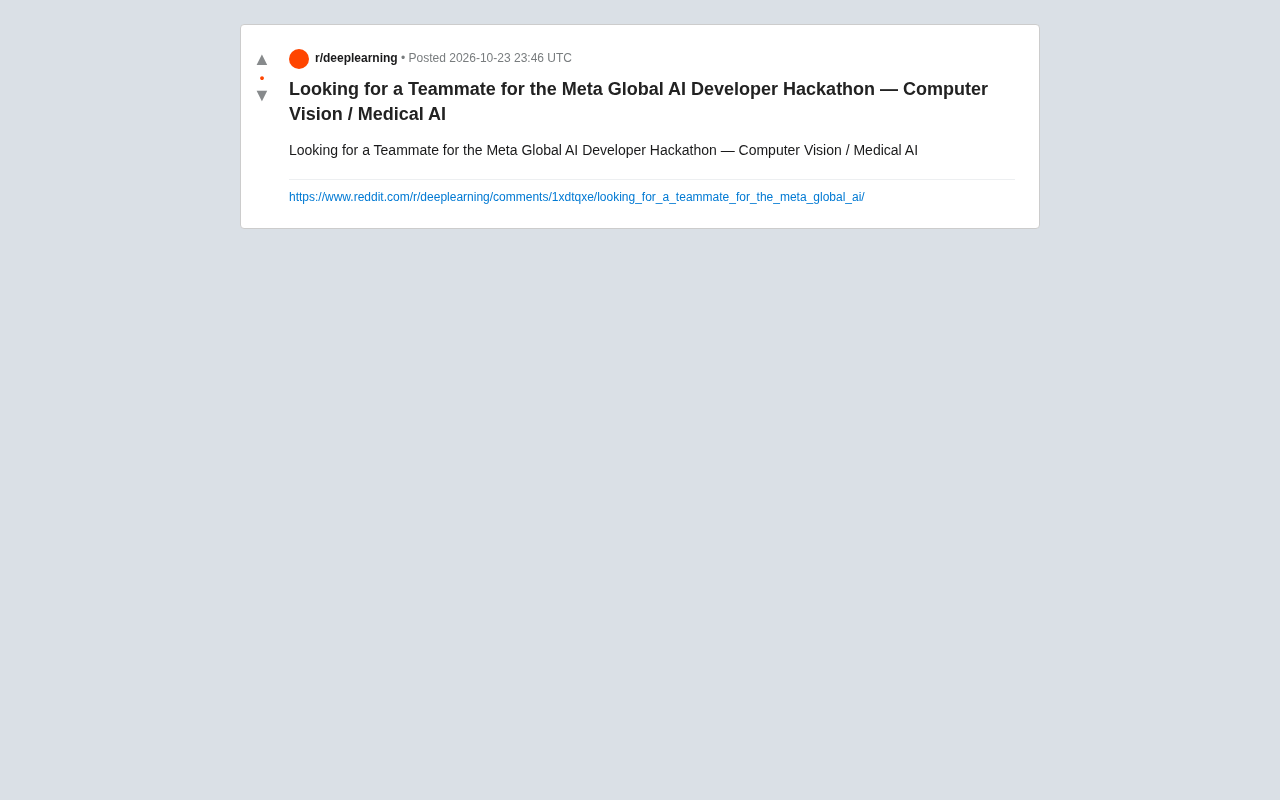
Teammate Wanted for Meta Global AI Developer Hackathon: Computer Vision & Medical AI
A Reddit developer seeks teammates for the Meta Global AI Developer Hackathon, focusing on computer vision and medical AI. This article analyzes the track logic, skills-complementarity needs, and topic selection strategy behind this teaming signal.
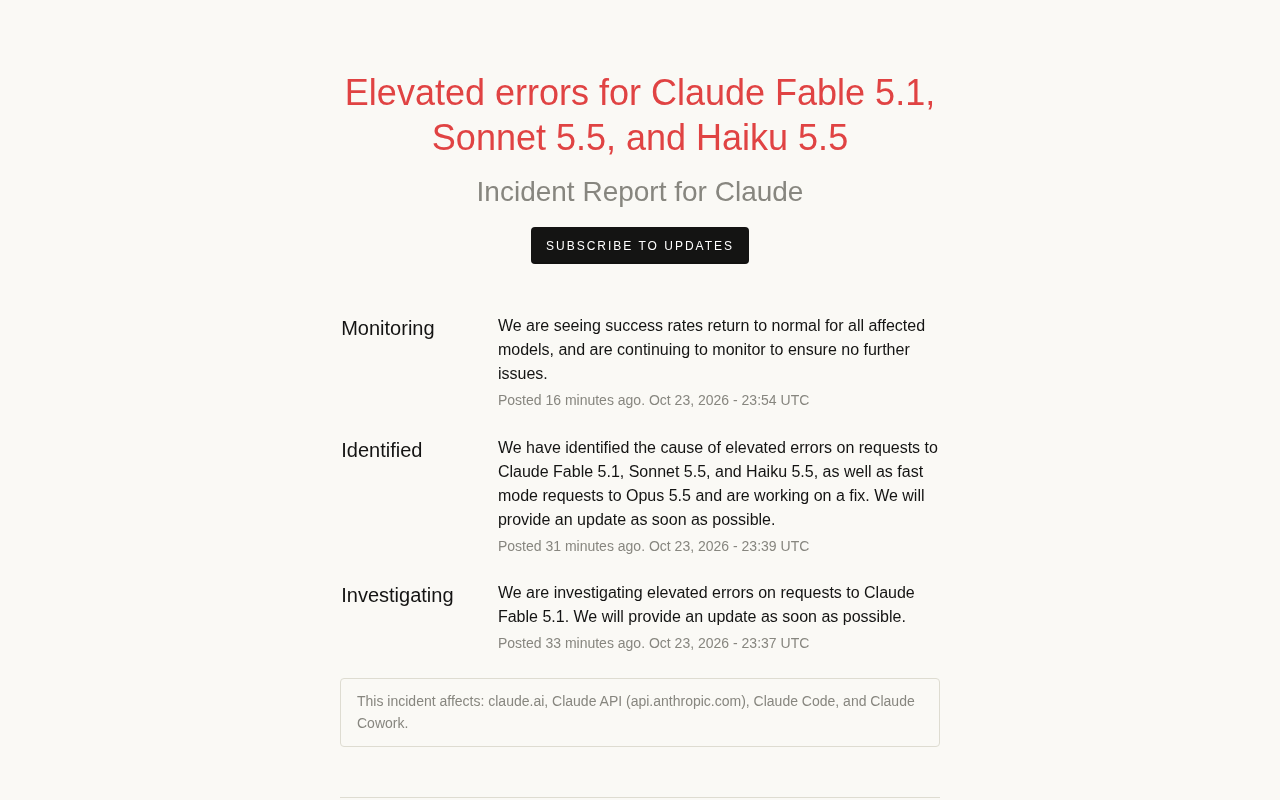
Multiple Claude Models Hit by Errors: A Postmortem of Fable 5.1, Sonnet 5.5, and Haiku 5.5
Claude Fable 5.1, Sonnet 5.5, Haiku 5.5, and Opus 5.5 fast mode saw elevated errors; Anthropic identified and resolved the issue in 17 minutes. This postmortem covers the timeline, the technical reasons for the multi-model cascading failure, and practical lessons for retry and degradation strategies.