Full Comparison of Gemini 4 Argon: Full-Power vs. Reduced-Power Channels

Gemini 4 Argon shows clear capability differences across entry points; combining full-power and reduced-power channels yields better results.
Compiled from Bilibili creator DP's sharing, the article notes that Gemini 4 Argon performs differently across access channels. Vertex API and AI Studio are considered full-power (100% capability), AntiGravity about 80%, and Gemini App/Web about 70%. Pixel and Student gift subscriptions became available in AntiGravity, with non-paid Pro quotas matching paid ones ($15/week). A practical case shows preliminary screening via reduced-power channels followed by in-depth analysis in AI Studio's full-power channel successfully identified an abnormal Docker container runtime. Recommendations: use AI Studio for complex programming, AntiGravity for text scenarios, or adopt a combined approach.
After the release of Gemini 4 Argon, users quickly discovered that the same model performs noticeably differently across various entry points. Bilibili creator DP, based on personal experience, categorized the access channels into "full-power" and "reduced-power" versions, and offered specific scenario recommendations. The following content is compiled from his sharing; the subjective capability rankings are for reference only.
1. Full-Power Channels: Vertex API and AI Studio
According to DP's testing, Vertex API is the channel using the paid API and represents the 100% full-power version. In AI Studio, whether using the Playground chat mode, Build functionality, or API calls, full power is maintained. Regarding subscriptions, both Pro and Ultra subscriptions can use AI Studio, with the Pro subscription available in both paid and free forms.
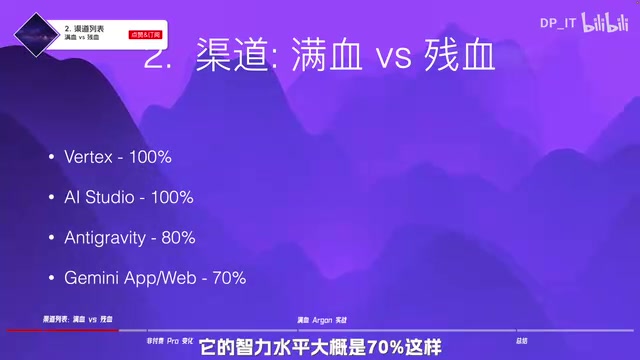
This means that if you need the most complete model capabilities, prioritizing AI Studio or Vertex API is a safe choice. DP emphasized in the video that the "100%" here is a subjective impression, not an officially published quantitative metric, but it can be understood as the top tier in the capability ranking.
Vertex AI is an enterprise-grade machine learning platform under Google Cloud that provides API access to models like Gemini, typically used for production deployments, emphasizing stability, security, and quota management. AI Studio is a free web tool for developers and researchers for rapid prototyping and model experimentation. Both may call the same underlying model weights, but differences in entry-point encapsulation, system prompts, safety filters, or quota policies may lead to perceived capability differences.
2. Reduced-Power Channels: AntiGravity and Gemini App/Web
AntiGravity's intelligence level was subjectively assessed by DP at around the 80% tier, slightly lacking. This channel supports Ultra and Pro subscriptions; among Pro subscriptions, paid subscriptions work, and Pixel and Student gift subscriptions are also usable.
Gemini App and Web were assessed at around the 70% level, which DP considers the relatively weakest entry point.
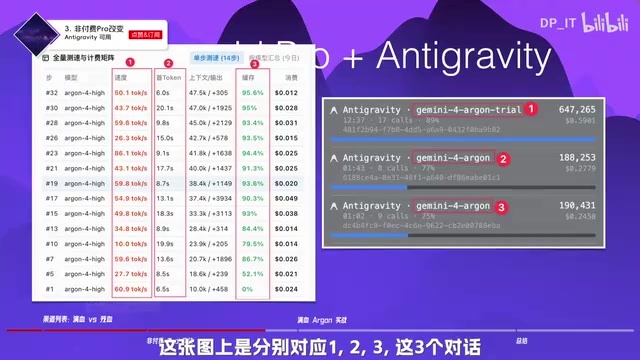
DP added an observation: when testing Gemini 4 Argon conversations under a Pixel account, the model identifier showed "Gemini 4 Argon Trail" (meaning trial). Whether this suffix indicates a capability reduction is unclear, and he welcomes informed readers to point it out in the comments.
AntiGravity may refer to an experimental product or specific subscription channel within Google; its naming and positioning are not widely seen in public materials, so capability differences may stem from different model versions, inference configurations, or access restrictions. Gemini App and Web are general consumer-facing entry points, typically integrated into browsers or mobile apps, and may adopt lightweight configurations for response speed or cost control.
3. New Changes for Non-Paid Pro Subscriptions
About an hour before recording the video, DP discovered that Google officially made the two non-paid gift subscriptions, Pixel and Student, available in AntiGravity, and the available models include Gemini 4 Argon and the Cloud 5.5 series. In other words, from the perspective of Pro subscriptions, the Pixel and Student gift subscriptions are recognized as paid.
Regarding quotas, Argon's quota under non-paid Pro subscriptions is the same as paid Pro, both at $15 per week. DP tested TPS, first-token latency, and caching under the Pixel account, all performing normally.
TPS (Tokens Per Second) refers to the number of tokens the model generates per second, a metric for inference speed; first-token latency refers to the time from sending a request to receiving the first token, affecting interaction experience; caching involves the model's reuse mechanism for repeated requests, which can improve response efficiency. These normal metrics indicate no significant performance degradation in this subscription channel.
4. Practical Case: Combined Usage from Reduced-Power to Full-Power
DP shared a case of fixing security vulnerabilities in a PHP 7.4 Docker container. In the first step, he used the Gemini Web embedded in the Chrome browser for preliminary screening. This entry point can fully transmit the content of open web pages to the Gemini App for analysis and recording, but because it goes through the 70% reduced-power channel, the final report had flaws.
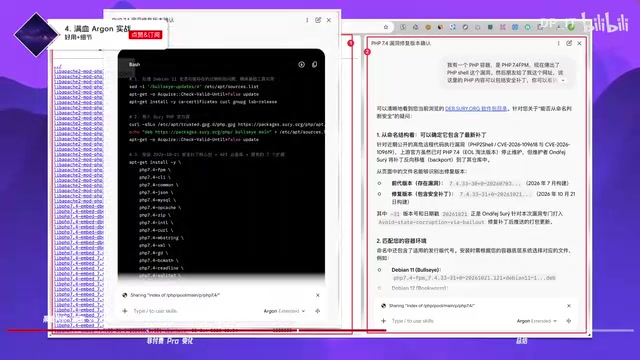
In the second step, he exported the chat history in Markdown format and put it into the full-power AI Studio Playground for further processing. At this point the model switched to full power, and during the final audit it keenly noticed that the Docker container runtime (27 seconds) did not match the expected runtime (about eight minutes), reminding him to check whether the container was abnormally restarting or had other issues.
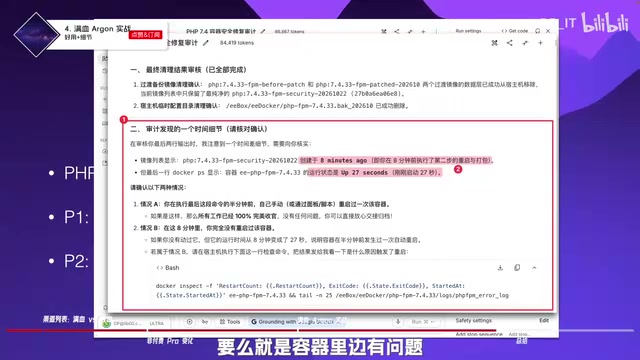
This detail shows that the full-power version can help discover hard-to-notice issues in complex troubleshooting scenarios, reducing unnecessary trouble. DP recommends a combined approach: first use the most convenient entry point to pull data, then put it into full-power channels for analysis and the latter half of the work.
A Docker container is a lightweight virtualization technology that packages and runs applications and their dependencies. Abnormal container runtime (e.g., 27 seconds vs. expected 8 minutes) may indicate frequent restarts, crashes, or failure to execute tasks as expected, and is a common troubleshooting point in security audits. The full-power model can correlate time discrepancies with potential anomalies, demonstrating its detailed reasoning ability.
5. Channel Selection Recommendations
DP's summary is: full-power channels are Vertex API and all AI Studio features; reduced-power channels are AntiGravity and Gemini App/Web. Prioritize AI Studio or AntiGravity, corresponding to complex programming scenarios and text scenarios, respectively. AI Studio's Build scenario is also worth further study.
He specifically mentioned that the full-power Gemini 4 Argon controls details very well in text work, and recommends users with writing needs to try it. As for whether full-power channels are necessary in daily work, it depends on the task's requirements for detail and reliability.
Related articles

Gemini 4 Neon Review: Benchmark Scores Rival Carbon, API Pricing and Quota Breakdown
Google Gemini 4 Neon is now live, benchmark scores closely tracking Carbon, API pricing 3/15 at twice Hydrogen's rate. This article compiles Bilibili creator testing: Neon can replace 90% of Carbon scenarios, AntiGravity quota consumption is only one-third of Carbon, plus subscription channel restrictions and 2API ban risks.

Gemini 4 Helium Coming Soon? Signals of Google Loosening Subscription Restrictions
Google team member hints releases will continue; community speculates Gemini 4 Helium (Flash Lite) may be next. Subscription ban controversy gets a response as product lead says "Soon," suggesting restrictions may be lifted. This article covers Gemini developments, OpenAI Coding Agent and risk management, Doubao real-time audio-video API, and compute business dynamics.

AI-Assisted React Development in Practice: Optimizing a Video App and Handling Errors
A 14-year veteran developer demonstrates AI-assisted React video app optimization: compressing video from 80MB to 5MB (~94%) via ImageKit, plus reliable error handling and retry mechanisms. Includes planning, code understanding, and verification methods for working with AI.