GameAgent vs. Pink: Three-Round Showdown of Game Development AI Agents
GameAgent edges Pink across three Cocos Creator game dev rounds, with stability as the key differentiator.
This evaluation tests two Cocos Creator game development AI agents — GameAgent (0.3.4) and Pink (0.0.1.36 Alpha) — both running GPT-5.6 Sol, across three tasks: Hello World, Snake, and a platformer level. GameAgent narrowly won Round 1 on interaction details; Round 2 was a draw; Round 3 saw Pink fail repeatedly due to request errors while GameAgent delivered interim results. The key finding: both agents handle simple prototypes adequately, but struggle with scene construction and complex project management, requiring human oversight.
Game development is emerging as a new frontier for AI agents. This evaluation puts two development agents running on Cocos Creator — GameAgent and Pink — through the same test, using three progressively challenging tasks to assess their real-world capabilities. Both agents were connected to the same model (GPT-5.6 Sol) with reasoning level set to high, minimizing model-side variables so the focus stays on each agent's own engineering ability.
The Two Contestants and Test Setup
GameAgent is a plugin running inside Cocos Creator; version 0.3.4 was used here. Pink operates within its own editor, offering game development and conversational interaction, and was tested at version 0.0.1.36 Alpha alongside Cocos Creator 3.8.8. It's worth emphasizing that Pink is currently in Alpha early access, and its performance here does not represent the final product quality.
The evaluation methodology deserves recognition: each round documented not just the final deliverable, but the full development process — reading the project, writing scripts, binding components, opening previews, and executing interactions. This dual "process + outcome" perspective gives a far more honest picture of how each agent performs in a real workflow, rather than just showcasing a polished screenshot.
Cocos Creator is a cross-platform game engine developed by Chukong Technologies, built around a component-based, data-driven design philosophy. It supports 2D/3D game development and can publish to Web, iOS, Android, and other platforms. Its core workflow revolves around a three-layer structure: Scene → Node → Component. Developers place nodes in the scene editor and attach script components to implement logic. This architecture is both an opportunity and a challenge for game development AI agents — they need not only to write script code, but also to understand node hierarchies, Prefab reuse mechanisms, and asset binding relationships in order to truly wire code into a runnable scene, rather than just generating isolated
.tsfiles. The difficulties exposed in Round 3 stem precisely from the high demands that scene construction places on understanding project structure.
Round 1: Hello World Basic Code
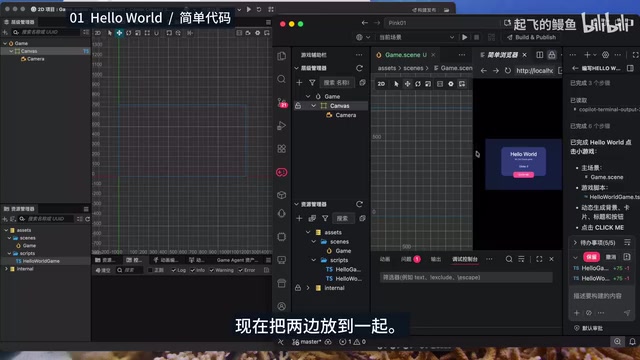
Round 1 was a warm-up — a single-sentence prompt: build a Hello World game, with no specific UI requirements. The focus was on whether the basic code runs and whether clicking produces the correct feedback.
Both agents needed to read the project, plan an implementation, and wire scripts into the scene. GameAgent produced a preview screenshot with a title, description, and button relatively early; Pink continued modifying files and handling component bindings. Once both versions were interactive, they were compared on click counting, text changes, and button feedback.
In terms of results, Pink's click counter updated and the button provided feedback — basic interaction was functional. GameAgent went a step further: in addition to counting, each click also cycled through different greeting messages, adding an extra layer of engagement. Based on what was actually delivered, GameAgent edged out Round 1, with the gap coming from extra interactive details rather than core functionality.
Round 2: Snake — Full Gameplay
Round 2 tested full game design and development capability. The prompt was again a single sentence: build a Snake game, leaving UI and rule details up to the agent. The focus was on whether movement, eating food, scoring, game over, and restart could all come together into a playable loop.
The challenge here was transforming the previous click demonstration into a continuously running game loop. GameAgent laid out the board, score, and directional buttons in distinct sections, resulting in a busier screen; Pink continued generating game logic and UI in a comparatively minimal style. Both agents had preview and testing capabilities — one checking runtime state and executing interactions, the other opening a browser to capture and inspect the preview.
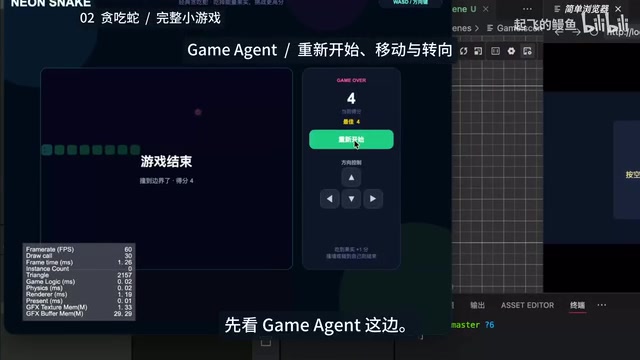
During the process, Pink encountered an error and did not complete the full task run, but the Snake it had already generated was still playable, and the evaluator recorded a separate gameplay segment. In the end, the core mechanics worked on both sides: snake movement, scoring, and game over were all visible. GameAgent had richer on-screen elements; Pink was more minimal. This round was judged essentially even.
Round 3: Scene Construction and Asset Comprehension
Round 3 was the most differentiating and the most demanding in terms of each agent's grasp of project structure. Both agents were given pre-made assets — a character, platforms, coins, and enemies — with the goal of building a vertical platformer level featuring double jump, coin collection, and stomping enemies. The core question: how does each agent interpret the assets and actually assemble them into a scene?
The evaluator made one correction mid-task — initially neither agent planned to build out the scene, but since that was the whole point of this round, they were explicitly told to construct the scene and use Prefabs where appropriate for reuse. This human intervention was transparently noted in the results.
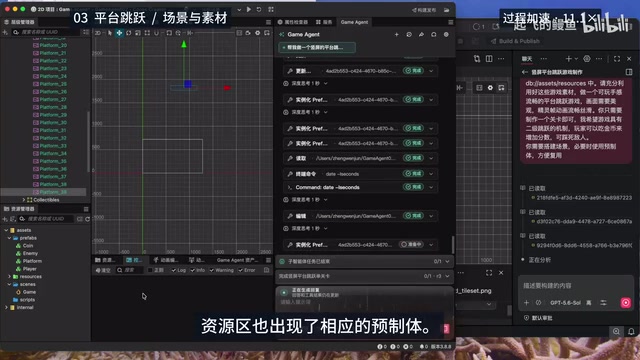
GameAgent's scene hierarchy grew progressively — platforms, coins, enemies, and the player all appeared in the project, and corresponding Prefabs showed up in the assets panel. Pink, on the other hand, ran into repeated request failures: the first attempt failed, a second was initiated, then a third — both also errored out. Given two chances, it still couldn't produce a demonstrable result.
To be objective: Pink's task was interrupted by an error, so this outcome cannot be taken as a judgment of its scene-building capability in general. Round 3 therefore could not form a complete comparison.
A Prefab in Cocos Creator is a reusable node template that packages a node together with its child nodes and component configuration into a standalone asset. In level design, objects of the same type (such as coins or enemies) are typically managed as Prefabs and instantiated dynamically at runtime — reducing manual placement work and making it easy to update shared properties in one place. For a game development AI agent, the ability to proactively recognize "this type of object should be a Prefab" and correctly create and reference it is a key indicator of whether the agent truly understands Cocos project structure. The fact that the evaluator had to explicitly ask agents to use Prefabs reflects a revealing tendency: without clear instruction, agents default to statically placing nodes directly in the scene rather than adopting a more engineering-minded, reusable approach.
GameAgent Solo Showcase
Since Pink was unable to finish, Round 3 could only observe GameAgent on its own. It continued processing the scene, scripts, and preview checks. Some code sub-tasks also failed along the way — these errors were kept in the record as-is — and it then moved on to handle the control scripts.
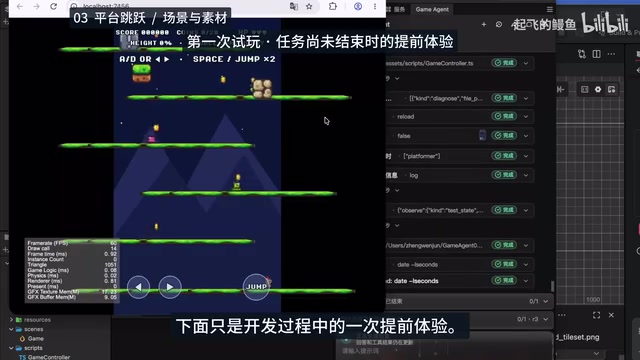
Based on the interim experience, the character could move and jump across the scene, the top of the screen displayed score, coins, and health, and stomping a slime triggered a score bonus. Two playthroughs confirmed the level was interactive and the scene structure remained editable. However, when recording ended, GameAgent's task had still not fully completed — what was shown represents an interim result, and final verification would need to continue.
Evaluation Summary and Observations
After three rounds, the conclusions are clear — though with appropriate caveats:
- Round 1: Both completed basic interaction; GameAgent edged ahead on details like rotating greeting messages.
- Round 2: Core mechanics worked on both sides; judged even.
- Round 3: Pink was disrupted by errors and couldn't complete the comparison; only GameAgent showed interim results.
The most valuable takeaway from this "digital cricket fight" isn't the scoreboard — it's what the tests exposed about the shared bottlenecks of current game development AI agents: the more complex the task (especially when it involves scene construction, asset comprehension, and multi-object project management), the more likely request failures and sub-task interruptions become. GameAgent held an advantage in completeness and interactive detail, while Pink, as an Alpha product, still has clear room to improve on stability.
For developers, these agents are already capable of handling simple code and small game prototypes — but when it comes to production-level scene organization and complex logic, human correction and review are still necessary. They're better understood as productivity tools than as developers you can fully hand the wheel to.
Related articles

NVIDIA cuML Accelerates Spectral Clustering: 100x+ Speedup Over Scikit-Learn Benchmarked
NVIDIA cuML lets Scikit-Learn spectral clustering run on GPU without code changes, delivering 200x+ speedups on large datasets. Learn how it works and how to use it.

Google DeepMind Launches New Institute to Bring the AGI Debate into the Open
Google DeepMind has launched a new institute to bring AGI debate into the public sphere. We analyze what this signals about the shift from technical competition to AI governance.
How Cooley Is Reinventing IPO Legal Workflows with ChatGPT: A Look at the GO Public Tool
Cooley built GO Public on ChatGPT Work to accelerate IPO legal workflows, helping lawyers catch issues earlier and focus judgment where it matters most.