GameAP: Open-Source Game Server Management Platform, Rewritten in Go with Weekly Updates

GameAP is an open-source game server manager rewritten in Go, featuring Wasm plugins and flexible deployment options.
GameAP is a free, open-source game server management platform that completed a full Go rewrite a year ago and now ships updates weekly. It follows a lean-core-plus-plugin architecture, where plugins can be written in any language that compiles to WebAssembly (Rust, C, Go, AssemblyScript, etc.) and run safely in sandboxed environments. Deployment options range from native Linux/Windows and Docker to full Kubernetes clusters. The bundled gameapctl CLI tool simplifies maintenance with one-command system updates and Let's Encrypt HTTPS setup. A live demo is available, though the plugin ecosystem's maturity remains to be proven.
For players and community admins who self-host game servers, managing multiple instances has always been a hassle. GameAP is an open-source project aiming to change that — a free, open-source game server management platform that recently caught significant attention in Reddit's selfhosted community.
Go Rewrite Enables Rapid Iteration
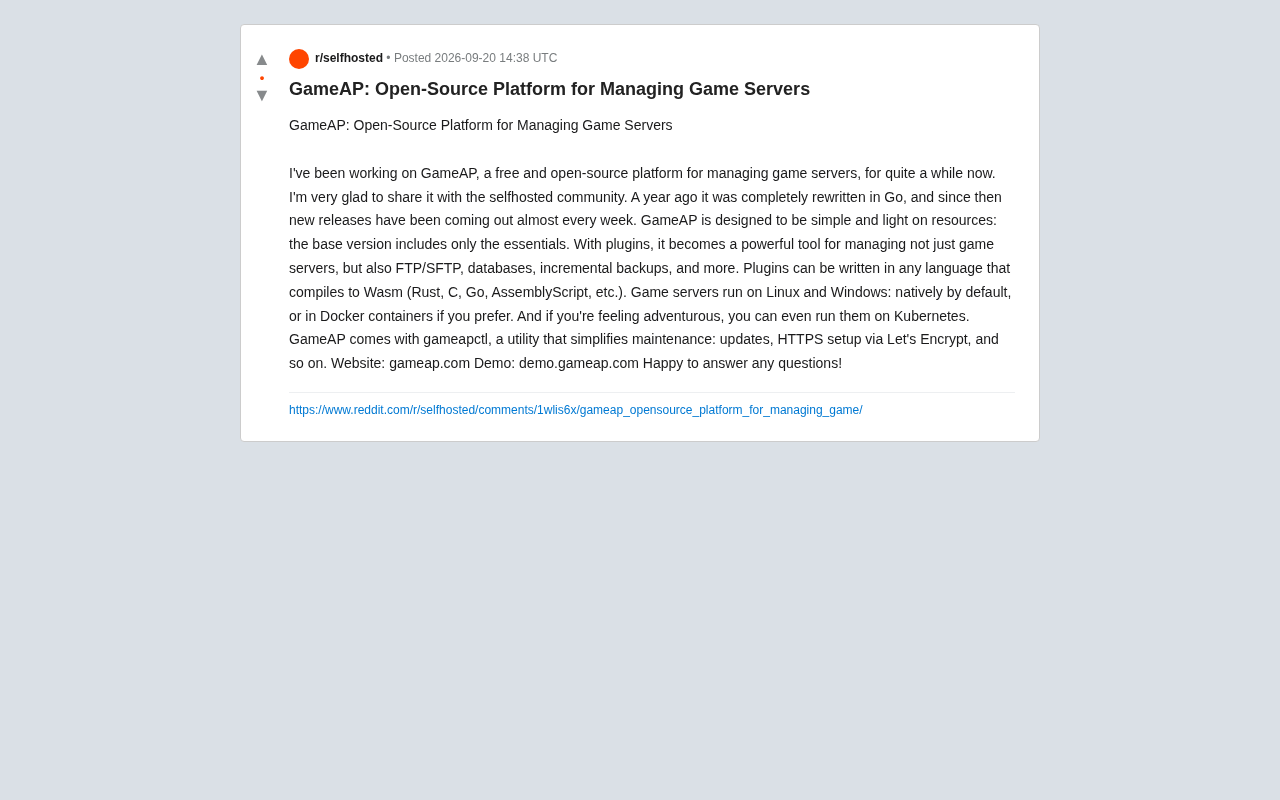
According to the project's author on Reddit, GameAP has been in development for quite some time. A year ago, the entire platform was rewritten from scratch in Go. The immediate result was a noticeably faster release cadence — the author mentioned that since the rewrite, new versions ship almost every week.
For an open-source project, Go is a pragmatic choice. Its compiled nature and low runtime overhead align naturally with GameAP's goal of being "simple and resource-efficient." The author emphasizes that the base version includes only the most essential features, without stuffing in rarely-used modules from the start — which is especially friendly for resource-constrained self-hosted environments like small VPS instances or home servers.
Plugin System: Extending Capabilities with WebAssembly
GameAP's real potential lies in its plugin architecture. The base version stays lean, but plugins can transform it into a much more comprehensive tool — capable of handling not just game servers, but also FTP/SFTP, databases, incremental backups, and other operational tasks.
A noteworthy technical choice: plugins can be written in any language that compiles to Wasm (WebAssembly), including Rust, C, Go, AssemblyScript, and more. This design offers two key advantages. First, developers aren't locked into a single language and can use whatever stack they're comfortable with. Second, Wasm provides a sandboxed runtime environment that isolates plugins from the host process, balancing flexibility with security. Using Wasm as a plugin system has become increasingly common in infrastructure projects, and GameAP's application of it to game server management is a compelling use case.
WebAssembly (Wasm) was originally designed as a binary instruction format for browsers, allowing code written in C/C++/Rust to run at near-native speed in web environments. In recent years, Wasm has rapidly expanded into server-side use cases — the WASI (WebAssembly System Interface) standard enables Wasm modules to run in standalone runtimes (such as Wasmtime and WasmEdge) without a browser. This makes Wasm an ideal foundation for plugin systems: each plugin runs in an isolated sandbox, unable to directly access the host process's memory. Even if a plugin contains a vulnerability, it's far harder for it to affect the main program, significantly reducing the security risks of third-party extensions. Infrastructure projects like Envoy Proxy and the Zellij terminal multiplexer have adopted similar architectures. For game server management, this means community developers can contribute plugins in their preferred language, while the platform itself doesn't have to bear the full security burden of arbitrary code execution.
Flexible Deployment: From Bare Metal to Kubernetes
In terms of deployment flexibility, GameAP covers everything from lightweight setups to complex orchestration. Game servers can run on Linux and Windows natively by default; if you prefer containerization, Docker is also supported.
The author also half-jokingly mentioned that "if you want to go wild," you can even deploy game servers on Kubernetes. While K8s may be overkill for most individual players, this option has real value for communities or commercial operators managing large-scale, highly available game server clusters. This full spectrum — from single-machine native deployments to cluster orchestration — shows that the architecture was designed with room to grow.
gameapctl Simplifies Day-to-Day Maintenance
GameAP ships with a command-line tool called gameapctl, designed specifically to lower the barrier to routine operations. It handles tasks like system updates and automatic HTTPS configuration via Let's Encrypt.
For users who don't want to manually deal with certificates and update workflows, this kind of one-click tooling saves significant time. The Let's Encrypt integration is especially practical — free, automated HTTPS allows a publicly accessible management panel to achieve basic transport security at near-zero cost.
Let's Encrypt is a free, automated certificate authority (CA) operated by the Internet Security Research Group (ISRG), which officially launched in 2016. It uses the ACME (Automated Certificate Management Environment) protocol to automate certificate issuance, validation, and renewal — entirely without human intervention. For self-hosted server operators, traditional commercial SSL certificates require annual fees, whereas Let's Encrypt eliminates that cost entirely and makes "one command to get HTTPS" a reality through clients like Certbot. Certificates are valid for 90 days, but automatic renewal means they rarely require manual management in practice. The built-in integration in
gameapctlmeans that even users with no ops experience can run their public-facing GameAP panel over an encrypted connection, preventing credentials from being exposed in plaintext during transmission.
Summary
GameAP has a clear positioning: a lightweight, open-source game server management platform that's infinitely extensible through Wasm plugins. The Go rewrite brought an active weekly release cadence, while multiple deployment options and the gameapctl tool strike a balance between ease of use and flexibility.
The project offers an online demo at demo.gameap.com and an official site at gameap.com — interested self-hosters can try the demo before committing to a deployment. One caveat: the information in this article is primarily based on the author's own account on Reddit, and real-world performance, usability, and the maturity of the plugin ecosystem still need to be validated in actual production environments.
Related articles

Cursor AI Programming in Practice: Build a Student Management System from Scratch in 30 Minutes
A Bilibili creator demonstrates Cursor AI programming: generating a student management system in 30 minutes with natural language. Details on Agent mode, Claude selection, prompt techniques, and thresholds.

Top 20 AI Coding Tools Ranking: From Rock-Solid to Lackluster, a Scored Matrix
Bilibili creator releases top 20 AI coding tools ranking, tiered T0–T4 from rock-solid to lackluster, with Claude Code and Codex tied at T0. This article details the scoring dimensions (capability, reliability, robustness, durability, cost, domestic availability) and tool performances to help developers choose the right AI coding assistant.

Vibe Coding Systematic Tutorial: Master AI-Assisted Programming from Zero
A three-month Vibe Coding tutorial from a Bilibili creator covering Codex, ClaudeCode, and Cursor, from core logic to commercial project practice for beginners.