GameRoll: All-in-One Game Library Manager for 200+ Platforms

GameRoll unifies game library management, decision-making, and social features across 200+ platforms in one mobile app.
GameRoll is a mobile app for cross-platform players that consolidates collections from 200+ gaming platforms into one place. Beyond basic backlog and wishlist management, it offers a "Your Roll" feature to help players overcome choice paralysis, along with ratings, reviews, and community interaction — following the social-tracking model of Letterboxd and Goodreads. Built by an indie developer, it's available on Android and iOS and still in early stages. Its long-term value hinges on database quality, platform sync, and whether it can build an active gaming community.
For players who span multiple platforms and sit on massive game libraries, figuring out "what to play next" can be more mentally taxing than actually playing. Modern consoles, handhelds, PC, and vintage retro systems scattered across different accounts and collections make it nearly impossible to get a clear, unified picture of what you own and what you want to play. GameRoll is a mobile app built specifically for this pain point — an attempt to bring your entire gaming life under one roof.
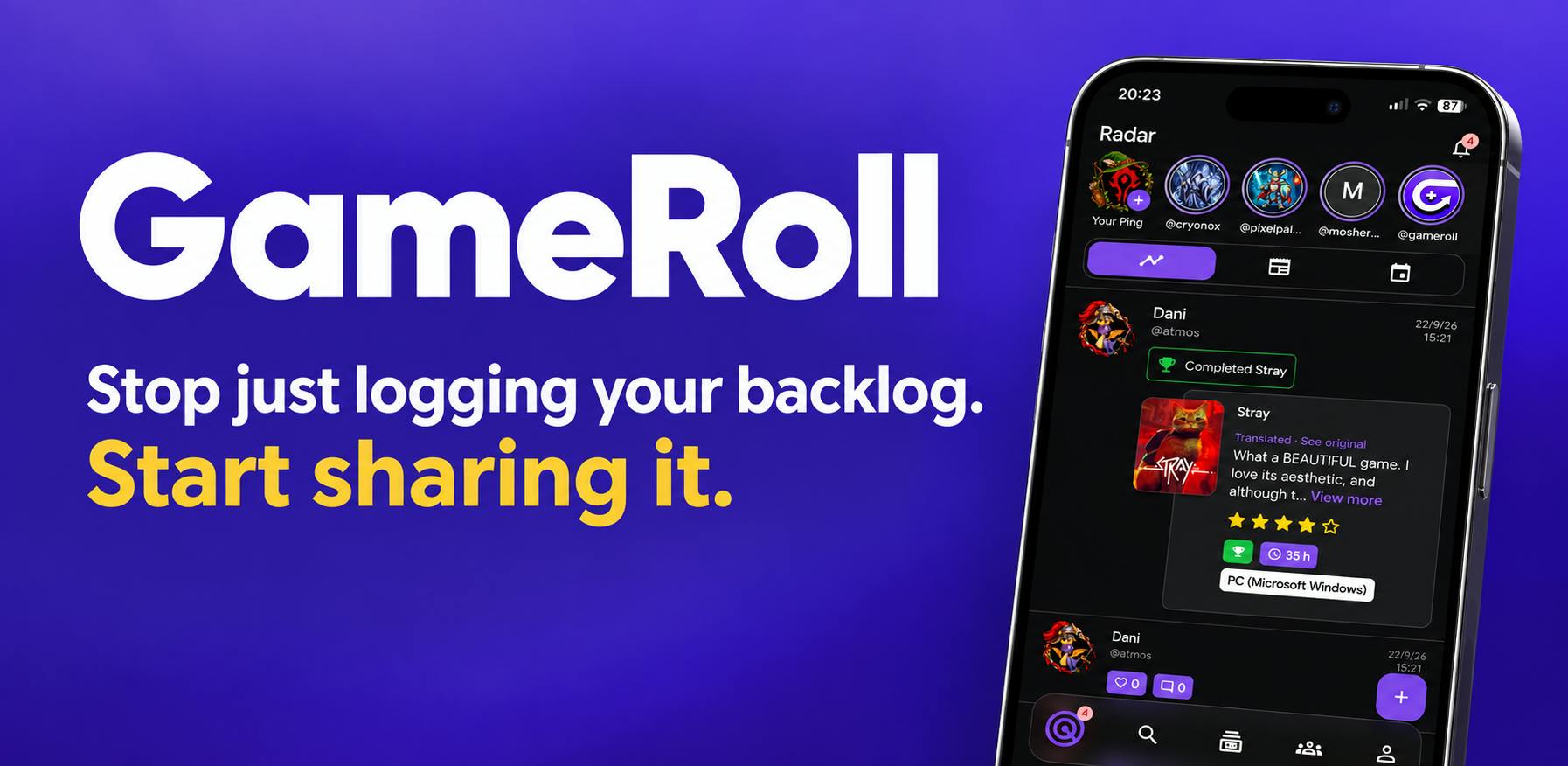
One App to Manage Your Entire Game Collection
GameRoll's core identity is a game backlog tracker. According to its Product Hunt listing, the app supports library management across more than 200 gaming platforms — spanning contemporary consoles all the way back to classic retro systems. That means whether you're playing the latest AAA release or revisiting titles from decades-old hardware, everything can live within the same collection framework.
For cross-platform players, this kind of unified inventory management delivers immediate value by eliminating information silos. Collections that previously required juggling Steam, PSN, Xbox, and Nintendo accounts can now be viewed in their entirety from a single app. The 200+ platform coverage also means GameRoll isn't just for players chasing the newest releases — it equally caters to retro gaming enthusiasts who've held onto their classics.
From Collection Management to Decision-Making
GameRoll goes beyond being a static list tool. It wraps a suite of features around the player's entire "gaming decision chain." Users can organize their backlog and wishlist, rate and review games, and browse trending and top-rated titles to discover what to play next.
One standout feature is Your Roll, designed to help players decide "what to play next." For players who've accumulated huge libraries and suffer from choice paralysis, this kind of decision-assist feature addresses a more genuine need than simple list management alone. Combining "track what you own" with "decide what to play next" is one of the ways GameRoll distinguishes itself from a generic collection tool.
Social Layer: Not Just Logging, But Sharing and Community
Beyond personal inventory and decision tools, GameRoll incorporates a clear social dimension. Users can follow other players, join communities, discuss games, and share their discoveries anywhere on the internet.
This social design follows a well-trodden path established by content-tracking apps in film and books — Letterboxd and Goodreads — where "logging" becomes "expression" and personal collections become social currency. For gaming, a category with an inherently strong community culture, the combination of following, reviewing, and discussing has real potential to drive user retention and content accumulation. GameRoll describes itself as "home for everything you play," and the social layer is central to making that vision credible.
Letterboxd and Goodreads are the canonical reference points here. Letterboxd focused on film diaries — logging watches, writing short reviews, following critics — and grew into a hub for cinephile communities. Goodreads started with reading lists and, after accumulating hundreds of millions of book reviews, was acquired by Amazon. Their shared lesson: the utility features are just the entry ticket. The real moat is built on the density of user-generated content (UGC) and the depth of social graphs. The gaming space already has vertical tools like Backloggd and HowLongToBeat, but there's still room for an integrated product that combines cross-platform inventory management, decision assistance, and a complete social graph. If GameRoll can establish a "review–follow–discuss" content flywheel among core gamers, that will be its key differentiator against purely utilitarian competitors.
Product Status and Observations
GameRoll is currently available on Android and iOS, listed under the Games category, and built by developer Pablo Rodríguez Palomino. Based on Product Hunt data, the product has received 12 upvotes and 3 comments, ranking 14th — very much in early-stage independent product territory.
From a market perspective, game library tracking isn't a new concept, and several established competitors already exist. GameRoll's differentiation bets on a three-part combination: ultra-broad platform coverage (200+), decision assistance (Your Roll), and a full social community system. Whether it can build sufficient database reputation and community activity among existing players will determine whether it remains a niche tool or grows into a high-frequency daily app.
For players with sprawling collections across many platforms, a tendency to agonize over what to play, and an itch to share their gaming experiences, GameRoll is worth a try. Its long-term value, however, ultimately depends on database accuracy, platform sync capabilities, and the network effects of its community.
The main existing competitors in the game library tracking space include: HowLongToBeat (focused on logging completion times, with a massive database but weaker social features), Backloggd (a Letterboxd-style game journal community, primarily English-speaking), and the native library systems built into each platform (like Steam's "Played" tags or PlayStation's game library). Each has its strengths, but all suffer from platform fragmentation or limited feature scope. GameRoll is attempting to fill that gap with a combined punch of "200+ platform unified entry point + decision assistance + social," but that also means sustaining investment on three simultaneous fronts — database maintenance, product experience, and cold-start community growth. For an independent developer, that's a remarkably high resource threshold.
Related articles

Free Unlimited Claude Code Solution: Agnes AI + CC Switch Setup Guide
No paid subscription needed — pair the free AI platform Agnes AI with the open-source tool CC Switch to provide a backend for Claude Code, enabling unlimited free calls to text, image, and video models. This guide covers the full setup, test results, and usage boundaries.

A Complete Zero-Cost Guide to Getting Started with Claude Code for Beginners in China
A beginner's guide to Claude Code for users in China: two installation methods (command line and IDE plugin), full configuration steps for replacing the official API with the free domestic LongCat model, and a hands-on demo of building a small tool with natural language, plus tips.

When the NSA Gets Involved: The AI Supply Chain Crisis Behind Open-Source CVEs and API Key Hijacking
Multiple open-source projects disclosed severe CVEs in one day, PHP flaws alarmed the FBI, and Railway and OpenCode were breached with API keys stolen. This article breaks down the vulnerability window, AI-accelerated exploitation, and the AI supply chain crisis behind the API key black market, with a developer defense checklist.