Gauth AI Course: An AI Education Tool That Turns Any Topic into an Interactive Course with One Click
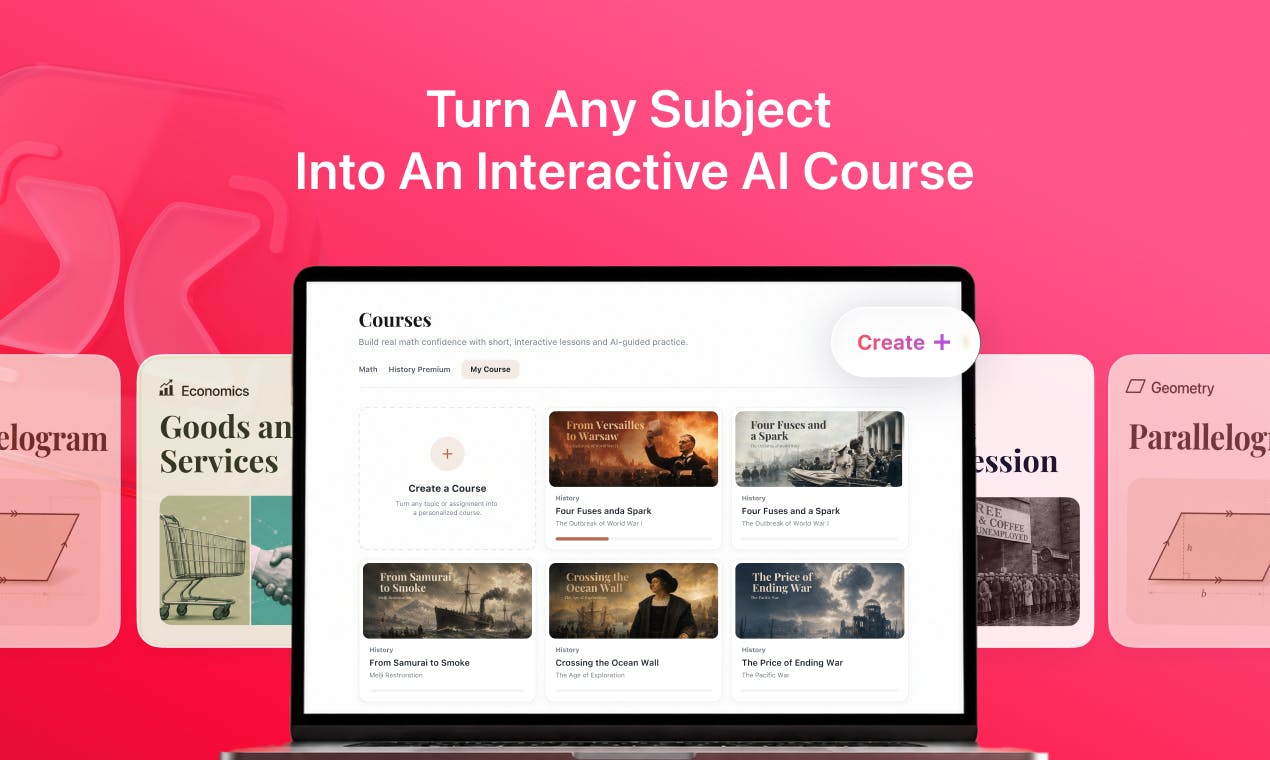
Gauth AI Course uses AI to turn any topic into interactive, quiz-embedded courses in seconds.
Gauth AI Course launched on Product Hunt with 200+ AI-generated math courses covering the full U.S. high school curriculum. It combines visual demonstrations, active recall quizzes, real-time AI tutoring, and one-click custom course generation into a single learning loop. By starting with math's verifiable, structured knowledge domain, the platform aims to evolve from a tool into a content community with UGC-driven network effects.
The Next Step in AI Education: From Passive Watching to Active Learning
Online education has passed through several stages — pre-recorded videos, live-streamed classes, MOOC platforms — but one core pain point has never been truly resolved: learners are mostly in a state of passive reception. It's easy to zone out while watching videos, there's no one to ask when questions arise, and it's hard to verify how well you've actually mastered the material.
This isn't a new discovery. Since 2012, when Coursera, edX, and other MOOC platforms kicked off what was dubbed the "year one of online education," the industry has gone through multiple iterations: pre-recorded videos (attracting users with quality content), live interactive sessions (attempting to recreate the classroom atmosphere), and adaptive learning (using algorithms to recommend learning paths). Yet MOOC platform completion rates have long hovered between 5% and 15%, with the core reason being learners' lack of sustained cognitive engagement in passive reception mode. The "Attention Decrement Theory" in cognitive psychology points out that when people passively receive information, their attention typically begins to decline significantly after 10–15 minutes — fundamentally at odds with the 30–60 minute durations common in most online courses.
Recently launched on Product Hunt, Gauth AI Course is attempting to use AI to redefine this experience. After launch, the product quickly shot up to #4 on the daily leaderboard, garnering 130 upvotes and 21 comments.
Gauth AI Course has a clear core positioning: turn any subject into an interactive course you can watch, quiz yourself on, and create. It's not just another course video library — it integrates "watch — ask — test — create" into a single AI-driven learning loop.
Starting with Math: 200+ Courses Covering All U.S. High School Topics
The product chose a very smart entry point — math. The first batch of 200+ AI math courses comprehensively covers all U.S. high school math topics, from Algebra I all the way to AP Calculus.
It's worth noting that the U.S. high school math curriculum differs significantly from systems in other countries. The typical pathway is: Algebra I → Geometry → Algebra II → Pre-Calculus → AP Calculus AB/BC. AP (Advanced Placement) courses are managed by the College Board, and students who pass AP exams can earn college credit in advance. The 5-score rate for AP Calculus BC is around 40%, but achieving a high score still requires solid knowledge foundations. For students applying to top U.S. universities, AP math courses are practically mandatory — meaning this market has both a standardized content framework to build on and strong test-prep motivation.
Math is an ideal starting point for several reasons:
- Clear knowledge structure: Math has well-defined prerequisite relationships and standardized curricula, making it easier for AI to generate content that is structurally accurate and logically rigorous. Mathematical knowledge naturally forms a Directed Acyclic Graph (DAG) — for example, learning calculus requires first mastering functions and limits, and Algebra II requires an Algebra I foundation. These strong dependencies give AI a clear structure to follow when sequencing courses, making automated course design far easier than for humanities subjects.
- Verifiable answers: Math problems have clear right and wrong answers, making active-recall quiz grading more reliable. By contrast, AI grading for open-ended tasks like essay writing or historical analysis remains highly controversial.
- Strong demand: Math tutoring from middle school through high school has always been one of the categories with the highest willingness to pay in online education. According to Grand View Research, the global online math tutoring market is expected to reach billions of dollars by 2030, with the K-12 segment contributing the largest share.
Gauth itself started as a product focused on photo-based problem solving and AI math tutoring. Launching a systematic course offering can be seen as a natural extension from "solving individual problems" to "systematic learning." The massive problem-solving data and math knowledge graphs Gauth has previously accumulated provide an important data foundation for automated course generation and quality assurance.
Three Key Capabilities of Gauth AI Course
Compared to traditional pre-recorded courses, Gauth AI Course introduces several differentiating design elements in the learning experience.
Visual Demonstrations and Mind Maps
Courses embed visual demonstrations and mind maps to help learners transform abstract mathematical concepts into intuitive graphical structures. Mind maps are especially suited for organizing the knowledge connections between chapters, giving learners a holistic view of the entire knowledge system rather than memorizing formulas in isolation.
This design is supported by Cognitive Load Theory, proposed by educational psychologist John Sweller. The core idea is that human working memory has limited capacity and can only process a finite number of information elements at a time. When learning materials are presented in pure text or symbols, learners must mentally construct the relationships between concepts themselves, consuming large amounts of "extraneous cognitive load." Visualization tools effectively reduce this cognitive burden by making abstract relationships explicit, allowing learners to devote more mental resources to genuine understanding and thinking — what's known as "germane cognitive load."
Built-in Active Recall Quizzes
Every lesson embeds Active-Recall Quizzes. Active recall is a highly effective learning method repeatedly validated by cognitive science — strengthening long-term memory through continuous self-retrieval rather than repeated reading. Embedding quizzes directly into the course flow means learners test themselves as they learn, exposing knowledge gaps in real time.
The scientific basis of active recall traces back to the "Testing Effect" in psychology, also known as the "Retrieval Practice Effect." A landmark 2006 study published in Psychological Science (Roediger & Karpicke) showed that students who underwent active recall testing retained approximately 50% more information after one week compared to students who simply reread the material. The neuroscience mechanism is that each act of active retrieval reactivates and consolidates the relevant neural pathways in the brain, encoding information from short-term memory into long-term memory more effectively. When combined with Spaced Repetition — a strategy of reviewing at increasing time intervals — learning outcomes are further amplified. The popularity of flashcard tools like Anki is a testament to this principle. By embedding quizzes into the course itself, Gauth essentially productizes the "deliberate practice" process that learners previously had to organize on their own.
Pause Anytime to Ask the AI Tutor
This is the feature that best embodies the word "interactive": any lesson can be paused at any time to ask the AI tutor a question. This fills the biggest gap in pre-recorded courses — having no one to ask when you don't understand something. With an AI Tutor available on demand, the learning process transforms from a one-way broadcast into a two-way conversation.
From a technical implementation perspective, the core challenge of an AI Tutor is not just "being able to answer questions" but "answering questions using proper pedagogical methods." Traditional search engines or general-purpose large language models give direct answers, but educational scenarios require guided responses — using follow-up questions, hints, and step-by-step breakdowns to help students derive answers on their own rather than being "spoon-fed" conclusions. In education, this is known as the "Socratic Method." Implementing this teaching strategy requires specialized fine-tuning or prompt engineering on top of large language models to ensure the model prioritizes guided rather than direct responses in specific teaching contexts. This is also the key dividing line between an "AI chatbot" and a true "AI tutor."
From an educational paradigm perspective, this feature represents a paradigm shift from "one-to-many broadcasting" to "one-on-one tutoring." Educational psychologist Benjamin Bloom's 1984 "2 Sigma Problem" showed that students receiving one-on-one tutoring scored an average of two standard deviations higher than those in traditional classroom instruction — meaning the average tutored student outperformed 98% of students in the classroom group. However, one-on-one tutoring is economically unscalable. The emergence of AI Tutors represents the first time we can see a technological possibility for solving the "2 Sigma Problem" at scale.
One-Click Course Generation: Making Everyone a Course Creator
Where Gauth AI Course truly shows its imagination is that it doesn't just let you consume courses — it lets you generate your own course in seconds.
Users can quickly generate personalized course content on any topic, learn at their own pace, and share courses with others. This design delivers value on multiple levels:
- Breaking content boundaries: The official content currently only covers math, but the user-created course feature can theoretically turn any subject into an interactive course, vastly expanding the platform's content breadth;
- Personalized learning paths: Everyone has different starting points and goals, and AI-generated custom courses are more tailored to individual needs than standardized courses;
- Potential content network effects: If user-created and shared courses can accumulate over time, the platform has the opportunity to evolve from a "tool" into a "community," forming a content flywheel.
The "content flywheel" is a repeatedly validated growth model for internet platforms: more users creating content → richer content attracting more consumers → larger audiences incentivizing more creators → an ever-expanding content pool, forming a positive cycle. YouTube, Notion template libraries, and Quizlet flashcards have all achieved exponential growth through this flywheel. However, the UGC (User-Generated Content) model faces unique challenges in education: educational content has a right and wrong distinction, and an incorrect math derivation or imprecise physics explanation could mislead large numbers of learners. Therefore, if Gauth pursues a UGC approach, it will need to establish a reliable content quality review mechanism — likely a hybrid model combining AI-powered automated verification with community voting. Additionally, the "Feynman Technique" tells us that teaching others is the best way to verify whether you truly understand something, so the course creation feature itself can also serve as a tool for deep learning.
Challenges and Prospects for Gauth AI Course
Gauth AI Course's approach represents a clear trend in AI education products: AI is no longer just a Q&A tool or content generator, but educational infrastructure that connects "teach, learn, test, and create" into a complete loop.
However, products like this also face several questions that need to be validated:
- Content quality control: AI generates courses quickly, but can accuracy and pedagogical soundness be consistently guaranteed, especially when user-created courses venture into complex domains beyond math? The "hallucination" problem of large language models — where the model confidently generates content that appears reasonable but is actually incorrect — is especially dangerous in educational contexts. In math, where answers are verifiable, the risk is relatively manageable; but once expanding into history, biology, law, and other fields, the cost of detecting factual errors rises dramatically.
- Deep learning outcomes: Interactive quizzes and AI Q&A certainly boost engagement, but whether they truly lead to better learning outcomes requires long-term data to support. Measuring the effectiveness of educational products is far more complex than for other consumer software — user retention rates and session duration are not equivalent to learning outcomes. The ideal validation method is conducting randomized controlled trials (RCTs), comparing the performance of students using AI courses versus traditional learning methods on standardized tests.
- Competition with existing platforms: Mature educational products like Khan Academy and Duolingo are also rapidly integrating AI features, and Gauth will need to build moats through a more refined experience.
On the competitive landscape, Khan Academy launched its GPT-4-powered AI tutor "Khanmigo" in 2023, also offering Socratic one-on-one tutoring; Duolingo has deeply integrated GPT-4 into language learning with AI-driven features like "Explain My Answer" and "Roleplay," significantly enhancing learning interactivity. Additionally, Photomath (acquired by Google) and Mathway are also extending into systematic learning. Compared to these competitors, Gauth's differentiating advantage lies in merging "learning" and "creating" — not only letting users consume AI content but also empowering them to generate and share courses. However, whether this advantage can translate into a sustainable competitive moat depends on whether its UGC content ecosystem can truly take shape. In an era of increasingly homogenized AI capabilities, data flywheels and community moats are often much harder to replicate than mere technical features.
Overall, Gauth AI Course enters through math — a high-value, easily verifiable domain — and combines visual teaching, active recall quizzes, real-time AI Q&A, and one-click course generation into a highly competitive product portfolio. It's worth continued attention from anyone following AI in education.
Related articles

GPT-Next Leak, Gemini 4 Argon Imminent: AI News Roundup
GPT-Next leak suggests extreme efficiency; OpenAI's 28-day shipping pledge boosts speed 50%; Gemini 4 Argon nears release; Anthropic subscription value report sparks debate.

GPT-Next Leaked, Gemini 4 Argon Speeds Up, Fable 5.5 May Launch Today
OpenAI's GPT-Next model leaks, expected to be extremely low-cost and possibly part of the 28-day release plan; Gemini 4 Argon internal testing accelerates, NanoBanana 2.1 is live; Semi Analysis tests show Claude Max's equivalent API value is about 5 times that of ChatGPT Pro; Fable 5.5 may launch today.

Gemini 4 Argon Launches Globally: Key Highlights from the AI Daily Brief
Google opens Gemini 4 Argon globally across Pro and Ultra subscriptions and the API, and demonstrates robot control. This article rounds up open-source models, Agent infrastructure, cost transparency, and safety governance updates.