Gemini 2.0 Flash Live & Extended Thinking: Google's Most Advanced Voice Conversation Models
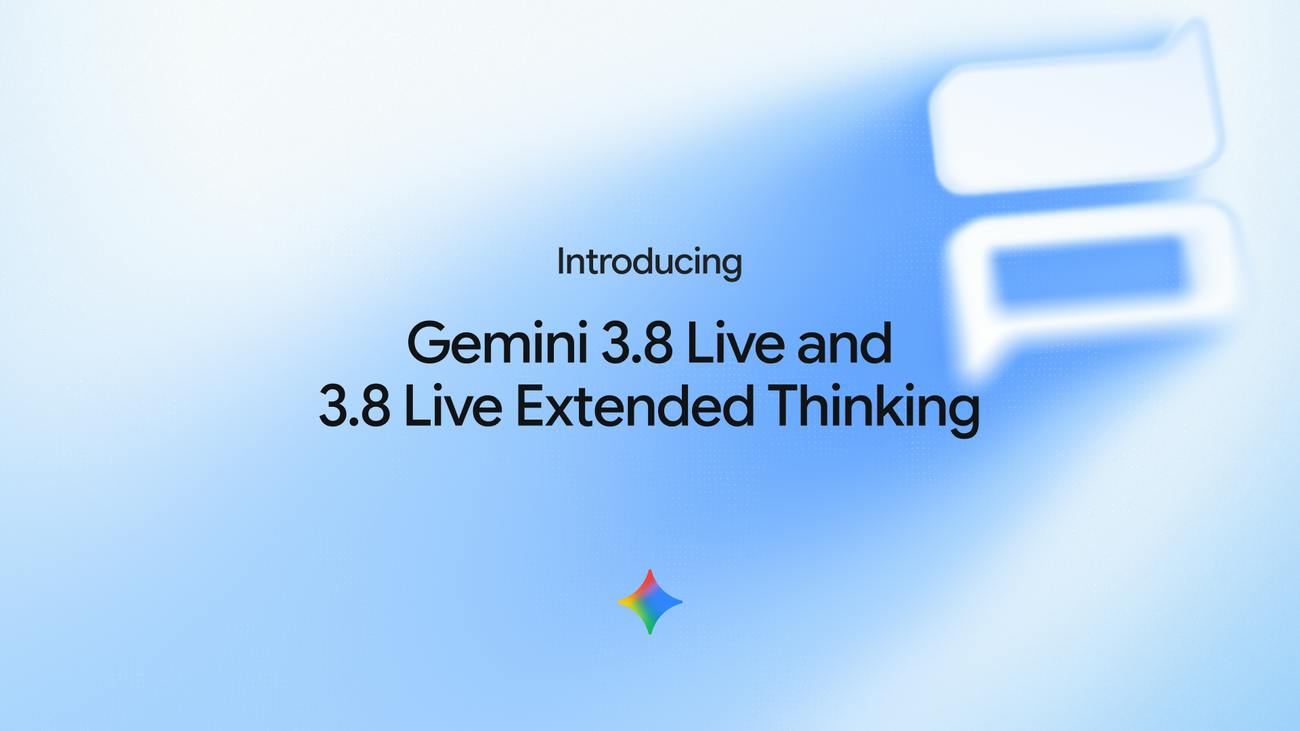
Google debuts Gemini 2.0 Flash Live, a real-time voice model, alongside an Extended Thinking variant for complex reasoning.
Google has launched Gemini 2.0 Flash Live and Gemini 2.0 Flash Live Extended Thinking on Product Hunt, with CEO Sundar Pichai listed as Maker. The standard model targets fluid, low-latency voice conversation, while the Extended Thinking variant adds inference-time deep reasoning for complex queries. Both debuted in the top five on Product Hunt's daily chart with 96 upvotes. The article highlights the core tension between real-time responsiveness and deep reasoning latency, noting that shipping them as separate versions likely gives developers flexibility to choose between speed and depth.
Google has launched Gemini 2.0 Flash Live and Gemini 2.0 Flash Live Extended Thinking on Product Hunt, officially touting them as "the most advanced Gemini audio models to date." Both models center on natural voice conversation capabilities, and on their first day live, they shot to the top of Product Hunt's daily rankings with nearly a hundred upvotes — with none other than Google CEO Sundar Pichai listed as the Maker.
What Each Model Is Built For
The naming alone signals that Google is releasing two distinct versions, both revolving around "Live" — meaning real-time interaction.
Gemini 2.0 Flash Live is positioned as a real-time voice interaction model, described as "built for natural conversation." It targets a long-standing pain point in voice assistants: that robotic, laggy, off-topic feeling that plagues so many of them. Truly fluid voice interaction requires a model to complete the full loop — speech recognition, semantic understanding, and speech synthesis — in milliseconds, while maintaining conversational coherence and natural rhythm.
Gemini 2.0 Flash Live Extended Thinking layers an "Extended Thinking" capability on top of real-time conversation. The name follows a line of thinking that has gained traction in the LLM space around inference-time compute: the model invests more computation into reasoning before delivering an answer, enabling it to handle more complex questions. Combining this kind of deep reasoning with real-time voice means the model can not only respond quickly but also think more carefully when the situation calls for it.
What is Extended Thinking? Extended Thinking has become a major technical direction in the LLM space. The core idea is to dynamically allocate more compute at inference time, allowing the model to work through intermediate "draft reasoning" steps before producing an output. This differs from traditional training-time scaling — which relies on larger models and more training data — in that it keeps model parameters fixed while improving accuracy on complex tasks by extending the chain-of-thought or introducing self-verification mechanisms. OpenAI's o1/o3 series and Anthropic's Claude Extended Thinking both belong to this paradigm. Combining it with real-time voice is a fairly rare engineering challenge, since Extended Thinking typically trades latency for quality — a tension that runs directly counter to the strict low-latency demands of voice applications.
Why Voice Conversation Is the Next Competitive Battleground
Voice is rapidly becoming a must-win arena for LLM providers. Compared to pure text interaction, real-time voice conversation sets a much higher bar for end-to-end latency, multi-turn context retention, and understanding of emotion and tone.
Google has been building out multimodal and Live capabilities across the Gemini lineup for a while now. Launching the 2.0 Flash Live with the positioning of "most advanced audio model" is a clear move to widen the gap in natural conversation experience. Product Hunt's category tags tell the story plainly — "Bots" and "Audio" — pointing squarely at voice assistants, conversational bots, and any product that needs human-machine voice interaction.
The balance between Extended Thinking and real-time responsiveness is worth watching closely. Deep reasoning typically means longer response times, while real-time conversation demands low latency. How that tradeoff is managed often determines the actual user experience. Google's decision to ship this as a separate version may be precisely to give developers the freedom to choose between "fast" and "deep" depending on their use case.
End-to-end vs. cascaded voice models The distinction between end-to-end speech models and traditional cascaded pipeline systems is worth understanding. Conventional voice assistants chain together three separate modules — Automatic Speech Recognition (ASR), Natural Language Understanding (NLU), and Text-to-Speech (TTS) — and each handoff introduces latency and information loss. Paralinguistic cues like emotion, tone, and pauses are almost entirely stripped away during text conversion. End-to-end models attempt to map acoustic signals directly to semantic understanding and speech output, preserving richer voice characteristics throughout. The "natural conversation" experience that the Gemini Live series emphasizes depends on exactly this kind of end-to-end or near-end-to-end architecture — and it represents a fundamental departure from the technical approach behind the original Google Assistant.
Reading the Market from Product Hunt Feedback
On launch day, the product ranked #4, collecting 96 upvotes and 2 comments. For a product launched by an industry giant and personally credited to its CEO, that kind of opening reflects strong community interest.
That said, it's worth keeping perspective: Product Hunt votes tend to reflect buzz and brand pull more than actual product quality. The real test — naturalness of the voice output, multilingual support, noise robustness, and the performance of Extended Thinking on genuinely hard tasks — still needs to be validated by third-party benchmarks and the developer community.
Summary
Gemini 2.0 Flash Live and Extended Thinking represent Google's latest push in real-time voice interaction. One is optimized for smooth, natural real-time conversation; the other adds deep reasoning on top of that, covering the spectrum from lightweight exchanges to complex question answering.
For developers and product teams, the key factors in determining how widely these models get adopted will be their real-world capabilities, how open the API access is, and pricing. As major players continue to accelerate in the voice space, the human-machine conversation experience looks set for a meaningful upgrade.
Related articles
AI Agent Fundamentals: The Three Core Components — Brain, Memory, and Tools
A beginner's guide to AI Agents: covering the three core components (brain, memory, tools), four stages of LLM deployment, and why Agents matter for real business use cases.

Boycotting Software That Doesn't Support Linux: One Developer's Philosophy of Choice
A Linux-only developer shares his philosophy of boycotting non-Linux software — without sacrificing productivity — and explains how coding agents like Claude Code are closing the gap with commercial tools.
Why Do All AI-Generated Projects Look the Same? The Aesthetic Homogenization Problem in Vibe Coding
Why do vibe coding projects all use purple gradients and dark glassmorphism? We break down the technical roots of AI aesthetic homogenization and how to escape it.