AI Agent Fundamentals: The Three Core Components — Brain, Memory, and Tools
AI Agents combine brain, memory, and tools to transform LLMs from passive consultants into autonomous workers.
This article systematically explains what a true AI Agent is, its three core components (LLM brain, memory management, and tool use), and the four stages of LLM commercial deployment: native models, prompt engineering, RAG, and full-scale Agents. Unlike chatbots, Agents can proactively reason, call external tools, retain context across sessions, and break complex tasks into executable steps. The key distinction: prompt engineering and RAG help models answer questions better, while Agents enable models to think and act autonomously — which is what enterprises actually need to reduce costs and drive efficiency.
What Is a True AI Agent?
Many people mistake chatbots or visual agent-building platforms for AI Agents — but strictly speaking, they're not. A chatbot can only respond to direct questions. A building platform merely provides tools for construction. A true Agent, by contrast, is a software application capable of proactive reasoning, tool use, and independently completing complex tasks.
Here's an intuitive comparison: say you want to create a PowerPoint presentation from a set of materials. Using a tool like Doubao, you'd have to upload files one by one, wait for the server to process them, then manually download the output — a tedious process. An Agent works differently. It can read your files on its own, identify their types, build the presentation, save it locally, notify you when it's done, and even run a self-check. In short: tools like Doubao and DeepSeek are more like your AI consultants, while an Agent is the employee who actually gets the work done.
The Three Core Components of an Agent
What enables an Agent to work independently comes down to three key components: Brain, Memory, and Tools.
Brain refers to the large language model — the same underlying technology powering Doubao or DeepSeek. It understands requirements, breaks tasks into steps, and decides what to do next.
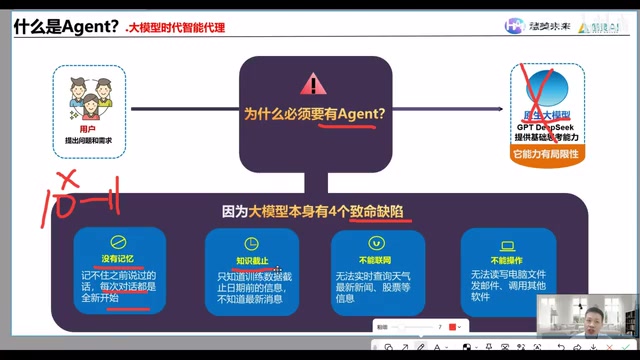
Memory allows the Agent to remember what you said earlier and track task progress until completion. Native language models start fresh with every conversation and have no context retention — memory components solve this critical limitation.
Tools are the most essential piece. An Agent can use tools just like a person does: controlling a browser, managing folders, editing Excel files and PowerPoints, even writing and running code. Without tools, an Agent can only "talk" — it can't actually act.
In engineering terms, memory typically comes in two forms: short-term memory (conversation history within the context window) and long-term memory (persistent information stored in external databases). Short-term memory is constrained by the model's context length (e.g., GPT-4's 128K token limit); content beyond that limit gets truncated. Long-term memory uses vector databases or key-value stores to persist important information, enabling the Agent to retrieve it across sessions.
The Tools component is typically implemented via Function Calling — developers pre-define a tool's name, parameters, and description; the model decides at inference time whether to invoke a tool and generates a structured call instruction, which external code executes before returning the result to the model. This "brain decides, external system executes" division of labor is the underlying mechanism that allows Agents to operate in real computing environments.
Three Categories of Agents on the Market
Today's Agents generally fall into three categories:
General-purpose Agents: Often products from large companies — such as Claude Code, Codex, or local desktop agents. Given the right capabilities, these can handle almost any task, making them ideal for everyday users looking to boost productivity.
Specialized Agents: Focused on doing one thing well — video editing, image processing, e-commerce operations, and so on. Their advantage lies in targeting a single high-frequency use case with a streamlined interface that anyone can pick up. The author sees the rise of specialized Agents as a defining characteristic of this new era.
Agent-building Platforms: Platforms used to construct Agents with fixed workflows and decision nodes, where AI participates in decisions at key steps.
For most people looking to use AI to improve productivity, the author recommends starting with general-purpose Agents.
The Four Stages of LLM Commercial Deployment
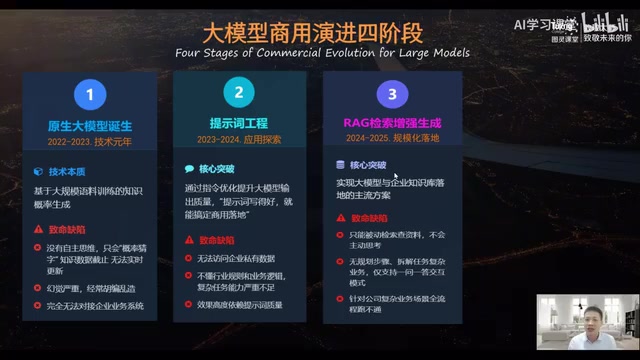
To appreciate the value of Agents, it helps to understand how large language models evolved to where they are today. The author identifies four stages.
Stage 1: Native Large Language Models
This is where it all started. Native LLMs learn from massive amounts of publicly available internet data to generate content — writing copy, writing code — and initially amazed everyone. But their limitations were severe: no autonomous reasoning, knowledge cutoff dates, tendency to hallucinate, and inability to integrate with enterprise systems. Ask one something outside its training data, and it will confidently make things up.
Stage 2: Prompt Engineering
To improve output quality, the industry dove deep into prompt engineering — techniques like Chain-of-Thought and Tree-of-Thoughts became popular. But prompt engineering has three major drawbacks: it can't access private enterprise data, can't handle real business problems, and results depend heavily on manual optimization. The author puts it plainly: prompt engineering is now a baseline skill for LLM application engineers — "like knowing how to type before using a computer, but knowing how to type doesn't make you an IT engineer."
Chain-of-Thought (CoT) prompting is one of the most impactful prompt engineering techniques, introduced by Google researchers in 2022. The core idea is to include "Let's think step by step" in the prompt, or provide few-shot examples with explicit reasoning steps, guiding the model to output its intermediate reasoning before giving a final answer. This significantly improves accuracy on complex math, logic, and commonsense tasks.
Tree-of-Thoughts (ToT) is an advanced variant that allows the model to generate multiple candidate branches at each reasoning step, evaluate and prune them, and select the optimal path — better suited for tasks requiring global planning.
The essence of these techniques is to guide models into "slow thinking" through structured prompts. But they all require carefully hand-crafted prompt design, and their effectiveness varies significantly across model versions and task types — making them difficult to scale. This is the ceiling of prompt engineering as a standalone skill path.
Stage 3: RAG — Retrieval-Augmented Generation
RAG became the go-to approach for many traditional enterprises undergoing digital transformation. Companies store their documents, spreadsheets, images, and other data in a knowledge base; the model retrieves relevant content from that base before answering, enabling responses grounded in private data. The majority of today's intelligent customer service systems and enterprise knowledge bases are built on RAG.
But RAG has its own clear limitations: it can only react passively, doesn't think proactively, struggles with complex business processes, and only handles single-turn Q&A. If you don't ask, it will never do anything on its own.
RAG works in three steps: first, enterprise documents are chunked and converted into vector embeddings stored in a vector database. When a user asks a question, the query is also vectorized and compared against the database to retrieve the most semantically similar passages. These retrieved passages are then fed into the LLM alongside the question, letting the model answer based on real source material.
This mechanism essentially gives the model an external "living dictionary" — bypassing training data cutoffs without the enormous cost of retraining on private data. Vector databases (such as Pinecone, Milvus, and Chroma) are the critical infrastructure for RAG deployment. They convert unstructured content like text and images into high-dimensional numerical vectors, measuring semantic similarity by computing vector distances rather than simple keyword matching — which is why RAG understands paraphrased questions far better than traditional search engines.
Stage 4: The Rise of Agents
As the technology matured, LLMs gained the ability to autonomously plan and execute multi-step reasoning — evolving from simple Q&A tools into "employees" capable of calling tools and independently completing tasks. This is now one of the top priorities for enterprises undergoing AI transformation.

What Problems Does an Agent Actually Solve?
The author compares an Agent to a translator between a Chinese speaker and an English speaker — a proxy that bridges communication. More specifically, Agents solve four core problems:
- Translator: Converts natural language requests into instructions the LLM can process, then converts the model's output back into human-readable results.
- Tool Expert: Helps the LLM call external tools — APIs, web search, file operations, system integrations — turning the model from something that "talks" into something that "acts."
- Memory Manager: Retains context, user information, and conversation history to enable coherent multi-turn interactions.
- Task Manager: Breaks complex problems into sequential sub-tasks, plans execution flow, adapts to obstacles, and proactively solves problems like a real person would.
Whether it's Doubao, DeepSeek, or coding tools like Cursor and Claude Code — they're all fundamentally Agents. When you send a message to Doubao, it first goes to Doubao's Agent layer, which calls the underlying LLM, processes the result, and returns it to you. When a developer uses Cursor to write code, the tool's ability to remember project structure and call a compiler for debugging is powered by exactly these memory and tools components.
Why Learn Agent Development Now?
Drawing on years of experience as a project manager, the author notes that many people who study LLMs stop at writing prompts or building simple RAG systems — and freeze up in interviews when asked whether they can build systems that "automatically process orders, update customers, and generate reports." The reason: prompt engineering and RAG solve the problem of making models answer questions well. Agents solve the problem of making models think proactively and resolve problems autonomously. Enterprises adopting AI ultimately want to reduce costs and drive revenue — simple chatbots can't deliver that.
On the policy front, China has released a series of action guidelines on artificial intelligence in recent years, making substantial investments across industry, consumer, social services, and international cooperation. The author draws a parallel between today's "AI+" moment and the "Internet+" wave of a decade ago, encouraging learners to align their technology choices with policy direction. At a time when industries across the board are embracing AI and companies are focused on efficiency, investing deeply in practical, deployable technologies like Agents is genuinely one of the most reliable paths forward.
Final Thoughts
This primer lays out the definition of Agents, their three core components, major categories, and the evolutionary arc of LLM commercial deployment in a clear, accessible way — particularly useful for readers with little or no background who want to build a solid mental model. The core takeaway in one sentence: An Agent is an application that can reason autonomously, use tools, and independently complete complex tasks — transforming a language model from a "consultant" into an "employee." For anyone serious about enterprise-grade AI deployment, understanding this underlying logic is the essential first step.
Related articles
AI Agent Learning Roadmap: A Four-Stage Guide for Complete Beginners
A four-stage AI Agent learning roadmap for beginners: from core concepts and model deployment to RAG, LangChain, LoRA, and interview-ready projects.
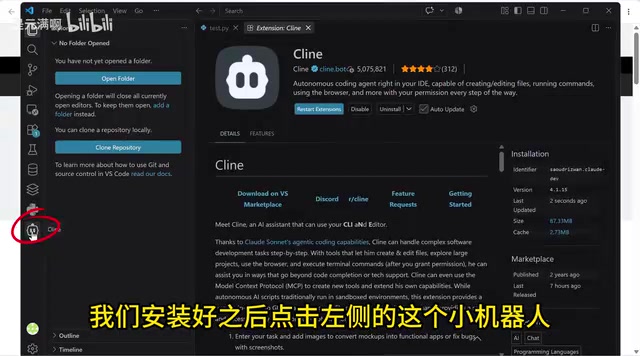
Free Access to Mystery Model & DeepSeek V4 via Cline: Complete Setup Tutorial
Learn how to use DeepSeek V4 and the mystery "Niumai" model for free on Cline — covering IDE extension and CLI installation, account setup, and model selection.
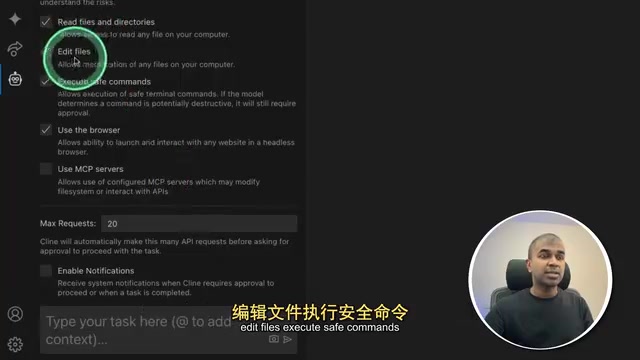
Cline + VS Code in Practice: Generate a To-Do App from a Single Prompt
Cline is an autonomous coding agent inside VS Code. This hands-on guide shows how to generate a to-do app from one prompt and compares Claude, Ollama, and Groq integrations.