Gemini 3.6 Flash Hands-On Review: Free Model Approaches Top-Tier Performance with 65% Cost Reduction

Gemini 3.6 Flash delivers near-top-tier performance for free with 65% lower token costs than competitors.
Google's new Gemini 3.6 Flash model offers impressive performance approaching Claude Opus-level reasoning while being completely free to use. Hands-on testing shows strong multimodal counting accuracy, one-shot generation of physics-based 3D games, and reliable Agent task execution. With 65% fewer output tokens and API costs around $0.1 versus $1.5-1.8 for competitors, it represents a compelling option for production Agent applications despite some limitations in creative tasks.
Google's Triple Launch: Faster, Cheaper AI Agents
In the fiercely competitive AI model landscape, Google has released three new Gemini models in one go: Gemini 3.6 Flash, Gemini 3.5 Flash Lite, and Gemini 3.5 Flash Cyber. All three models share a single core objective—making AI Agents faster, smarter, and more cost-effective.
AI Agents refer to AI systems capable of autonomously perceiving their environment, formulating plans, and executing multi-step tasks. Unlike traditional single-turn Q&A models, Agents possess capabilities like tool calling, memory management, task decomposition, and self-correction. For example, an AI Agent can automatically browse web pages, call APIs, write and execute code, and process files to complete an entire workflow—rather than simply answering a single question. From 2024 to 2025, Agents have been widely recognized by the industry as the core direction for deploying large models in production. Google, OpenAI, Anthropic, and other companies are all competing intensely around Agent capabilities. It's against this backdrop that all three models Google released this time prioritize Agent scenarios above all else.
The most noteworthy among them is Gemini 3.6 Flash. According to analysis by Chinese tech YouTuber Zero Degree Commentary, official data shows it comprehensively outperforms the previous generation across multiple benchmarks including Agent tasks and code generation. The improvement is particularly notable in writing production-grade code—not only generating faster but also being far less likely to get stuck in infinite loops.
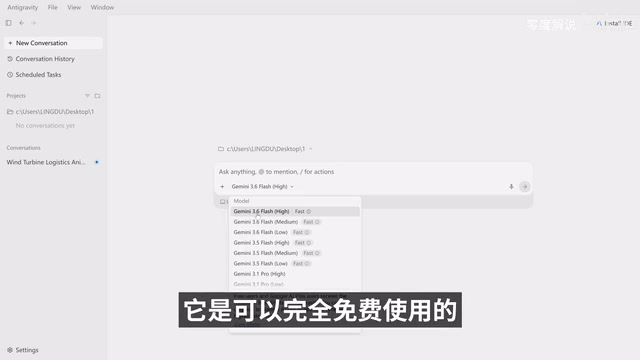
Even more striking is that this significantly upgraded model is completely free. It's now available across the web interface, mobile app, and the Anti-Gravity development platform, accessible to everyone.
Performance Data: Approaching Top-Tier Reasoning Models
According to official data cited by Zero Degree Commentary, Gemini 3.6 Flash delivers impressive results across multiple dimensions:
- It achieved near-perfect scores on a deep benchmark test, reportedly reaching the level of Claude Opus-class reasoning modes;
- It scored 1537 points on a well-known frontend development community ranking, jumping from 21st place (previous generation) to 12th;
- It ranked in the top 10 and top 20 across multiple categories including design, marketing, gaming, and content creation.
Notably, this level of performance from the Flash series—traditionally perceived as "fast but mediocre"—has genuinely surprised many observers. The Flash series was originally positioned as a "lightweight" model that trades some reasoning depth for lower latency and lower cost, primarily targeting speed-sensitive applications. Yet this 3.6 version has dramatically narrowed the capability gap with the flagship Pro series while maintaining its speed advantage, effectively blurring the boundary between the two product lines.
Gemini 3.6 Flash Token Efficiency: Usage Costs Nearly Halved
The biggest surprise this time isn't just the capability improvement—it's the token efficiency. Multiple developers who tested the model reported that Gemini 3.6 Flash produces significantly fewer tokens when completing the same tasks.
It's worth explaining why token efficiency matters so much. Tokens are the basic units that large language models use to process text, roughly equivalent to one English word or 2-3 Chinese characters. API billing is typically based on the number of input and output tokens. High token efficiency means the model can accomplish the same task with less "filler"—reducing redundant explanations, avoiding repeated generation, and getting straight to the point. This is critical for large-scale production environments because an Agent executing complex tasks may need to make dozens or even hundreds of model calls, and token savings on each call create a multiplier effect on total costs.
According to data compiled by Zero Degree Commentary, compared to other models, its token output is reduced by approximately 65%, with overall usage costs dropping by nearly half. This means it's not only more powerful but also more economical—an extremely attractive combination for Agent applications requiring large-scale API calls.
In API cost comparisons, for the same test task: GPT series cost approximately $1.8, Claude approximately $1.5, Kimi approximately $0.5, while Gemini 3.6 Flash had the lowest total cost at only about $0.1. This cost advantage has significant implications in real production environments. Consider that a medium-scale Agent application might generate millions of model calls per day—saving a few cents per call can translate to tens of thousands of dollars in difference on monthly bills.
Multimodal Testing: Precise Counting Demonstrates Spatial Analysis
Benchmarks are just benchmarks—real usability requires hands-on testing. Zero Degree Commentary used several tricky tasks to verify Gemini 3.6 Flash's multimodal capabilities.
Multimodal refers to a model's ability to simultaneously process and understand multiple information types including text, images, audio, and video. In counting tests, the model needs to do more than just "see" the image—it must perform complex operations like spatial segmentation, object boundary recognition, overlap detection, and logical reasoning. This capability relies on a Vision Encoder that converts images into vector representations the model can understand, combined with language reasoning capabilities. Precise counting has long been a weakness of multimodal models because it requires pixel-level fine-grained understanding rather than general scene descriptions.

The first test asked the model to count toothpicks in a densely packed image. The model divided the image into five regions for group counting, ultimately concluding "approximately 70 toothpicks, with a margin of error of 1-2." The actual count was 71. Considering that several toothpicks in the image were indeed overlapping, this result was quite impressive, demonstrating solid multimodal understanding and spatial analysis. Notably, the model's "zone counting" strategy itself reflects a high level of reasoning—rather than attempting to count all objects at once, it decomposed the complex problem into smaller manageable units, much like a human would.
The second test was easier: counting a group of skewers. The model broke it down by region: "1 at the top, 4 on the left, 5 in the middle, 7 on the right, totaling 17." Manual verification confirmed this was completely correct. For precise counting of such small objects, the model's performance proved the reliability of its multimodal perception.
Code Generation Testing: From Mini-Games to 3D Physics Engines
Code capability is a key highlight of Gemini 3.6 Flash this time around. Zero Degree Commentary conducted two sets of tests.

Fruit Ninja Game Runs on First Try
The first test asked the model to write a Fruit Ninja game. After downloading and running the generated code, the game ran smoothly with complete sound effects—slicing fruit, bomb detection, and other basic mechanics all worked properly, running successfully on the first attempt.
3D Billiards Game with Realistic Physics
The more complex test required creating a 3D billiards game with realistic physics, including collision, friction, cushion rebounds, and force control.
A physics engine is a software library that simulates real-world physical laws (such as gravity, collision, friction, and elasticity), with common examples including Bullet, PhysX, and Cannon.js. Having AI generate complete, runnable code with physics engine logic in one shot means the model must understand not only programming syntax but also the engineering implementation of physics formulas—such as collision detection algorithms, vector operations, and approximate simulations of energy conservation. Packaging all of this into a single HTML file that runs in a browser demonstrates the model's mature understanding of both WebGL/Canvas rendering pipelines and JavaScript physics libraries.
The model generated a complete 3D billiards game based on a physics engine, all encapsulated in a single HTML file that runs when opened in a browser. In testing, mouse movement for aiming displayed a dotted line predicting collision points, holding the left button charged power (the power bar transitions from red to green), and upon striking, the ball-cue collision, cushion rebounds, and deceleration from rolling friction all appeared quite natural. The pocket detection for all six pockets also worked correctly. Generating this level of physics simulation in one shot truly demonstrates impressive engineering capability.
Agent Capability Testing: GitHub Analysis and Document Batch Processing
Using Google's own Agent development platform Anti-Gravity, Zero Degree Commentary further tested the model's tool-calling and agent capabilities.
Anti-Gravity is Google's AI Agent development platform that provides an integrated environment for developers to quickly build, test, and deploy Agent applications based on Gemini models. The platform's core value lies in packaging the infrastructure Agents need—tool calling, code execution sandboxes, file processing, web access—into ready-to-use services, eliminating the need for developers to build complex orchestration frameworks (like LangChain or AutoGen) themselves. Platforms like this represent the infrastructure layer trend as large model applications evolve from "conversation" to "automated execution."
GitHub Project Analysis and Code Structure Parsing
The first task asked the model to open GitHub, find the AI Agent project with the most stars, and analyze its code structure. The model completed this quickly by calling a Python script, returning results showing the top project had approximately 384,000 stars and the runner-up had about 220,000—manually verified as accurate. It then performed a deep analysis of the top project, including project introduction, core code, directory structure, and framework design breakdown, completing everything as requested. The entire process was extremely fast.
This test validates the core Agent workflow: receive high-level goal → decompose into specific steps → call tools for execution → integrate and present results. The model needed to autonomously decide whether to use the GitHub API or a scraping script, how to sort and filter, and what granularity of code structure analysis to provide—none of these decisions were explicitly specified in the prompt but were planned and executed by the model independently.
Batch Processing 100+ PDFs to Markdown Output
The second test focused on document processing capability. Faced with over 100 PDF files, the task required finding all API updates and outputting them in Markdown format. The model similarly called a Python script to batch-process these documents, ultimately outputting results in clean Markdown format, reliably completing this tedious task. This type of batch document processing is one of the most common deployment scenarios for enterprise-level Agent applications—converting large volumes of unstructured documents into structured, searchable information.
Controversies and Shortcomings: Not a Clean Sweep on Creative Tasks
Of course, the feedback isn't unanimously positive.
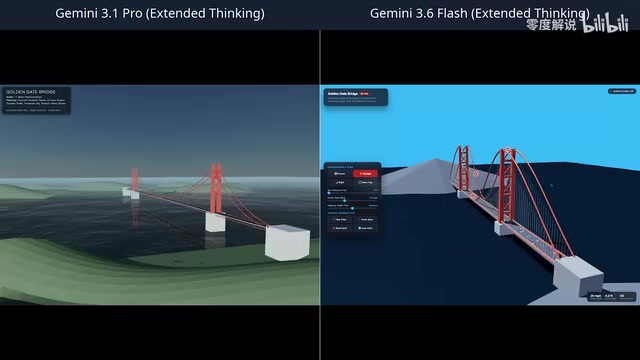
Some users online believe Gemini 3.6 Flash falls short of the previous-generation Gemini Pro on certain creative design tasks. For instance, when designing the Golden Gate Bridge, the two generations produced results with their own strengths—which is "better" largely depends on personal aesthetic preferences. In several comparison groups of 3D scenes generated by different models, there was no definitive winner either.
This reminds us that while benchmark scores and cost advantages are hard metrics, whether the Flash model can comprehensively surpass the larger Pro model on creative aesthetic tasks still requires case-by-case evaluation. This aligns with the industry's general understanding of model distillation—when compressing large model capabilities into smaller models through knowledge distillation, logical reasoning and structured tasks are typically well-preserved, while the diversity and "creative spark" in open-ended generative tasks can sometimes be diminished.
Conclusion: A New Inflection Point for Generative AI Development
The most impressive demonstration was a 3D wind turbine installation animation generated by Gemini 3.6 Flash in Anti-Gravity in a single pass—heavy trucks transporting blades up the mountain, crawler cranes hoisting them, and precise installation atop the tower—the entire construction workflow generated entirely by AI.
The value of such demonstrations isn't in flashy visuals but in showing that AI can now understand an entire engineering construction workflow and spatial relationships. Previously, creating this kind of engineering-grade 3D demonstration might have taken a modeler days or even weeks, but now it only takes a single prompt and a few minutes to get an interactive demonstration prototype. This represents a qualitative shift from "AI-assisted creation" to "AI autonomous production"—the model no longer just provides suggestions or fragments but directly outputs complete, usable engineering artifacts.
For Agent application developers, Gemini 3.6 Flash's free pricing strategy combined with nearly halved costs could significantly shift the model selection equation. While it may not be the strongest in every dimension, the combination of "good enough, fast enough, cheap enough" is precisely what generative development needs most for scaling to production. As the industry transitions from "who's smarter" to "who's more practical," Google's pricing strategy and performance balance point this time may carry more strategic significance than raw benchmark rankings alone.
Related articles

Claude Autonomously Designs Proteins with 35% Success Rate, Far Exceeding Human Expert Performance
Anthropic's Claude achieves 35% wet-lab success rate in autonomous protein design, far surpassing the 10-15% human expert average, signaling AI's move toward real scientific productivity.

Perplexity Discover's Multilingual Support Suddenly Disappears — Why Are International Users Upset?
Perplexity Discover's multilingual news feature suddenly dropped non-English support, frustrating international users. We analyze possible causes and the broader challenges of AI product internationalization.

GitHub Daily · August 20: Mojo Tops the Charts & The Local-First Open Source Rebellion
GitHub Trending Aug 20: Mojo tops charts for AI compute stack ambitions, OpenLogi surges 1225 stars with local-first philosophy, and privacy rebellion dominates.