Gemini 3.7 Flash: Google Launches an Agent Land Grab Through Price Cuts

Google rushes out Gemini 3.7 Flash with aggressive pricing to claim the Agent model market while its Pro line stalls.
Google released Gemini 3.7 Flash just three weeks after 3.6 Flash, cutting prices to half while boosting Agent task performance by 176%. Rather than a capability breakthrough, this is a strategic repositioning — using post-training optimization and knowledge distillation from its stalled Pro line to compete as a cheap Agent workhorse against DeepSeek and Claude.
Three-Week Iteration: Google's Unusually Aggressive Update Pace
Google's latest move reeks of urgency. Gemini 3.7 Flash arrived just three weeks after its predecessor, 3.6 Flash, setting the fastest update record in Google's AI product line. This cadence is itself a signal — it doesn't look like a measured technical upgrade, but rather a hurried repositioning forced by market pressure.
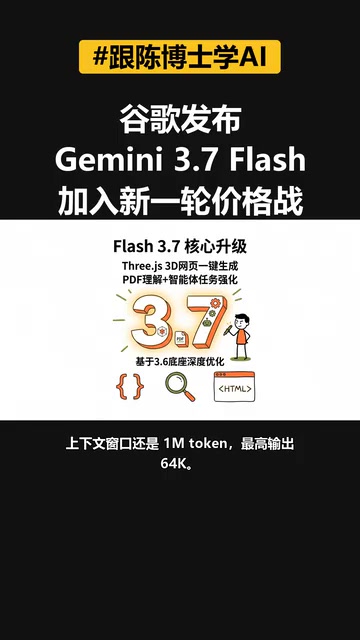
According to official messaging, 3.7 Flash shows clear improvements in coding, knowledge work, and web development, with particular strength in long-running software engineering tasks, PDF comprehension, and Agent tasks. In the launch demo, it built a 3D web game from scratch using 3D assets — handling engine logic, art assets, and procedurally generated audio all in one pass — showcasing end-to-end execution capability rather than single-turn Q&A.
Interestingly, according to analysis from a Bilibili creator, 3.7 Flash isn't an entirely new pretrained model. Instead, it's built on the 3.6 Flash base with a round of substantial algorithmic optimization and post-training. Post-training refers to the process of further optimizing model behavior after large-scale pretraining is complete, using techniques like RLHF (Reinforcement Learning from Human Feedback), DPO (Direct Preference Optimization), and instruction fine-tuning. Compared to doing a full pretraining run from scratch (which requires tens of millions of dollars in compute and months of time), post-training costs far less but can significantly improve model performance on specific tasks. The choice to post-train on the 3.6 Flash base rather than retrain from scratch suggests Google judged that the underlying knowledge capacity was already sufficient, and that the bottleneck lay in task execution alignment and tool-calling stability. The context window remains at the 1-million-Token level, with a maximum output of 64K.
A Shift in Positioning: From Chat Model to Workhorse Agent
The most interesting aspect of this upgrade is its positioning trade-offs. General knowledge reasoning hasn't seen a dramatic leap — what's clearly improved are Agent-related capabilities.
It's worth explaining what Agent means in the AI context. An Agent (intelligent agent) refers to an AI system capable of autonomously perceiving its environment, formulating plans, invoking tools, and executing multi-step tasks. Unlike traditional single-turn Q&A, an Agent can decompose complex goals into subtasks, autonomously decide which APIs or tools to call, handle exceptions in intermediate results, and continue running until the task is complete. Typical Agent applications include automated code debugging, document processing pipelines, and data analysis workflows. In the current industry landscape, OpenAI's Codex, Anthropic's Claude Code, and various open-source frameworks (such as LangChain, AutoGPT) are all competing for this segment.
According to reported data: benchmark performance on long-running tasks in terminal environments improved by 176%, automated tasks improved by 79%, and software engineering and web development metrics saw 30% to 40% gains. Artificial Analysis assigned an intelligence index of 56, four points higher than 3.6 Flash; output speed is approximately 340 Tokens per second, with low, medium, and high effort levels available — the lowest tier can push per-task costs down to $0.16.
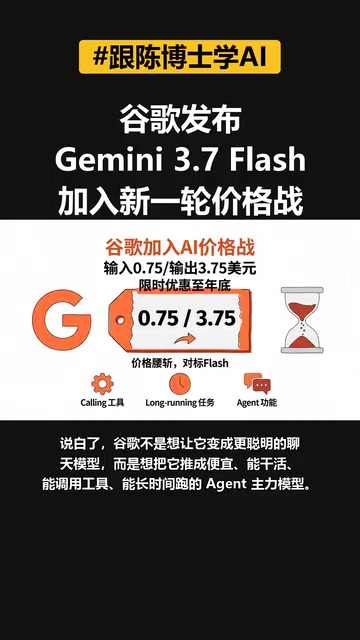
Stringing these numbers together, Google's intent becomes clear: they don't want to make 3.7 Flash a smarter chat model. They want to position it as a cheap, capable, tool-calling, long-running Agent workhorse. This is a product direction fundamentally different from "stack knowledge, compete on reasoning."
Capability Benchmarks and Real Cost-Effectiveness
In terms of capability, 3.7 Flash benchmarks against the Claude Sonnet series and GPT's latest generation. Under this comparison, competitors do look somewhat awkward.
But whether its cost-effectiveness truly leads requires a question mark. Looking at software engineering metrics (like SWE-bench), the real value-for-money winner may still be DeepSeekAd V4 Flash. SWE-bench is a software engineering capability benchmark released by a Princeton University team that draws resolved Issues and corresponding Pull Requests from real GitHub open-source projects, requiring AI models to autonomously generate correct code patches given a code repository and problem description. This benchmark is valued by the industry because it tests not simple code completion, but the comprehensive ability to understand complex codebases, locate root causes of bugs, and make cross-file modifications — precisely the core capability required in Agent scenarios. Google's move here looks more like using price cuts and the Agent narrative to reclaim mindshare, rather than achieving a crushing capability advantage.
Gemini 3.7 Flash Pricing Breakdown: The First Real Price War
Pricing is the headline of this release — and Google's first genuine entry into the AI model price war.
3.7 Flash is priced at $0.75 per million input Tokens and $3.75 per million output Tokens, roughly half the original price of 3.6 Flash. Google also dropped 3.6 Flash to the same tier. It's important to note that this is a promotional price, valid through year-end, after which prices will double.
To understand what this pricing means, you need to understand how large models are priced. A Token is the basic unit of text processing for large language models — roughly every 750 English words corresponds to 1,000 Tokens, while Chinese is approximately 500 characters per 1,000 Tokens. Model vendors charge separately for input and output Tokens, with output prices typically higher because text generation requires more computational resources. Additionally, cached pricing offers discounts for repeated input content, which can dramatically reduce actual costs in Agent scenarios with repeated calls — and this is precisely the hidden variable that's easy to overlook when comparing vendor pricing.
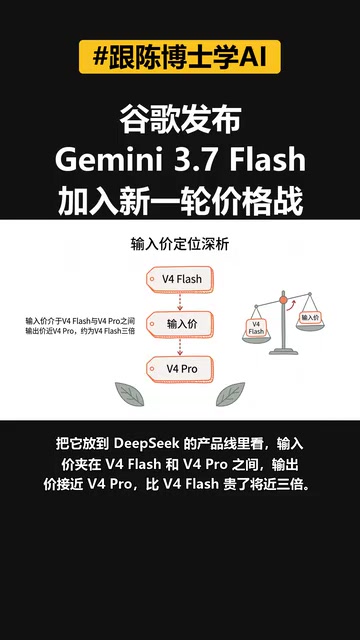
Comparing it against DeepSeek's product line makes it more intuitive: the input price sits between V4 Flash and V4 Pro, while the output price approaches V4 Pro — nearly three times more expensive than V4 Flash. So looking at base numbers alone, it appears to be competing directly with DeepSeek, but if you don't factor in cached pricing, the "high value" impression has some padding.
Why the Rush: The Gemini Pro Line's Predicament
Iterating every three weeks — the reason behind it isn't complicated. Google's Pro line has hit a wall.
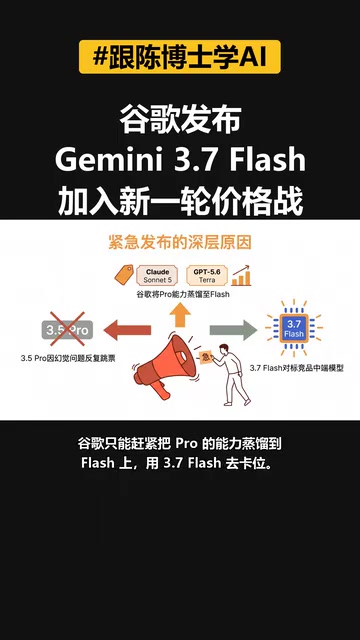
According to analysis, the 3.5 Pro line has essentially stalled. The previous-gen Pro has remained in Preview since the beginning of the year, and 3.5 Pro has been repeatedly delayed. Rumors suggest the team is internally rebuilding this line due to recursive calling and hallucination issues. With Pro unable to ship, Google has no choice but to distill Pro's capabilities into Flash, using 3.7 Flash to hold the position.
Knowledge Distillation is a technique for transferring capabilities from a large model (Teacher) to a smaller model (Student). The core idea is to have the smaller model mimic the output distribution of the larger model, rather than learning directly from raw data. This way, the smaller model can approach the larger model's performance with fewer parameters and lower inference costs. In Google's context, distilling Pro-line capabilities into the Flash line means using a lighter, cheaper model architecture to deliver capabilities that would normally require a heavyweight model — a common approach for finding engineering balance between cost and performance.
Looking at the results, 3.7 Flash's overall pricing has approached the former Gemini 3 Flash and 3.5 Flash Lite tiers, while its capabilities are aimed at competing with Claude Sonnet and GPT's latest generation. This is a transitional strategy of using a lower-end product line to meet high-end capability expectations.
Conclusion: A Card Forced Back to the Table
All things considered, Gemini 3.7 Flash isn't a capability leap — it's a strategic adjustment. It re-established Google's presence through price cuts and the Agent narrative, forcing the "cheap Agent workhorse" card back onto the competitive table.
It may not win everyone back — users truly chasing software engineering cost-effectiveness will likely still lean toward DeepSeek. But for Google, stabilizing with Flash during the window while the Pro line is stuck is itself a pragmatic exercise in damage control. This AI price war has only just begun.
Related articles

Apple HomeView Hands-On Review: Is the $300 Smart Home Hub Worth It?
Apple HomeView hands-on: a $300 smart home hub with facial recognition for quick account switching, but no App Store or voice recognition. Is the wall-mounted version worth it? Should you buy the first generation?

Meta Muse Wonder Launch: What It Means for Meta's Return to the Frontier AI Race
Meta releases Muse Wonder and WonderFull, benchmarks reach the frontier, community feedback is polarized. An in-depth look at Meta's return to the frontier AI race, its personal agent strategy, and Zuckerberg's different path.

Apple Home Smart Home Lineup Leaked: LG and Schneider Team Up, UWB Door Lock on Board
Apple Home ecosystem gains new LG and Schneider devices: UWB smart lock with proximity unlock, 2.5K dual-camera doorbell, privacy indoor camera, and AirPods-like seamless pairing.