Gemini 4 Argon Hands-On: How Powerful Is a 1M Token Output?

Gemini 4 Argon hands-on: standout ultra-long output and speed, but front-end design is the weak spot.
Google's new flagship model Gemini 4 Argon is now available to Google AI Pro subscribers. Bilibili creator "Programmer Xiaohui" compared it with GPT-6 Astra on two development tasks: a deluxe Tetris and a personal Pomodoro timer. Argon targets complex long-chain tasks, supports 1 million token output, took first place in 13 of 19 official tests, and has already been used internally by Google to migrate the 800,000-line Zircon kernel from C/C++ to Rust. In testing, Argon wrote Tetris in one pass in about 5 minutes — roughly twice as fast as Astra — proving the ultra-long output isn't just a paper spec; but on the Pomodoro task its UI completion clearly lagged. For selection: choose Argon for long text and code migration, Astra for fine-grained front-end work, and Claude Opus 5.5 remains an option for terminal coding.
Google's new flagship model Gemini 4 Argon is now available to regular users — anyone with a Google AI Pro subscription can use it directly in the web interface. Bilibili creator "Programmer Xiaohui" ran a hands-on test right away, pitting it against GPT-6 Astra on two real development tasks. This article draws on his first-hand testing, combined with officially published data, to map out Argon's real capability boundaries.
Positioning: Built for Complex, Long-Chain Tasks
Argon is Google's first new model above the Flash tier in over seven months, and its core positioning is clear — tackling complex tasks with many steps and long chains. The official focus areas include software engineering, enterprise knowledge work, cybersecurity, and creative writing.
What best illustrates this is how Google uses it internally: running large-scale code migration with Argon, porting C and C++ code to Rust, including the Zircon kernel at over 800,000 lines. This isn't a benchmark run — it's real production engineering.
The most striking spec is the 1 million token output ceiling. Previously, models had to stop after tens of thousands of output tokens; Argon can theoretically generate hundreds of thousands of tokens in a single pass — roughly the length of a full novel. Of the 19 officially published tests, Argon took first place in 13.

On pricing, there's a limited-time 50% discount until November 30: $2 per million input tokens and $10 per million output tokens; after the promotion ends, it reverts to $4–$20. The value during the discount window is quite compelling.
Tokens and output limits: A token is the smallest unit of text a model processes, roughly equivalent to one English word or half a Chinese character. A model's "context window" determines how much it can read in at once, while its "maximum output length" determines how much it can write in one go. Early models typically capped output at a few thousand to tens of thousands of tokens, truncating anything beyond that. Argon pushes the output limit to 1 million tokens, meaning it can complete hundreds of thousands of words of code or documentation in a single generation without segmenting and continuing — hugely significant for tasks like large-scale code migration or writing an entire manuscript.
Zircon kernel: Zircon is the microkernel Google developed for the Fuchsia operating system, written in C/C++ with over 800,000 lines of code. Migrating a low-level system codebase of this scale to Rust involves rewriting memory safety models, adapting cross-language interfaces, and validating a large amount of concurrency logic — widely recognized as a high-difficulty engineering feat. Google using Argon for this kind of migration internally shows its capabilities have reached production-grade validation, not just benchmark scores.
Test 1: Deluxe Tetris — Twice as Fast as Astra
The first task was building a deluxe Tetris from scratch, requiring 7 block types with rotation, hard drop, scoring, online multiplayer, level speed-up, and next-block preview — with all code written into a single HTML file.
Argon finished in about 5 minutes, outputting 74,000 characters in one pass. The result was a pixel-style Tetris where left/right movement, rotation, hard drop, multiplayer, and next-block preview all worked, complete with a ghost piece. GPT-6 Astra took about 13 minutes and output 50,000 characters; its functionality was equally complete, with extra features like dual-block preview, session timer, level-up progress bar, and high-score saving.
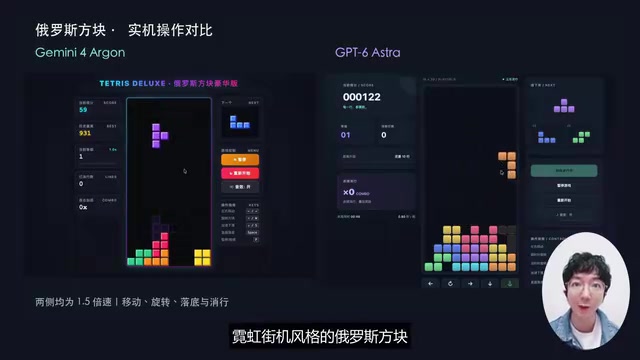
Both wrote everything in one pass, with no truncation and no obvious bugs. The difference was speed: Argon at 5 minutes versus Astra at 13 — more than twice as fast. This test at least proves that the 1 million token ultra-long output isn't just a spec on paper.
Ghost piece: A common assist feature in Tetris-style games that displays a semi-transparent outline at the bottom of the column where the current piece will land, helping players judge placement. Implementing it requires calculating the collision distance between the current piece and the stacked blocks in real time, and drawing an extra virtual piece in the render layer that doesn't participate in collision. Whether a model can correctly implement the ghost piece is often used to test whether it truly understands game state management and rendering logic.
Test 2: Personal Pomodoro Timer — Front-End Design Is the Weak Spot
The second task was building a personal Pomodoro timer, with a focus on front-end design. GPT-6 Astra completed it in about 4 minutes, producing a page that looked like a polished product landing page: brand logo, large heading, circular timer, stat cards, quote card — a high level of overall completion. Argon finished in about 5 minutes with all functionality working — 25-minute focus, 5-minute break, start/pause/reset, today's stats, keyboard shortcuts — but the UI was clearly a notch weaker: a black notification bar appeared at the top of the page and wouldn't go away, and the overall layout was just a simple centered card with less visual hierarchy than Astra.
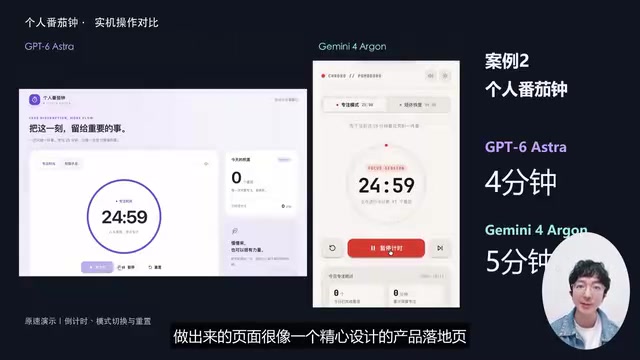
Xiaohui's summary comes down to three points: strong hard skills and a low hallucination rate; the ability to write ultra-long code in one pass is real, and it's fast; front-end design isn't its strong suit.
Pomodoro timer: The Pomodoro Technique is a time-management method that breaks work into cycles of 25 minutes of focus plus 5 minutes of rest, with each cycle called a "pomodoro." A Pomodoro timer app needs to implement countdown, start/pause/reset, focus/break phase switching, and daily completion stats — and often demands a certain level of visual design. It's frequently used as a beginner front-end test because the code volume is small but it exercises state management, timing accuracy, and UI completion all at once.
How to Choose: Route by Task Type
Based on this round of testing, the selection advice boils down to:
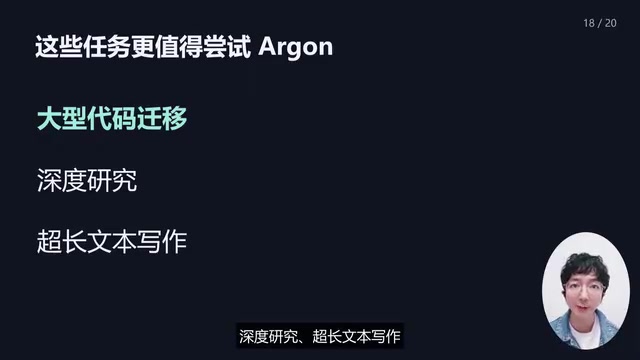
- Large-scale code migration, deep research, ultra-long text writing: Gemini 4 Argon is worth trying, with clear advantages in output length and speed.
- Fine-grained front-end and UI design: GPT-6 Astra performed better this round, with stronger visual completion and attention to detail.
- Command-line and terminal-style coding tasks: Claude Opus 5.5 remains competitive.
- Everyday Q&A and research: All the models are sufficient; the differences aren't a deciding factor.
It's worth noting that these conclusions come from two test tasks by a single creator, so the sample size is limited — and the front-end design assessment especially depends on task complexity. The safer approach is to run a comparison against your own real workflow before deciding which model to use as your primary. Argon's discount window, though, does offer a low-cost opportunity to experiment.
One-line Summary
Gemini 4 Argon hands-on: standout ultra-long output and speed, with front-end design as the weak spot.
Paragraph Summary
Google's new flagship model Gemini 4 Argon is now available to Google AI Pro subscribers. Bilibili creator "Programmer Xiaohui" compared it with GPT-6 Astra on two development tasks: a deluxe Tetris and a personal Pomodoro timer. Argon targets complex long-chain tasks, supports 1 million token output, took first place in 13 of 19 official tests, and has already been used internally by Google to migrate the 800,000-line Zircon kernel from C/C++ to Rust. In testing, Argon wrote Tetris in one pass in about 5 minutes — roughly twice as fast as Astra — proving the ultra-long output isn't just a paper spec; but on the Pomodoro task its UI completion clearly lagged. For selection: choose Argon for long text and code migration, Astra for fine-grained front-end work, and Claude Opus 5.5 remains an option for terminal coding.
Related articles

Build an AI Super Employee System at Zero Cost: A Full Breakdown of Automated Agent Workflows
A deep breakdown of the AI super employee system demoed on Bilibili: agent orchestration, digital human voiceovers, map and enterprise lead generation, 24/7 customer service, and legal modules. We analyze the business logic and compliance risks behind zero-cost signup to help entrepreneurs judge the real ROI of this AI digital employee system.

The Essential Difference Between Chatbots and AI Agents: Crossing from Conversation to Execution
What's the difference between a chatbot and an AI agent? Based on the MCP series on the Learn Tech channel, this article uses examples like booking flights and summarizing notes to explain: a chatbot only gives answers, while an agent actually completes tasks through a think-act-observe loop. It breaks down the four core components—model, tools, memory, and goal—as well as MCP's role as a bridge, and discusses agents' applicable boundaries and permission risks.

Free GitHub Repo: 342 Hours of AI Courses, from Math to MCP Servers
A free GitHub repo offers 342 hours of AI courses: 523 lessons across 20 phases, from math fundamentals to agent building and MCP servers. Nearly 100,000 learners have started.