Gemini 4 Argon Hands-On Test: Can It Crush Other AI Models at Web Fiction Writing?

Gemini 4 Argon excels in web fiction tests, but results depend on a specific toolchain and long-term capability remains unverified.
This article evaluates Gemini 4 Argon's web fiction writing ability based on a Bilibili creator's hands-on test. Opening generation shows clear progress in dialogue rhythm and payoff density, with tight pacing within 500 characters. The full chapter outline workflow is demonstrated, connecting idea generation, golden openings, outline continuation, and character card integration. However, self-review bias, tool dependency, potential compute decline, and insufficient long-form samples warrant caution. The takeaway: AI web fiction writing has entered the workflow competition stage.
Gemini 4 Argon Launches — Is AI Novel Writing Really in a League of Its Own Now?
A Bilibili creator posted a hands-on test video of Gemini 4 Argon (referred to in the video as "True Human 4.0"), demonstrating the new model's generation quality in web fiction writing scenarios. The core conclusion in the video is quite striking: the creator believes Gemini 4 Argon "crushes all other models" in web fiction writing, with output that's nearly publish-ready with almost no editing required.
Does this assessment hold up to scrutiny? This article combines the hands-on test content to analyze it across three dimensions: generation quality, workflow integration, and practical limitations.
Golden Opening Test: How Good Are the Web-Native Feel and Pacing?
The creator used the "Golden Opening Generator" in the Xingyue Collaboration tool for testing, inputting a relatively simple prompt: a suspense/mind-bending fiction opening, choose three from ten magical talents, include a cute female character, no system-based comedy style, intersperse a threat event, and end with a hook.
With no external text references and relying solely on the prompt, Gemini 4 Argon generated the opening chapter text in one pass. The creator specifically pointed out that just the line "Atop the high platform, an auctioneer with a face full of bulging flesh was spittle-flying as he pounded the bronze hammer" was enough to show its writing style is completely different from the previous generation model (referred to in the video as "True Human 3.1 Pro").
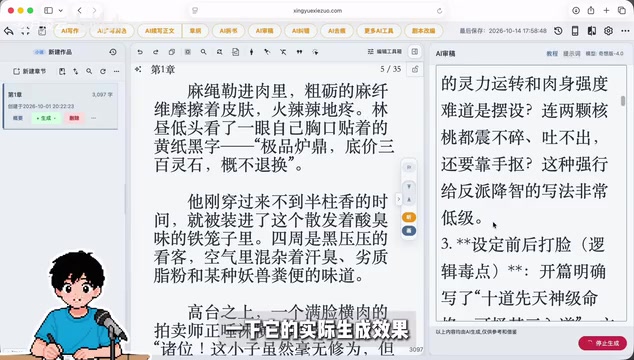
Dialogue generation was the standout part of this test. The auctioneer's lines — "Ladies and gentlemen, this boy may have no cultivation base, but he's born with pure yang and severed meridians, personally dug out of the mass grave by the Black Wind Stronghold's chief himself. Whoever wins the bid can throw him straight into the pot tonight!" — combined with the crowd's roaring laughter and jabs like "Old Devil Zhang, your teeth aren't up to it, why not buy him home to serve as your ancestor's chamber pot," genuinely presented a quite natural web fiction dialogue rhythm.
The protagonist's inner monologue and the golden finger introduction were also very swift. The creator emphasized that this was generated directly without any additions, deletions, or modifications, and the plot pacing within the first 500 characters was already very tight. Talent realizations like "Three, Swiftly Scan Ten Blocks Tenfold, Supreme Ancient Evergreen, Born Succubus, 100% Bare-Handed Blade Catch" were also rolled out sequentially as required.
Model Self-Review: What Does AI Grading Its Own Work Tell Us?
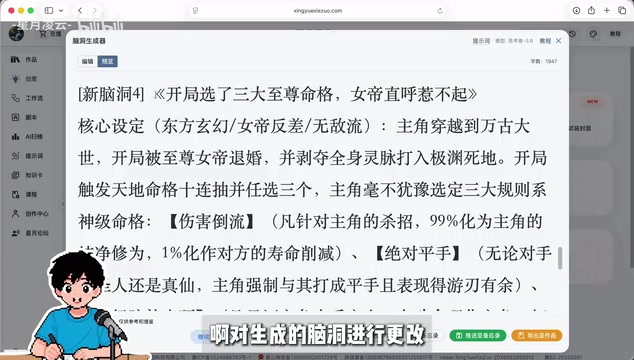
An interesting segment was when the creator used the AI review feature built into Xingyue Collaboration to have Gemini 4 Argon score its own generated content. The review result provided seven chapter title options, along with chapter scores and detailed commentary.
The commentary mentioned that "the opening cuts in quickly without lengthy background introduction, placing the protagonist directly in the iron cage at the Black Wind Stronghold auction, building a sense of crisis effectively."
What needs to be viewed objectively is that having a model self-review is essentially using the same model for self-evaluation, and its scoring has limited reference value. However, the identification of "problematic sentences" and reading-point analysis in the review feature do have practical value for actual creators.
LLM-as-a-Judge is a commonly used method in the evaluation field over the past two years, where a more capable language model is used to score, rank, or write commentary on another model's (or its own) output. It's low-cost, fast, and can do large-scale screening without human annotation. But it has two recognized flaws: first, self-preference bias, where models tend to give higher scores to outputs with styles similar to their own; second, position bias and length bias, where the same content reordered or lengthened can cause score fluctuations. Therefore, the more robust industry practice is to have the reviewing model and the generating model belong to different families, or introduce human spot-checks for calibration. Returning to this article's scenario, having Gemini 4 Argon review its own draft is essentially closer to a "capability demonstration" than a "quality certification." Its value lies in quickly pointing out structural issues like awkward sentences, dragging pacing, and insufficient hooks — not that total score.
Chapter Outline Workflow: The Complete Chain from Idea to Final Text
The latter half of the video showcased Xingyue Collaboration's complete creation workflow, and the design philosophy of this workflow is worth noting.
Idea Generation and Screening
Users can first generate creative ideas in multiple directions through the idea generator. In the video, five ideas were generated for selection, including a "female emperor breaking off engagement" style where "the opening chose three supreme destiny patterns and the female emperor exclaimed she couldn't afford to mess with him," and a "brain-supplement halo" deification fic. Different prompt templates produce different styles of ideas, and creators can select from or mix and match them.
From Golden Opening to Chapter Outline Implementation
After selecting an idea, fill it into the supplementary information area of the Golden Opening Generator to generate the first chapter text. Then, through the outline generator, link the already-created work and the first chapter text to generate a ten-chapter detailed outline. The video mentioned that detailed outline generation first sorts out the core summary of the preceding text, identifies unresolved core conflicts, and provides character anchor analysis and a foreshadowing checklist.
Character Cards and Knowledge Base Integration
A relatively key detail is character consistency management. The creator first copied the character anchor information from the chapter outline to the character library, automatically importing character personalities and background settings through intelligent recognition. When generating subsequent chapters, by checking the corresponding character cards and linking the chapter outline in the memo, the model can maintain character consistency.
In the second chapter generation test, because a humorous persona was configured, when the male protagonist answered questions, a passage appeared like "Haven't brushed your teeth in millions of years, your breath is so foul and you're still flaunting your power everywhere — can you show some basic hygiene? Then the Heaven-Viewing Demon Earth got furious." The "absolute tie" rule set up earlier also directly delivered the payoff, with a single chapter reaching 3,918 characters.
Character Cards and Knowledge Bases (RAG) solve the "character drift" problem in long-text generation. Large language models don't have persistent memory across sessions — information outside the context window is invisible to them. So by chapter ten, the model may well have forgotten that chapter three established the protagonist can't eat spicy food. Character cards package a character's name, appearance, personality, catchphrases, taboos, etc. into fixed entries that get injected with the prompt each time. Knowledge bases vectorize and store chapter outlines, setting collections, and previous text summaries, retrieving by relevance and stitching them into context. The technical name for this mechanism is Retrieval-Augmented Generation (RAG). Its boundaries are also clear: retrieval hit rate depends on chunking granularity and embedding model quality, and too many entries will eat into the already-limited context budget, resulting in "remembering the character but not the plot."
Chapter Outline Continuation and Cyclic Iteration
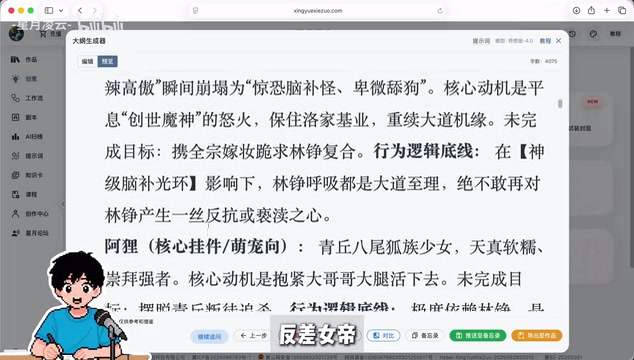
When the ten-chapter outline is used up, you can use the AI chapter outline continuation feature to continue diverging plot points for the next three chapters based on the preceding text. In the video, a new character "Dumb-Cute Sword Spirit Xiaoloudi" was added, demonstrating the cyclic iteration flow of chapter outline → main text → new chapter outline.
The chapter outline flow (some teams call it "detailed outline-driven" or "waterfall generation from outline to main text") is the current mainstream paradigm for AI web fiction writing. The core idea is layered dimensionality reduction: first use a one-sentence idea to set direction, then expand into a chapter synopsis, then expand into a detailed outline containing conflict points, emotional curves, and hooks, and finally land it as main text. The benefit of this approach is that each layer can be manually intervened and rolled back — when something goes wrong, you fix the outline rather than tens of thousands of words of main text. At the same time, the detailed outline itself constitutes a compressed context, alleviating the "the more you write, the more you forget" problem in long novels. The cost is that the more layers there are, the more creativity gets smoothed out through progressive expansion, with final output leaning toward neatness but lacking pleasant surprises — which is also one of the reasons many readers report AI fiction has a "strong formulaic feel." The key to judging whether a chapter outline flow tool is good is whether it can proactively introduce new variables when continuing chapter outlines, rather than repeatedly stir-frying existing conflicts.
A Calm Look: Several Issues to Note
The creator's assessment was quite high, but there are several aspects where creators should stay clear-headed.
Model output stability issues. The creator himself mentioned that "all models have their most stunning generation quality when they first come out, and after a while the compute power may decline somewhat." This is a phenomenon that does exist in AI model services.
Tool binding. The entire hands-on test was completed within the specific tool Xingyue Collaboration, and the model's capability demonstration depended heavily on the tool-side prompt engineering and knowledge base configuration. Whether pure API calls could achieve the same results outside this toolchain — the video did not demonstrate.
Limitations of self-evaluation. While the AI review feature is practical, models scoring themselves has inherent bias, and creators should not rely entirely on scores to judge content quality.
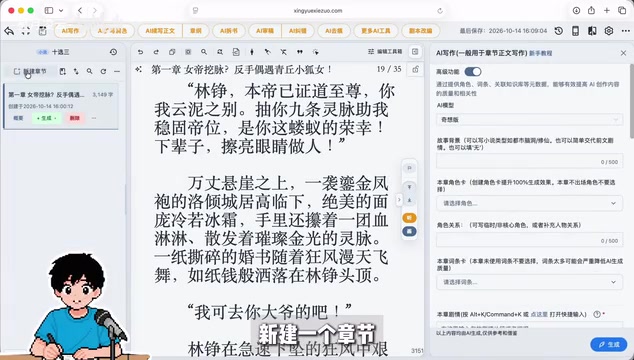
Sample size. The video showed generation results for the first and second chapters. For long novels, more complex capabilities like character arcs, foreshadowing payoff, and mid-to-late pacing control are hard to fully verify with short-term testing.
What This Means for the AI Writing Tool Market
Setting aside whether the "crushes all models" conclusion holds, this hands-on test at least demonstrates one trend: AI web fiction writing has moved from "can it write" to "how do you build the workflow."
Pure model generation capability is improving, but what truly affects creator efficiency is the entire engineering pipeline of idea screening, chapter outline management, character card integration, and knowledge base linkage. Gemini 4 Argon's performance in text quality and web-native feel has indeed improved, and the toolchain built around it is the key variable determining the actual creation experience.
Creators interested in AI writing should try it hands-on, but it's advisable to simultaneously maintain ongoing observation of model output quality and stability.
One-line Summary
Gemini 4 Argon performs impressively in web fiction testing, but conclusions depend on a specific toolchain, with stability and long-term capability still to be verified.
Paragraph Summary
This article combines a Bilibili creator's hands-on test video to evaluate Gemini 4 Argon's web fiction writing capability across three dimensions: generation quality, workflow integration, and practical limitations. Opening generation tests show the model has made clear progress in dialogue rhythm, payoff density, and talent setting rollout, with tight pacing within 500 characters and a web-native feel approaching human author level. The video also demonstrates Xingyue Collaboration's complete chapter outline workflow, connecting idea generation, golden opening, outline continuation, character cards, and knowledge base integration, forming a cyclic iteration from chapter outline to main text. However, the article also raises several reservations: self-review scoring has inherent bias, results depend heavily on a specific toolchain, model compute performance may decline after initial launch, and short-term samples are insufficient to verify long-form foreshadowing payoff and pacing control. The overall judgment is that AI web fiction writing has entered the workflow competition stage.
Related articles

AI Compute Is the New Oil, But the Market Mechanism Has Yet to Take Shape
Hacker News compares AI compute to the new oil, noting the lack of price discovery, concentrated supply, and no hedging tools. The article analyzes structural issues in compute trading and explores a possible three-tier market of spot, contracts, and derivatives, plus the real impact on AI practitioners' cost management.

Running Full iOS 16.5 Firmware on Android Devices: Technical Demo or Marketing Gimmick?
A Hacker News post claims full iOS 16.5 firmware can run on Android, with 315 upvotes. This analysis argues it is more likely a web UI simulation than a true firmware port, and explores the value and risks of such projects.

Etsy Cracks Down on AI Slop: Addressing Buyer and Seller Anxieties
Etsy introduces stricter rules limiting AI-generated content in listings, addressing buyer confusion over AI products and seller fears of original work being diluted by AI slop.