Gemini 4 Argon Hands-On: Topping the Benchmarks but Fumbling in Practice?

Gemini 4 Argon tops benchmarks, but hands-on tests expose 3D generation and video hallucination weaknesses.
Bilibili creator Chen Xiaoyan ran five hands-on tests on Google's Gemini 4 Argon, covering 3D animation, physics simulation, tool development, video understanding, and solution analysis. The model performed stably on structured tasks—the lottery tool was fully functional with clear interactions, multi-document analysis accurately identified all key changes, and the UI experience beat GPT-6 Ostra. But it showed clear weaknesses in creative and perception tasks: 3D animation had joint misalignment and crude visuals, and a higher thinking budget made it worse; video understanding hallucinated by describing a hand that never appeared in the frame, while the competitor chose not to fabricate. The article notes a persistent gap between benchmark dominance and real-world experience, with the failure of higher thinking budget raising questions about the effectiveness of its thinking mechanism.
After nearly a year of silence, Google is back in the top tier with Gemini 4 Argon. Topping 13 tests and tying for first in one is certainly impressive, but the gap between benchmark scores and real-world experience is what users care about most. Bilibili creator Chen Xiaoyan ran a comprehensive hands-on test of Gemini 4 Argon covering code generation, physics simulation, tool development, and video understanding—with results that brought both pleasant surprises and unexpected disappointments.
After Topping the Benchmarks, Real Testing Is the True Litmus Test
Gemini 4 Argon is now fully available to paid users, who can select different thinking budgets in settings. However, you might not have noticed that the Anti-Gravity feature is exclusive to Ultra subscribers—Pro users can't access it—and this precise tiering of subscription thresholds has sparked considerable discussion. The original Spark button has been renamed to "Tasks," supporting background execution, and Gemini 4 Argon can also be invoked as a task model.
This round of testing consisted of five problems covering 3D animation generation, physics interaction, lottery tool development, video content understanding, and event planning analysis—essentially covering the most common AI usage scenarios for ordinary users.
Thinking Budget is an important adjustable parameter during the inference phase of large models. Represented by the Gemini series and OpenAI's o series, these models first produce an "internal reasoning chain" before answering, consuming extra tokens for self-checking, step decomposition, and approach comparison. The higher the thinking budget, the larger the reasoning budget available to the model, which in theory makes it better suited for math, code, and complex planning tasks. But it's not a linear gain: when the budget is too high, the model may fall into over-deliberation and repeated self-doubt, or misapply "caution" as "conservatism" in generative tasks, leading to simplified visual elements and stiff animations. The article's observation that "higher thinking budget actually produces worse output" is a typical failure of this mechanism in creative generation scenarios—more reasoning power doesn't necessarily translate into better generation quality.
3D Animation Generation: A Clear Gap with Competitors
The first problem asked for a 3D animation of "a teapot riding a bicycle." The creator first ran it with medium thinking budget, and the result had the feet detached from the pedals, with the overall picture looking quite crude.

Switching to high thinking budget made the result even worse. Compared with the version generated by GPT-6 Ostra, the gap is immediately obvious—Ostra's version is clearly a notch above in detail completeness and visual richness. In the creator's words, "one looks like a bare shell, the other like a luxury renovation."
This problem exposed Gemini 4 Argon's weakness in 3D animation generation: even for simple concrete scenes, the model still has obvious defects in joint connections and motion plausibility, and increasing the thinking budget brought no quality improvement.
Physics Simulation and Tool Development: Trading Blows
The second problem was a physics interaction demo of five small balls rotating inside a hexagon. Gemini 4 Argon's version had basically normal ball trajectories, with no obvious physics rule violations like floating or boundary penetration. But GPT-6 Ostra's version added gravity direction indicators, and its irregularity at high speeds felt closer to real physics. Comparing the two, the creator felt Ostra edged ahead in following physics rules.
The third problem was developing a lottery mini-tool. Gemini 4 Argon's version, under a bold red UI, implemented complete functionality: supporting name deduplication (after pasting two "Xiao Wang" entries, it automatically identified five valid participants), preventing already-won participants from winning again, and retaining data after refresh.

When the remaining participants were insufficient, the tool gave a clear prompt: "Unable to draw—this round is set for two people, but only one remains." The restart function also had a confirmation popup, and the overall interaction logic was clear.

GPT-6 Ostra's version had basically the same functional logic, but fell short of Gemini in UI aesthetics and the warmth of user prompts. The creator awarded this round to Gemini 4 Argon.
Video Understanding: Strong Recognition but Prone to Hallucination
The fourth problem tested video content understanding. The creator uploaded a short video of "a pen on paper, the pen moves away, a cup is placed on the paper, the cup leaves the screen," asking the model to answer questions about the positional relationship between the cup and paper, the order of operations, and what was in the cup.
Gemini 4 Argon performed well in position judgment and content description, with a quite detailed description of the cup's contents. But it hallucinated when interpreting the initial frame—the original text states that the hand had not yet entered the frame, yet the model claimed "the right hand is holding it, ready to pick it up."
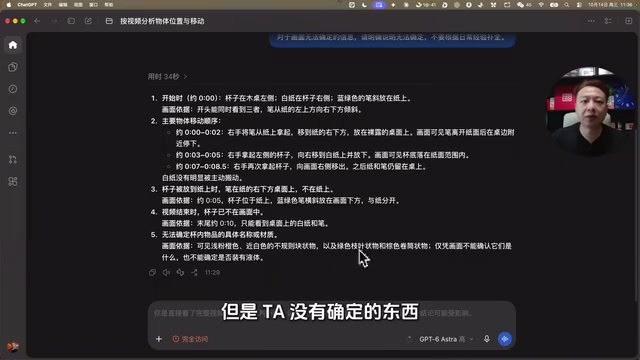
GPT-6 Ostra didn't make this error, and chose not to fabricate content it was uncertain about. The creator felt this baseline awareness of "if you don't know, don't say" was commendable. Both were generally acceptable in video understanding, but Gemini's hallucination problem reminds us: strong recognition ability and detailed descriptions don't equal accuracy.
Multimodal Hallucination refers to a model outputting people, objects, or actions that don't exist in an image or video during visual understanding. Unlike pure text hallucination, video hallucination is often more subtle: the model can correctly identify subjects and scenes, yet will "fill in" the motion connections between frames along the time dimension. Common triggers include strong priors about "typical action sequences" in training data—for example, seeing a pen and paper, the model tends to complete the common narrative of "hand holding pen, ready to write," even if the hand hasn't entered the frame yet. In the article, Gemini 4 Argon claiming "the right hand is holding it, ready to pick it up" when no hand appears in the frame is a typical manifestation of this prior overriding fact. In contrast, a model that chooses "if uncertain, don't describe" is essentially making a more conservative trade-off between hallucination and recall.
Real-World Scenario Application: Solid Solution Comprehension
The last problem simulated a real work scenario: given Plan A (old), Plan B (new), and Plan C (execution), the model was asked to list the issues that must be changed and any unreasonable points.
Gemini 4 Argon quickly provided answers: seats adjusted from 60 to 80, meal and gift quantities increased accordingly, end time extended from 16:00 to 16:30 while still within the venue rental period, host replacement, and so on—all correctly identified. The cost increase calculation was also accurate. This problem demonstrated Gemini 4 Argon's reliable performance in multi-document information integration and practical business understanding.
Multi-document Reasoning is a key capability for measuring whether a model can handle real office scenarios. It requires the model to simultaneously read multiple materials from different sources and formats, cross-compare them, identify conflicts, and provide actionable revision suggestions. Compared with single-document Q&A, its difficulty isn't in "understanding" but in "alignment": the same matter may be described inconsistently across documents A, B, and C, and the model must determine which is the latest version and which numbers need coordinated adjustment. In the article, seats changing from 60 to 80, meals and gifts increasing accordingly, and the end time being pushed back while still needing to fall within the venue rental period is a typical set of chained constraint reasoning. Stable performance on such tasks shows the model already has practical value in structured information processing.
What Does the Gap Between Benchmarks and Experience Tell Us
Five problems certainly can't cover all the capabilities of an AI model, but they already reveal several characteristics of Gemini 4 Argon: stable performance on structured tasks (tool development, solution analysis), but still obvious weaknesses in creative generation (3D animation) and perception tasks (video understanding).
Topping the benchmarks proves the model's strength in standardized tests, but the gap between standardized tests and real usage scenarios is exactly where users feel the difference most strongly in daily life. The fact that a higher thinking budget actually produces worse output also casts doubt on the effectiveness of the model's thinking mechanism.
Google's progress on Gemini 4 Argon is real, but between "back in the top tier" and "becoming the first choice again" lie countless real-world tests. Have you tried it? How did it feel?
Related articles

Amphibious Transforming Drone: Beyond 100x Power Savings, What Are the Real Needs?
Is the amphibious transforming drone just a gimmick? Starting from the 100x power difference of the M4 Morphobot, explore real application scenarios and thesis topic ideas, analyzing boundary conditions where pure drones and pure ground robots both fail.

Warhound Raises $200 Million: Genetically Engineered "War Dogs" Paired with Anduril Gear
Warhound raises $200M, backed by Ben Lamm and Palmer Luckey, to genetically engineer dogs for military and law enforcement use and equip them with Anduril gear. This article analyzes its technology direction, funding logic, and ethical controversy.

Claude API Comes to Google Cloud: IAM Integration and SDK Access Guide
Anthropic hosts the full Claude API on Google Cloud with IAM-controlled permissions and unified billing. This guide covers the Vertex AI and Anthropic-hosted entry points, IAM role configuration, and SDK access.