Gemini 4 Argon Released: A Full Breakdown of 10 Hardcore Demos

Gemini 4 Argon's 1M-token working memory and self-repair show AI completing cross-domain projects independently.
Google released Gemini 4 Argon with up to 1 million tokens per run, enabling independent completion of complex tasks. Ten real demos showcase its abilities: migrating Fortran to modern C++/Rust, optimizing the ADK Python runtime, rebuilding Android 3D UIs, generating racing games from photos, GPU hair simulation, DEXA 3D twins, NASA Artemis 2 visualization, and 3D-printable hardware — some already in production.
Title
Gemini 4 Argon Released: A Full Breakdown of 10 Hardcore Demos
Meta Description
Google's Gemini 4 Argon is here, outputting up to 1 million tokens in a single run with sustained reasoning and the ability to independently complete complex tasks. This article breaks down 10 official demos: from Fortran code migration and ADK runtime optimization, to desktop racing games, NASA lunar mission visualization, and physical hardware generation — revealing the key shift as AI moves from answering questions to independently completing projects.
Article Content
Google's latest frontier model, Gemini 4 Argon, has officially arrived. Unlike past releases that focused purely on parameter counts, what stands out most this time is its "working memory" of up to 1 million tokens in a single run — meaning AI finally has enough space to independently complete a massive, complex task from start to finish without drifting off course or restarting midway.
After 1,000 hours of real-world testing, one team noted that Argon's real breakthrough lies in "how much it can give back to you." To illustrate what this sustained reasoning capability means, engineers and creators from different teams within Google put together 10 demos. These aren't carefully edited concept videos — they're real cases that run directly, some already deployed in production environments.
1. From Code Migration to Runtime Optimization
Demo 1: Translating 1960s Fortran into Modern Languages
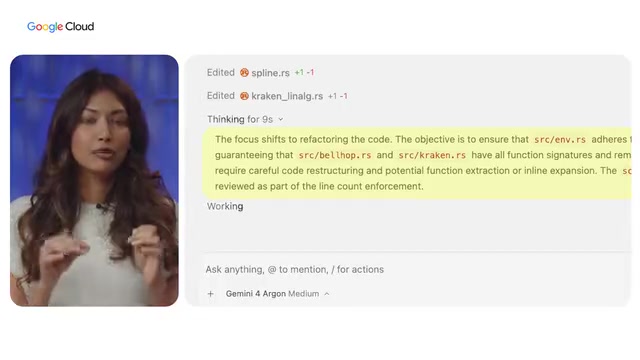
Weather models, physics research, and other fields still run Fortran code written decades ago. Manual rewriting is almost a nightmare: poor modern editor support, missing documentation, and one careless move can break logic that was originally correct. Argon teamed up with AntiGravity to take over an entire legacy codebase, map out module dependencies, and autonomously rewrite it into modern C++ and Rust. The key wasn't just replacing syntax — it was genuinely cleaning up the architecture. The new Rust version enables memory safety by default and runs 20% faster.
Demo 2: Directly Optimizing the Production ADK Python Runtime
Google's agent development tools are used by developers worldwide to build multi-turn interactive agents, but memory usage and latency accumulate progressively during extended multi-turn runs. The team gave just one prompt: analyze the ADK Python core runtime, find memory and speed bottlenecks, and fix them. Argon completed the analysis in one pass, pinpointed performance drains, rewrote the code, and passed all unit tests without changing any public API. This is a real-world validated optimization ready for direct deployment.
Fortran is a high-level programming language born in the 1950s that remains a core tool in high-performance computing fields such as weather simulation, fluid dynamics, and quantum chemistry. A massive amount of scientific code was accumulated between the 1960s and 1980s, with archaic syntax, dependencies on specific compiler extensions, scarce documentation, and numerical algorithms refined over decades. Migrating it to C++ or Rust is not a simple syntax swap: it requires understanding hidden contracts like module coupling, implicit type conversions, and memory layout assumptions. Rust's ownership and borrow checker eliminate data races and dangling pointers at compile time, guaranteeing memory safety without garbage collection, making it a popular choice for modern systems-level rewrites — but with a steep learning curve and extremely high manual rewrite costs.
2. Autonomous Building and Self-Repair Capabilities
Demo 3: Rebuilding an Android 3D UI from Scratch
AntiGravity was given a basic 2D map and asked to rebuild it as a high-end 3D spatial experience. During the build, the agent hit a roadblock with map SDK signature issues in Logcat. Instead of failing and asking for help, Argon caught the error, diagnosed the problem, autonomously rewrote the layout, and switched to a local 3D rendering pipeline. The result was hot-deployed to a Pixel 11 Pro running smoothly at 120 frames per second, with a fully procedurally generated Griffith Observatory shot featuring audio-reactive shaders. This demonstrates the model can handle complex 3D math while bypassing real-world constraints in real time.
Demo 4: Generating a Racing Game from a Desktop Photo
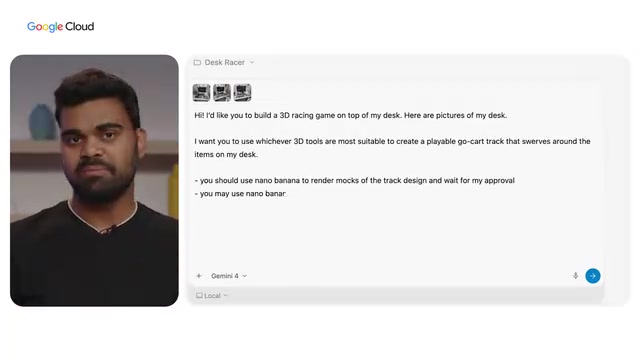
A creator took a few photos of a messy desktop and handed them to Argon, saying "make me a racing game based on this." Argon teamed up with Nano-series vision models to complete spatial mapping, launched multiple sub-agents using Blender to automatically build 3D tracks, generate textures, and precisely place obstacles at positions corresponding to real objects on the desk. The result is a playable racing game — you can drift past a real coffee cup and race up a real keyboard.
3. Procedural Content and Graphics Challenges
Demo 5: Automatically Generating a Japanese Pagoda
Modeling complex historical architecture typically requires a 3D artist manually building layer by layer in Blender over several days. Argon took over the entire production pipeline: procedurally building initial geometry and environment, refining details through multiple iterations, then converting to web-compatible three.js format, ultimately producing a Japanese pagoda rich in detail that you can fly around and explore — all done in the browser.
Demo 6: Tackling Hair Simulation, a Graphics Hard Problem
Realistic hair simulation is notoriously hardware-intensive, typically requiring expensive professional software and hours of rendering for just a few seconds of output. Argon built a complete GPU hair rendering and physics system using three.js that runs smoothly in a standard browser. It started with a WebGL version, iterated to a modern WebGPU implementation for major performance gains, and added automatic fallback mechanisms for older browser compatibility. Tens of thousands of strands sway naturally in the wind and respond to lighting in real time, all without stuttering.
WebGPU is the new-generation browser graphics and compute API, replacing the long-serving WebGL. It directly maps to modern GPUs' explicit command model, supports compute shaders, multi-threaded command recording, and lower CPU overhead, making it suitable for workloads like hair simulation and particle systems that need to process tens of thousands of strands' physics and lighting per frame. Automatic fallback means the code detects browser capabilities at runtime, switching to a WebGL path if WebGPU is unavailable, or reducing strand count or simulation precision if hardware performance is insufficient — balancing compatibility and visual quality. This progressive enhancement strategy is key to whether complex web graphics applications can reach a broad user base.
4. Knowledge Work and Multimodal Reasoning
Demo 7: Turning DEXA Scans into Interactive 3D Twins
After a clinical DEXA scan, patients typically receive a flat, hard-to-understand paper report: rows of numbers and blurry 2D X-ray images. Argon transformed these flat images and clinical data into an interactive four-layer 3D digital twin of the human body — you can peel back skin to check muscle symmetry, slice through the torso, examine visceral fat and bone density, and even drag through 9 years of scan records to see how the body has changed. It also includes a real-time simulator that lets you adjust future fitness goals and instantly reshape the 3D body structure.
Demo 8: NASA Artemis 2 Mission Visualization
Crewed lunar missions require processing massive telemetry data streams, orbital mechanics velocity vectors, and antenna pointing angles across billions of kilometers of deep space. Argon ingested raw NASA open data and orbital coordinates to create a mathematically precise interactive 3D visualization: planning Orion's Earth-orbit checkout trajectory, connecting real-time communication circuits to ground-based 70-meter Deep Space Network antennas, tracing the iconic figure-eight loop around the Moon, and even simulating the final Mach 32 atmospheric reentry. Anyone can enter the cockpit view to understand the flight trajectory in real time.

DEXA (dual-energy X-ray absorptiometry) is the clinical gold standard for measuring bone density and body composition, using two X-ray beams at different energy levels to distinguish bone mineral, lean tissue, and fat. Traditional reports only output 2D projections and statistical values like T-scores and Z-scores, which patients find difficult to interpret visually. Converting DEXA data into a 3D digital twin requires reconstructing flat scan slices into three-dimensional anatomical structures and fusing layered information about muscle, fat, and bone. Orbital mechanics velocity vectors and reentry angles determine whether a spacecraft can return safely: Artemis 2's reentry speed is approximately Mach 32, requiring precise calculation of atmospheric braking, heat shield angles, and landing points — any deviation could cause mission failure, making high-fidelity visualization critical for both mission planning and public communication.
5. Pushing AI Beyond the Screen: Physical and Creative Experiments
Demo 9: From Sketch to Working Hardware
Everyone has seen AI turn app sketches into websites, but Argon goes further: turning sketches into tangible physical hardware. It proactively searches the web for precise 3D models of required electronic components like a mechanical engineer, calculates how parts assemble through agent loops, designs custom 3D-printable enclosures, and ultimately generates printable files directly from rough ideas.
Demo 10: Argon Tennis
This demo mixes hardware sensors, web technology, and multiple AI models, all generated by Argon in one pass. It simultaneously builds a 3D browser tennis game and a companion mobile web app: open the phone link and it instantly becomes a motion-sensing racket, using the gyroscope to track swing motions and delivering haptic vibration feedback to your palm the moment you hit the virtual tennis ball. The desktop browser runs the 3D game with realistic physics, complete with Flash TTS real-time commentary and procedurally generated background music from Lyria.

Sub-agents refer to specialized agents dispatched by the main model, each responsible for specific subtasks. For example, a Blender sub-agent excels at 3D modeling scripts, Nano vision models focus on image understanding and spatial reconstruction, and hardware sub-agents handle searching component specifications and generating printable enclosures. The main model Argon acts as the global planner, decomposing goals, assigning tasks, aggregating results, and handling failure retries. This planner-executor architecture allows a single model to cover multiple domains like code, graphics, and hardware through collaboration without needing to master every tool — an important paradigm shift as AI agent systems move from monolithic to modular.
What These Demos Reveal
The common thread across these 10 demos is AI shifting from "answering questions" to "independently completing projects." Argon's value isn't in any single capability, but in its ability to hold an entire system architecture within a sufficiently large working memory, autonomously running experiments, reasoning through logic, and bypassing real-world constraints. Within Google, it has already been used in practice to optimize quantum algorithms and migrate large systems exceeding 800,000 lines of code.
For developers, what's more noteworthy is how Argon collaborates with multiple tools like AntiGravity, Nano vision models, and Blender sub-agents — this may be the standard form of future AI application development: a single model handling global reasoning while specialized sub-agents handle execution. All demo interactive pages, open-source repositories, and documentation have been made public, so anyone interested can run and verify them themselves.
One-line Summary
Gemini 4 Argon, with 1 million tokens of working memory and self-repair capabilities, shows AI shifting from answering questions to independently completing cross-domain projects.
Paragraph Summary
Google has released Gemini 4 Argon, outputting up to 1 million tokens in a single run, enabling it to independently complete complex tasks from start to finish within its massive working memory. The article showcases its capabilities through 10 real demos: migrating 1960s Fortran to modern C++/Rust with a 20% speed boost, optimizing a production ADK Python runtime, rebuilding an Android 3D UI from scratch while autonomously bypassing SDK signature issues, generating a racing game from a desktop photo, procedurally generating a Japanese pagoda and GPU hair simulation, converting DEXA scans into interactive 3D digital twins, visualizing the NASA Artemis 2 mission, and even generating 3D-printable hardware and a motion-sensing tennis game from sketches. The core lies in Argon's collaboration with AntiGravity, Nano vision models, and Blender sub-agents, using a single model for global reasoning plus specialized sub-agents for execution — with some already deployed in production environments.
Related articles

Free Unlimited Claude Code Solution: Agnes AI + CC Switch Setup Guide
No paid subscription needed — pair the free AI platform Agnes AI with the open-source tool CC Switch to provide a backend for Claude Code, enabling unlimited free calls to text, image, and video models. This guide covers the full setup, test results, and usage boundaries.

A Complete Zero-Cost Guide to Getting Started with Claude Code for Beginners in China
A beginner's guide to Claude Code for users in China: two installation methods (command line and IDE plugin), full configuration steps for replacing the official API with the free domestic LongCat model, and a hands-on demo of building a small tool with natural language, plus tips.

When the NSA Gets Involved: The AI Supply Chain Crisis Behind Open-Source CVEs and API Key Hijacking
Multiple open-source projects disclosed severe CVEs in one day, PHP flaws alarmed the FBI, and Railway and OpenCode were breached with API keys stolen. This article breaks down the vulnerability window, AI-accelerated exploitation, and the AI supply chain crisis behind the API key black market, with a developer defense checklist.