Gemini 4 Argon Released: AI Moves from Answering Questions to Completing Tasks

Google releases Gemini 4 Argon, marking a shift in AI competition from parameter scale to integration into user workflows.
Google's latest flagship model Gemini 4 Argon is now officially available, with its core positioning shifting from "answering questions" to "completing work tasks." The article analyzes this shift from three dimensions: long-content understanding supports processing research materials and project documents in one go; coding capabilities upgrade from simple completion to understanding project structure and analyzing code issues; and complex task handling migrates from the Q&A paradigm to the task paradigm. The article points out that as the benchmark scores of leading models converge, the difference in parameter scale for user experience is becoming smaller and smaller, and what truly determines user retention is whether the model is easy to use and saves time in everyday scenarios. The release of Gemini 4 Argon further intensifies the competition among Google, OpenAI, and Anthropic, with the focus of competition shifting from "benchmark scores" to "real-world deployment."
Gemini 4 Argon Released: AI Moves from "Answering Questions" to "Completing Tasks"
Google's latest flagship model, Gemini 4 Argon, is now officially available. Unlike previous generations of AI that excelled primarily at chat and Q&A, this generation aims to be a genuine work assistant—no longer content to simply "tell you the answer," but attempting to "help you get things done." This shift seems subtle, but it actually points to a core proposition in the AI product competition: as the marginal returns of parameter scale diminish, whoever first integrates into users' learning, work, and creative workflows may secure the ticket to the next stage.
According to an introduction by a Bilibili creator in a video, the release of Gemini 4 Argon represents another significant bet by Google in the large model race, further intensifying the competition among Google, OpenAI, and Anthropic.
Long-Content Understanding: From "Feeding in Segments" to "Digesting in One Go"

The most direct capability upgrade of Gemini 4 Argon is reflected in its handling of long content.
In the past, using AI to analyze a lengthy document often required manually splitting it into multiple segments, inputting them one by one, and then piecing together the results—a cumbersome process prone to losing contextual connections. The goal of this new generation is to let AI understand more content at once: research materials, project files, and lengthy documents can all be handed over for it to quickly organize the key points.

On the surface, this capability seems like merely "supporting a longer context window," but its actual impact goes far beyond that. When AI can fully read in a project document, it becomes possible for it to understand the document's internal logical structure and sequential dependencies, and then provide genuinely useful summaries and analysis—rather than fragmented information pieced together.
Context window refers to the maximum length of text a large language model can process in a single pass, typically measured in tokens. It determines how much information the model can "see" in one inference. Early models often had context windows of only a few thousand tokens, meaning long documents could only be truncated or fed in segments. When the context window expands to hundreds of thousands or even millions of tokens, the model becomes capable of reading an entire book, an entire code repository, or a full set of project documents in a single call. But expanding the context window is not without cost: the computational load of the attention mechanism grows quadratically with sequence length, and GPU memory usage and inference latency both rise significantly. Therefore, the truly meaningful breakthrough is not just "a bigger window," but the ability to maintain accurate localization of key information under extremely long inputs—this involves engineering optimizations of the attention mechanism and is a hard technical benchmark that separates different models.
Code Development: From "Completing a Few Lines" to "Understanding the Project"
For programmers, Gemini 4 Argon's coding capabilities deserve separate attention.
AI programming tools have long moved beyond simple code completion. According to the video, this new generation can understand project structure, analyze code issues, and assist in the development process. This means AI's role is upgrading from "autocomplete in the editor" to "a collaborative partner that can understand the entire codebase."
The technical bar for this shift is not low. Understanding project structure requires the model, on top of long context, to accurately track cross-file reference relationships and dependency chains. If Gemini 4 Argon performs reliably in this regard, its boost to development efficiency will be substantial—especially in scenarios involving the maintenance and refactoring of large codebases.
Code completion and repository-level code understanding are capabilities of two different orders of magnitude. The former relies on local syntax patterns and common API usage habits, typically represented by autocomplete features in IDEs; the latter requires the model, on the basis of understanding the semantics of individual files, to build cross-file symbol indexes, trace function call chains, and identify dependencies between modules. Technically, this requires the model to model the overall structure of the project, usually with the help of code parsing tools (such as AST analysis) or retrieval-augmented generation (RAG) to locate relevant code snippets. The difficulty of repository-level understanding lies in the fact that: the context window is limited, while the code volume of large projects often far exceeds the window limit, so the model must learn to "selectively read." This is also the key bottleneck for current AI programming tools in moving from "assisting with writing code" to "independently completing development tasks."
Complex Tasks: From "Answering What It Is" to "Helping You Build It"
The most intriguing change in Gemini 4 Argon is the way it handles complex tasks.
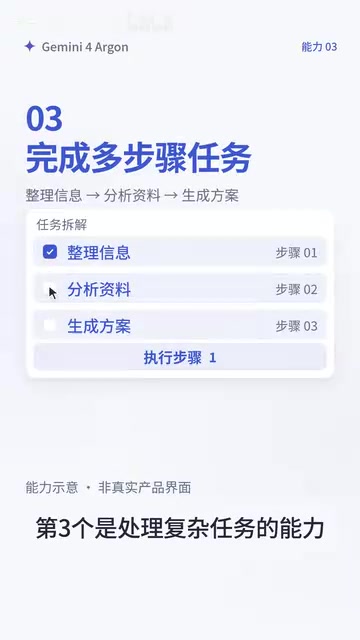
In the past, the AI interaction model was "you ask, I answer": you pose a question, it gives an answer. The new generation attempts to complete more steps based on user needs—organizing information, analyzing materials, generating proposals—stringing multiple stages into a complete workflow.
This is essentially a migration from the Q&A paradigm to the task paradigm. Under the Q&A paradigm, AI is a knowledgeable responder; under the task paradigm, AI is more like an assistant that can autonomously break down goals and execute them step by step. The difficulty of the latter lies in the fact that: the model must not only understand "what to do," but also plan "how to do it," while maintaining tracking of the goal throughout execution.
Of course, different AI models currently have their own strengths, and the real experience still needs to be verified by more users in actual use. The video creator also admitted that it is still difficult to draw a conclusion at this stage.
The core technical support for the task paradigm is the "Agent" architecture. Unlike the Q&A paradigm, where the model outputs just one answer, an agent needs goal decomposition, tool invocation, state tracking, and self-correction capabilities. Specifically, the model breaks down a complex requirement into several sub-steps, each of which may involve calling external tools (search engines, code executors, file read/write interfaces, etc.), and then decides the next action based on the execution results until the task is complete. This requires the model not only to generate text, but also to judge "which step we're currently at" and "what to do next." Current mainstream approaches include frameworks such as ReAct (alternating reasoning and acting) and Function Calling. The biggest challenge of the task paradigm lies in error accumulation during long-chain execution—any misjudgment at one step can cause subsequent steps to deviate from the goal, placing demands on the model's planning and error-correction capabilities far higher than those of Q&A scenarios.
The New Focus of AI Competition: Beyond Parameters
The release of Gemini 4 Argon reflects a shift in the focus of competition in the AI industry.
Over the past few years, model parameter scale was the primary yardstick for measuring AI capability. But a judgment raised in the video is worth noting: what people care about isn't just how large the model parameters are, but who can truly integrate into users' learning, work, and creative workflows.
There is practical logic behind this judgment. As the benchmark scores of leading models converge, the perceived difference in parameter numbers for ordinary users becomes smaller and smaller. What truly determines user retention is whether the model is easy to use, reliable, and actually saves time in everyday scenarios. The competition among Gemini 4 Argon, the GPT series, and the Claude series is shifting from "benchmark scores" to "real-world deployment."
Google's release of Gemini 4 Argon at this time is both a response to OpenAI and Anthropic and a bid for the key positioning of AI work assistant. In the future, AI will increasingly resemble an intelligent assistant—this trend is already clear, and the suspense lies in who gets there first.
Do you think Gemini 4 Argon can change the AI landscape?
One-line Summary
Google releases Gemini 4 Argon, marking a shift in AI competition from parameter scale to integration into user workflows.
Paragraph Summary
Google's latest flagship model, Gemini 4 Argon, is now officially available, with its core positioning shifting from "answering questions" to "completing work tasks." The article analyzes this shift from three dimensions: long-content understanding supports processing research materials and project documents in one go; coding capabilities upgrade from simple completion to understanding project structure and analyzing code issues; and complex task handling migrates from the Q&A paradigm to the task paradigm. The article points out that as the benchmark scores of leading models converge, the difference in parameter scale for user experience is becoming smaller and smaller, and what truly determines user retention is whether the model is easy to use and saves time in everyday scenarios. The release of Gemini 4 Argon further intensifies the competition among Google, OpenAI, and Anthropic, with the focus of competition shifting from "benchmark scores" to "real-world deployment."
Related articles

Free Unlimited Claude Code Solution: Agnes AI + CC Switch Setup Guide
No paid subscription needed — pair the free AI platform Agnes AI with the open-source tool CC Switch to provide a backend for Claude Code, enabling unlimited free calls to text, image, and video models. This guide covers the full setup, test results, and usage boundaries.

A Complete Zero-Cost Guide to Getting Started with Claude Code for Beginners in China
A beginner's guide to Claude Code for users in China: two installation methods (command line and IDE plugin), full configuration steps for replacing the official API with the free domestic LongCat model, and a hands-on demo of building a small tool with natural language, plus tips.

When the NSA Gets Involved: The AI Supply Chain Crisis Behind Open-Source CVEs and API Key Hijacking
Multiple open-source projects disclosed severe CVEs in one day, PHP flaws alarmed the FBI, and Railway and OpenCode were breached with API keys stolen. This article breaks down the vulnerability window, AI-accelerated exploitation, and the AI supply chain crisis behind the API key black market, with a developer defense checklist.