Gemini 4 Argon Surprise Launch: Benchmark King Slammed by Employees in Real-World Use

Gemini 4 Argon tops benchmarks but flops in practice, as DeepSeek, OpenAI, and Anthropic all make major moves.
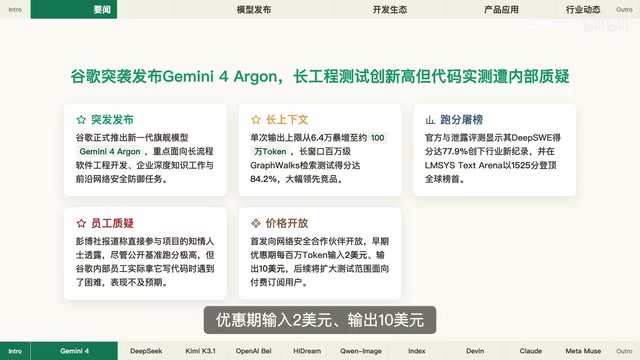
On October 1st, Google surprise-launched Gemini 4 Argon with up to 1M token output and a record 77.9% on the Deep7e software engineering benchmark — only to face reports of a real-world performance gap from internal employees. Simultaneously, DeepSeek Harness V0.2 launched, Kimi K3.1 entered gray-scale testing, Bilibili open-sourced a multilingual translation model, and OpenAI's experimental model Bell leaked. On the generation side, Vigo Turbo achieved up to 5x speedup; Devon's costs dropped up to 70%; and Anthropic's browser Agent went live for paid users. Consumer AI assistant Mios hit 5M US downloads in 22 days, outpacing ChatGPT's early growth.
Google caught the industry off guard once again. On October 1st, Gemini 4 Argon went live without warning, quickly topping multiple leaderboards with impressive benchmark scores — while simultaneously sparking internal controversy over real-world performance. Meanwhile, DeepSeek, Moonshot AI, OpenAI, Anthropic, and other top players all made significant moves, pushing the entire AI race into another intense wave of rapid iteration. Here's a roundup of the key developments from the Green Duck AI Daily.
Gemini 4 Argon: Leaderboard Champion or Paper Tiger?
Google's flagship Gemini 4 Argon model's standout feature is a dramatic boost in single-output capacity — up to approximately 1 million tokens per response. This is a significant leap for long-pipeline workflows, large-scale code generation, and document processing scenarios. On the Deep7e long-pipeline software engineering benchmark, Argon set a new record of 77.9%, surpassing the previous leader Claude Opus 5.5 to claim the top spot.
However, behind the shiny benchmark numbers, dissenting voices have emerged. According to Bloomberg, Google employees encountered difficulties when using Argon for actual coding tasks, revealing a gap between real-world performance and benchmark results. This "top of the charts, flops in practice" contrast once again highlights a persistent problem: benchmark scores don't fully reflect a model's usability in genuine engineering environments.
On the commercial side, Google chose to launch exclusively for cybersecurity partners first, with promotional pricing of $2 per million input tokens and $10 per million output tokens. The relatively high output pricing signals Google's premium positioning for this model.
What is Deep7e? Deep7e (Deep Software Engineering Benchmark 7th Edition) is one of the industry's most respected long-pipeline software engineering benchmarks. It evaluates a model's ability to complete end-to-end tasks within real codebases, covering the full development cycle: requirements understanding, multi-file edits, test writing, and debugging. This makes it far more representative of real engineering work than earlier benchmarks like HumanEval, which only tested single-function completion. As a result, its scores carry more weight for professional developers — but it also more readily exposes "benchmark overfitting," where a model performs well on specific test case patterns but fails in real-world codebases with different styles. The real-world gap reported by Google employees is essentially a concrete manifestation of this generalization problem.
Domestic AI Forces in Full Swing: DeepSeek, Kimi, and Bilibili Open Source
Chinese AI players were equally active on the same day. The DeepSeekAd Harness desktop client officially launched its V0.2 preview, supporting multi-agent collaborative management and local workflow orchestration — targeting the fast-growing demand for Agent development. As part of a National Day promotion, eligible users who log in can claim ¥6 in compute credits, with existing users able to receive credits by logging out and back in. Credits are valid for 7 days.
Moonshot AI's next-generation model, Kimi K3.1, was spotted by the community undergoing gray-scale testing on a staging subdomain. Screenshots suggest the team is in intensive end-to-end integration testing, with expected improvements focused on long-context reasoning and logical thinking capabilities.
Bilibili's Index large model team announced the open-source release of the Index Translate multilingual translation model family, spanning 2B, 9B, and 35B parameter scales with support for up to 150 languages. What's particularly interesting is that it includes specialized fine-tuning for internet slang and danmaku (bullet comment) culture — a localization detail that could be its key differentiator from general-purpose translation models.
OpenAI's Mysterious Model "Bell" Leaked
A tech blogger overseas revealed that OpenAI is secretly testing an experimental model internally codenamed "Bell." According to leaked information, Bell significantly outperforms the current GPT-6 Astra on multiple advanced reasoning and adaptive environment benchmarks, and is being viewed externally as a key research branch for the next-generation architecture.
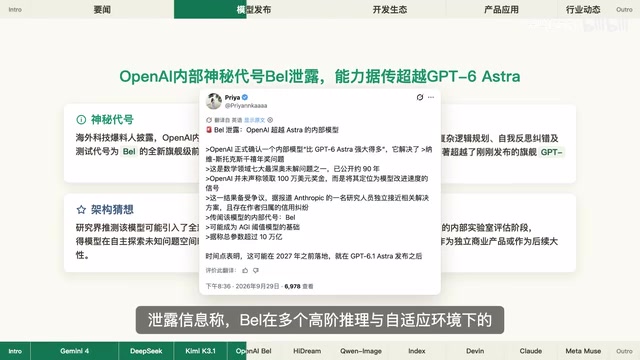
It's worth noting that Bell currently remains a single-source leak with no official confirmation. But based on the naming and positioning, OpenAI has clearly not stopped exploring at the foundational architecture level — the next round of capability competition is already heating up significantly.
Video and Image Generation: Open-Source Solutions Keep Accelerating
The generative media space also had notable developments. HiDream's open-source image-to-video model HiDream O Video 1.0 scored 1,456 points on the LMSIS Video Arena, ranking 7th on the leaderboard. Its strengths lie in excellent motion coherence and physical realism, along with highly efficient single-GPU inference — meaning ordinary developers can run it at relatively low cost.
In response to the newly released Qn Image 2.1, the Vigo team launched and open-sourced the Vigo Turbo acceleration solution. Using a novel distillation technique, the generation steps are compressed from 40 to just 6, without requiring additional CFG guidance computation — resulting in end-to-end generation speeds up to 5x faster.
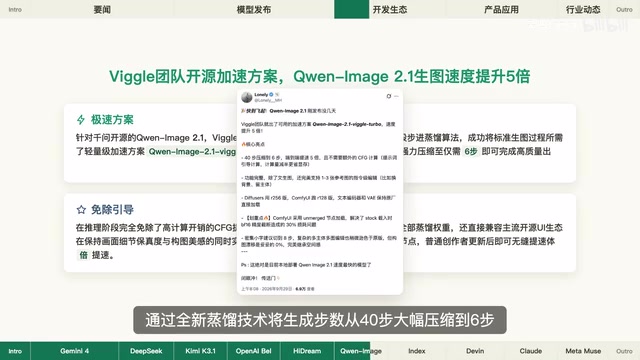
Step compression combined with CFG removal are optimizations that directly impact inference costs and response speed in real deployments — they are the critical link in scaling cutting-edge models to production applications.
What is CFG? CFG (Classifier-Free Guidance) is a common technique in diffusion models for generating high-quality images and videos. At each denoising step, it runs two forward passes — one "conditional" and one "unconditional" — and uses the difference between the two to strengthen alignment between the output and the prompt. This means enabling CFG effectively doubles the compute per step. Vigo Turbo uses distillation to train a student model that internalizes the CFG guidance effect in a single forward pass, eliminating the extra CFG computation while also reducing steps from 40 to 6. The two optimizations stacked together produce up to 5x end-to-end speedup. For commercial scenarios requiring large-scale batch generation, this translates directly to orders-of-magnitude improvements in throughput for the same compute budget.
AI Engineers and Browser Agents Move Toward Real Deployment
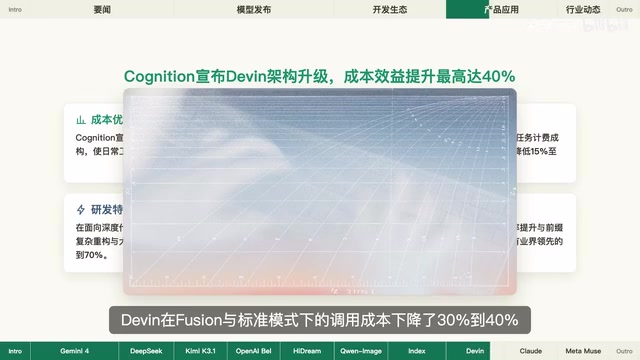
Cognition announced a major underlying architecture upgrade for its AI software engineer, Devon. Thanks to a new reasoning scheduling and code caching mechanism, Devon's invocation costs dropped 30–40% in Fusion and Standard modes, with savings of up to 70% on Devon R. This dramatic cost reduction means the commercial viability of AI coding assistants is improving rapidly.
Anthropic officially announced that Claude's Chrome browser extension is now available to all paid subscribers. The extension integrates deeply with the browser sidebar, not only understanding and summarizing current browsing content, but also autonomously performing multi-step operations on web pages such as data collection and form filling. The browser Agent moving from demo to real users' hands is a landmark moment in AI's transition from "conversation" to "action."
What is a Browser Agent? A browser agent is an AI agent capable of autonomously perceiving page content and executing actions — such as clicking, filling forms, and scraping data — within real web environments, as opposed to a traditional assistant that only answers questions in a chat interface. The technical challenge lies in the enormous variety of web page structures: the model must parse DOM trees or screenshots in real time and maintain state coherence across multi-step tasks while avoiding errors. Anthropic rolling out Claude's browser extension from demo to paid users marks the entry of this direction into scaled validation. Real user data will greatly accelerate the model's iteration on web operation reliability, and provides an important commercial reference path for the leap from information Q&A to task execution in human-AI collaboration.
Consumer Side: Neta's Mios Sets New Growth Record
On the consumer application front, the latest Sensor Tower data shows that Mios, the AI assistant launched by Neta, surpassed 5 million downloads on the US App Store in just 22 days — growing faster than ChatGPT did at launch — and has held the top spot on the US free download chart for 12 consecutive days.
An AI assistant achieving this kind of growth curve in the US market demonstrates that the competition for consumer-level AI entry points is far from settled, and newcomers still have opportunities to capture users.
Summary Observations
Several clear themes emerge from this dense day of developments: the "benchmark vs. real-world" gap in flagship models is pushing the industry back toward genuine usability; Chinese AI companies continue to fill in gaps in agent toolchains and vertical localization; the open-source ecosystem is accelerating inference efficiency for video and image generation; and falling costs for AI coding assistants and browser agents are pushing "AI doing the work" from concept to everyday reality. The competitive focus is shifting away from simply comparing parameter counts toward who can actually solve users' real problems.
Related articles
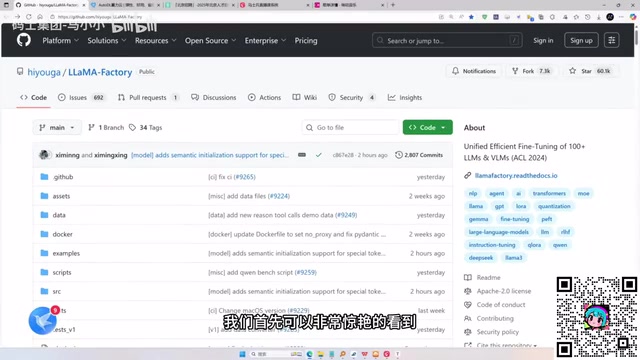
LLaMA-Factory in Practice: A Complete No-Code Guide to Fine-Tuning Large Models
An introduction to LLaMA-Factory, the open-source fine-tuning tool: its 60.1K-star background, supported models and algorithms, local vs. cloud deployment, and CUDA setup steps.

Zeng Ming's Deep Retrospective: Why OpenAI May Not Be the Ultimate Winner — and Why the Corporate System Will Disappear
Zeng Ming's deep retrospective on the AI endgame: model companies are just infrastructure, OpenAI and Anthropic won't be the final winners; the next battle is the Agent entry point standard; the corporate system will disappear as AI restructures collaboration, and only mission-driven companies can survive the cycle.

OpenHands v1.28.0: OpenCode and PI Added as Built-in Agents, API Keys Requestable In-Conversation
OpenHands ships 5 releases in 21 days: v1.27.0 adds OpenCode and PI as built-in agents, v1.28.0 enables in-chat key requests. ACP integration, credential reuse, model list changes, and upgrade advice.